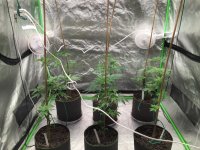
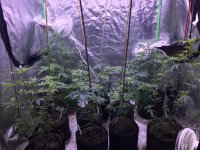
A while back I condensed some research I did on PPF/PPFD and will attach it here in case anyone is interested.
I guess I'm technologically inept because I tried to attach a PDF with that info but couldn't get it to take.
Apologies.
So I'm going to just paste it below.
_Photosynthesis is the most important chemical reaction on this planet. Plants use a band of light between 400nm-700nm as a source of energy to make food molecules from CO2 and H20.
The spectrum of light between 400nm-700nm is defined as PAR_Photosynthetic Active Radiation. Light outside this PAR range is not used by plants for growth. Plants do respond to UV and Infrared light but these extreme wavelengths are utilized more as “triggers†that assist or promote various stages of development such as initial growth and the onset of flowering.
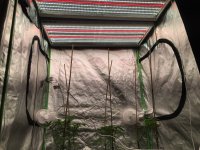
The lights I use provide a spectrum of 300-800nm so they account for small amounts of light outside the photosynthetic active radiation spectrum. They also provide a full range of green light which is also used by plants in various growth processes.
Electric light sources convert electrons into photons. Photo-biological reactions measure output with photosynthetic photon flux_ PPF which is a measurement of the total PAR output of a lighting system (basically the amount of specific colors within the range from UV to Infrared_ it isn’t a measurement of the strength of the light reaching your canopy, only the quality of the light).
PPFD measures how much of that light is delivered to a canopy at a specific distance and a specific area of coverage. PPFD is short for photosynthetic photon flux density. This measurement is expressed as micro moles per meter squared per second_umol/m2/s.
This is the only real life measurement that tells us how much light is being delivered to a crop canopy enabling photosynthesis.
Different lights provide variable amounts of PPFD. This is not directly related to the amount of watts a light draws in electrical power, or the strength of individual LED’s.
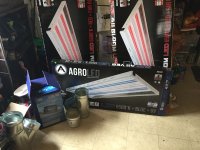
For instance the lights I'm using are designed to be used at least 18†from the canopy (not any closer). The manufacturer provides charts that provide the PPFD each of their lights provide at specific distances in six inch squares over a one square meter area. For example my two lights together hung 1 ft from each side of the growing area and one foot apart provide 880 PPFD at 22â€, 666 PPFD at 26†and 510 PPFD at 30â€. At 48†they provide 260 PPFD.
Even coverage over the entire canopy and depth of penetration are what really count when determining the sweet spot for your light(s).
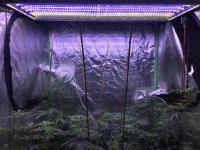
I start using my lights at a height that is close to what PPFD is recommended for specific stages and then lower them a bit at a time so I can match the ideal PPFD. The last three weeks of flowering they are about 20-22†above the canopy. With short plants, less than 20†tall there isn’t much difference between the size of the colas between the top and bottom because almost the entire plant is within the sweet spot.
For instance when setup 26†above the canopy they provide 666 PPDF over every square inch_ from one side to the other and end to end (no fall off).
The same setup provides 400 PPFD at 36â€. With this information it can be determined that these lights when hung 26†above the canopy will provide 666 PPFD at the canopy and still deliver 400 PPFD 14†below the canopy. This is important to know when trying to determine the best height for your lights at specific stages of development and the sweet spot relative to the depth of penetration.During the last 3-4 weeks of flowering I lower them to about 20â€, giving the plants about 700-800 umols/m2/s.
CANNABIS does best with 100-300 umol/m2/s during the seedling stage.
300-600 umol/m2/s during the vegetation stage,
and 600-900 umol/m2/s during flowering.
Generally the more light you can provide the more photosynthetic activity will result. But at some point a plants response to the amount of light it is receiving will plateau at saturation level. The saturation level can vary depending on the environmental conditions of the grow room.
When light saturation has reached its limit this can be due to some environmental factor, such as CO2 levels. When temperatures reach over 80 degrees additional CO2 can increase the saturation level, making it possible to obtain higher production at that temperature range.
I don’t have room for a mechanical CO2 generator, so I just try to get as good an air exchange as I can. I have tried products other than CO2 generators but haven’t known them to make a noticeable difference. Considering the environmental conditions in my grow room I may not even benefit from supplementing CO2 because I keep the temp below 80 degrees F.
Of course even the best lighting will not guarantee awesome harvests. There are many other environmental conditions for getting the most from your crop_ medium, nutrients, PH, temperature, relative humidity, photoperiod, etc.
Cheers to all and get growing!