What's new
GrowWeedEasy.com
You're browsing as a guest. Sign up to join the conversation, share your grows, and get help from thousands of fellow growers — it's free and takes less than a minute.

What is your biggest question about growing cannabis?

Congrats on a great harvest! At least for me I clean with bleach water, though hydrogen peroxide is another good choice! I think the most important thing is pulling everything out and cleaning all the dust and stray leaves that seem to get everywhere. It's also important to clean the intake and vent holes especially if they have mesh, because they can start to get dirty like the lint trap of a dryer which prevents to fan from cooling as well :) Lastly, if you have glass in your hood it's good to clean the glass on both sides because some light is lost when it has to go through dusty glass :)
 
Ahh okay, is it sap that covers the wound like coagulating blood? And if a leaf is severely damaged to the point that it withers, can the plant withdraw stored goods from it as it dies?
 
If you're talking about the sticky, honey-like substance that secretes from cannabis sometimes (http://www.growweedeasy.com/weird-or-what#flowering-cannabis-can-make-sap), I know that one cause of sap in cannabis seems to be giving a lot of sugar or carbohydrate based supplements. The sap in that case is sweet but not potent. It probably also has a genetic component, or other environment factors.

But often when you cut a cannabis plant it doesn't produce that kind of sap. It sort of gets wet at the injury site, which slowly hardens into a solid knuckle. I believe that wetness is caused by nutrient and sugar filled water that are being transplanted through the plant. The actual chemical process that seals off the injury site is complicated, but basically the plant has an emergency response when it detects and injury, and starts sending things to immediately plug up the breech, and then focuses on repairing the area more generally. I found an interesting article that explains some of what we know about plant injury response, if you wanted to check it out (it does get a bit wordy with a lot of jargon)! https://www.ncbi.nlm.nih.gov/pmc/articles/PMC4165286/

To your second question: Some nutrients can be transported throughout the plant (mobile nutrients: Nitrogen, Phosphorus, Potassium, Magnesium, Molybdenum, Nickel and Chlorine) and others mostly don't move once they're set down (immobile nutrients: Calcium, Sulfur, Boron, Copper, Iron, Manganese and Zinc). When a leaf is withered, I think it's a matter of whether the vascular system (like their veins) is intact enough to transport resources back to the main plant. If an undamaged leaf is on a part of the plant that doesn't get light any more, you'll notice it'll slowly start to get deficiencies and eventually die. It's like the plant is giving up on those leaves that aren't useful any more, and taking everything it can to use for the rest of the plant. Another example of a plant "stealing" nutrients is if a plant gets a Nitrogen deficiency. The bottom leaves keep turning yellow and falling off, as the plant takes the Nitrogen and transports it to the newest growth.
 
Yes, there is cannabinoid testing. You can either do it on buds after they're already grown, or you can perform a leaf test on young plants to get a rough idea of what cannabinoid ratios to expect later on. Here's one company that performs basic tests for about $40 (with more expensive options if you want to test for other cannabinoids, terpenes, etc): http://www.sdpharmlabs.com/pages/about-us I've never used them myself, but I've spoken with growers who have used them and were happy with the results of testing.
 
Your anwsers are allways spot-on thorough yet easly ounderstandable, thank you Nebula! :) Tryed that article but gotta sober up to boost the short term memory beyond 3seconds, it'll go perfect with morning coffie
 
Buddmarsh I do both my nutrient brand is ageoldorganics.com .I buy by the gallon about $40 for my inside grow. outside I use a mix of compost,promix,petmoss,vermiculite/perlite,organic plant tone. then about once a month I will feed them nutes . how I decided on old age is I went to a grow show and got all the free samples I could then tried each on different plants age old out performed everything else. but it was a real pain mixing nute for 1 plant at a time lol
 
Hi all......i don't know if this has been asked......apologies if it has:big-smile:.......so, how important to a plant is a high C.R.I*??


*colour rendering index.
 
Hi all......i don't know if this has been asked......apologies if it has:big-smile:.......so, how important to a plant is a high C.R.I*??


*colour rendering index.

That's a great question! CRI is a measure of how similar the colors of an object appear compared to if it were under natural light. The CRI is determined by the light source's spectrum. So for example an HPS grow light has a very low CRI because everything under HPS light looks yellow or orange, and very few other colors shine through. However, under a 'daylight' colored CFL, the colors are about the same as they would be under the sun, so it has a very high CRI. You can have LEDs that put out purple-looking light, so very low CRI, or LEDs that put out white-looking light, or high CRI. It depends on the spectrum.

For plants, the spectrum is important; there needs to be a combination of blue, red and at least a little green light for proper plant growth. But once the basic needs are met and plant is growing green and healthy, it seem the total amount of light (total light energy being received by the plant) has a more consistent effect on increasing overall photosynthesis than further changes to the light spectrum.

CRI is really important to people because it's been developed to help us represent natural colors in artificial light and with photography. However, CRI doesn't really have a whole lot of meaning to the plant because it has its own requirements for light spectrum that are not quite the same as what's most pleasing for human eyes.

That being said, the range of light spectra that can be used by the plant (PAR range) is roughly similar to the range of light spectra we can see with our eyes, which is why you sometimes see people using "human" measurements like lumens and lux as a rough estimate to apply to plants :)
 
The anatomy of cannabis. What all the parts on the plant are called and what that plants uses those parts for. like the calyx and pistols. Also terpenoids and trichs, etc. I'm just very curious as to the anatomy and make up of the plant.
 
Thanks NebulaHaze , that is great information,particularly for us new growers, as some might be swayed by a lights high CRI rating if it wasn't understood properly😂😂
 
The anatomy of cannabis. What all the parts on the plant are called and what that plants uses those parts for. like the calyx and pistols. Also terpenoids and trichs, etc. I'm just very curious as to the anatomy and make up of the plant.

I have a few examples here, and let me know if you have further questions!

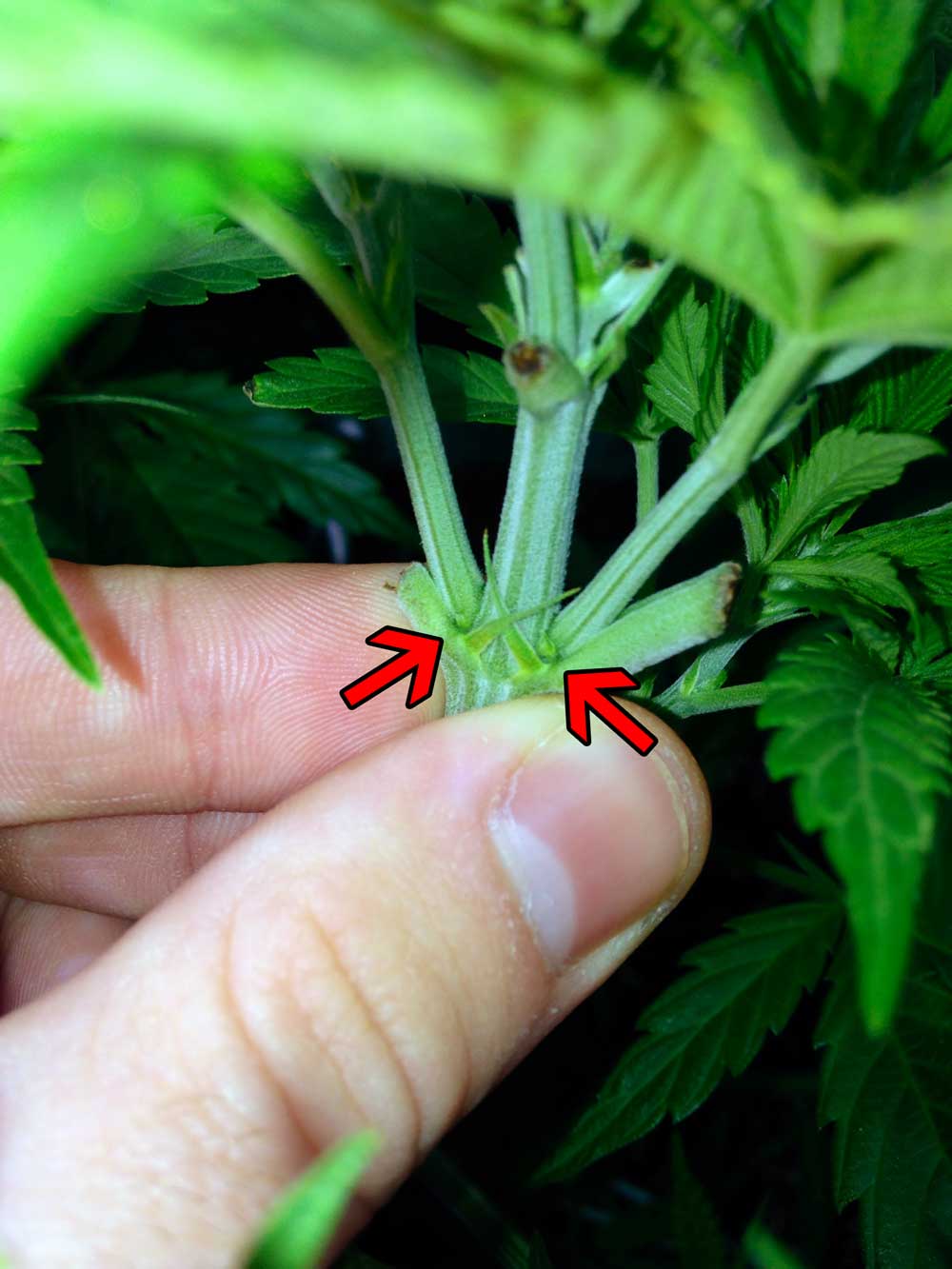
Here's a closeup of the base of cannabis leaves, where bud sites form.
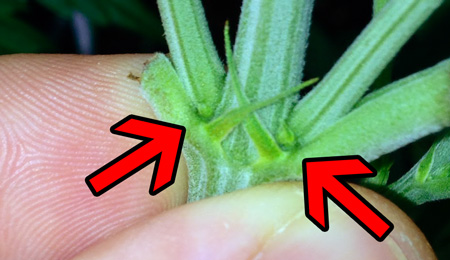
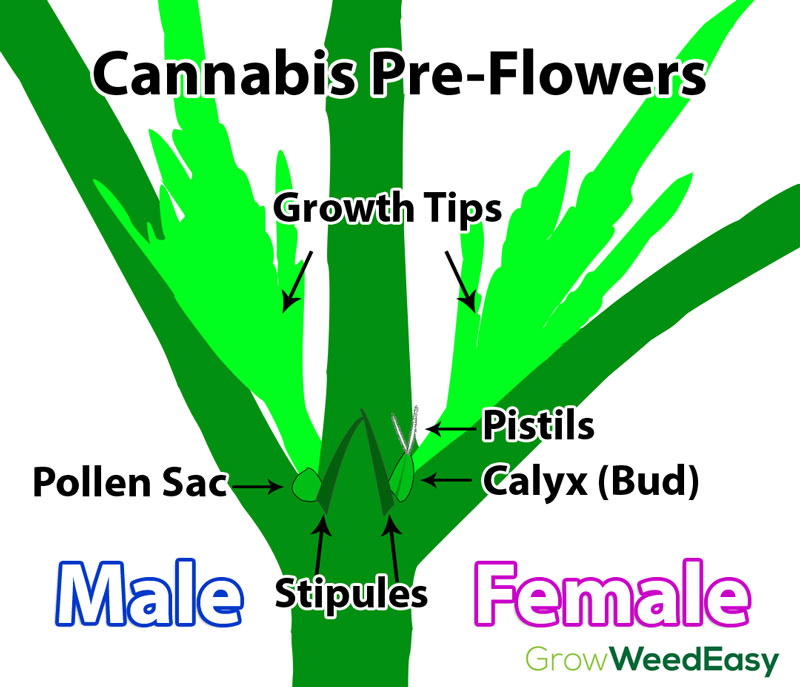
Those little bumps are preflowers. They appear on the plant when it's about 3-6 weeks old (even in the vegetative stage; earlier for males and later for females) and reveal the gender of the plant (whether it makes buds or pollen sacs). Here's a breakdown of male vs female preflowers. "Buds" are actually a bunch of female flowers stacked on top of each other!

​​​​​
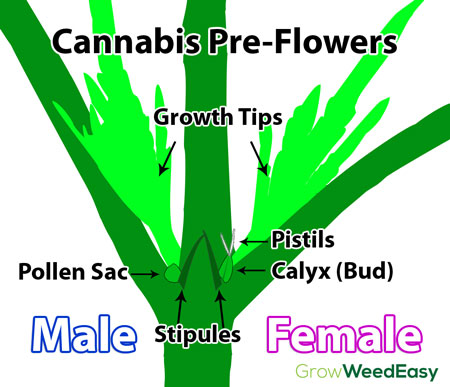
More on preflowers here!

As far as terpenoids, they have a variety of effects and many growers suspect that terpenoids actually change the effects of cannabis and may even make buds feel more potent. More here.

What about trichomes? I'm not 100% sure. I know there are different types of trichomes. If you look at plants under a microscope, you can see the mushroom shaped ones we're all familiar with, but there are also spikey, hair-like trichomes with out "heads" that are all over the leaves.

I've looked into this before and I think there's lots of debate about exactly what they're for, and it's probably a bunch of things, depending on the strain. In the wild, cannabis contains very low levels of THC, high levels of CBD, and very few trichomes. We only have high-THC buds with lots of trichomes due to selective breeding over thousands of years. It's difficult to look at modern plants, which are all hybridized from locally bred strains from around the world and bred over generations. We get a much closer picture of how they survived in the wild by studying wild hemp.

Now I want to do more research, post more pics, make more diagrams and publish a page all about the anatomy of a plant with tons of pictures. I'll tag you so you can take a look when it's done!

 
hi nebula. re your comment on selective breeding over 1000s of yrs, i read recently on another forum that supposedly truly wild (or no-human-interference) grown cannabis is extinct, or is at least not known to be not extinct. do you think that's true? if so, it's kinda sad but a friend i was talking about it with says i'm just being "sentimental" and that as long as it's grown, and grown well, why does it matter if it's wild or not. any thoughts?
 
One cool thing about high CRI is you can easily see your plants and leaf color, as well as take great pictures of them, so it definitely has some benefits!
 
I was taught that the original Ruderalis / auto-flowering strains were actually discovered in Siberia as a type of wild hemp. It automatically starts flowering and is ready to harvest in just a few months because they only have 2-3 months of weather that stays above freezing temperatures. Once it starts getting warm it's almost a race to finish before winter comes. Here's a picture of a small female Ruderalis plant: https://cannabisgrowing.files.wordpress.com/2012/09/ruderalis_roadside_hand_comparison.jpg

In fact, cannabis has found a way to grow on every continent except Antarctica. You can find tons of "ditch weed" all over the US, especially in areas where there used to be hemp cultivation. It's an insidious weed in certain parts of the middle of the country. I guess that's not truly wild since it was descended from industrial hemp, which was cultivated by humans.

One of the things I hope we maintain, even more than wild hemp, is landrace strains. That is any strain that has been bred and developed by locals in different parts of the world. Each population breeds cannabis with different effects, and some of the best strains have come from collecting local strains from around the world and breeding them together in unique and unusual ways. I hope we save as many seeds from these types of strains as possible! I know that's a big concern in parts of Europe. When cannabis is legal in the US, I've vowed to myself to maintain a seedbank, to make sure we're saving all these genes for future generations to enjoy! :)
 
I've read the article of when to harvest the plant, but my main concern is to know when to start the flushing process to time it with my ideal time for harvesting. I can't imagine there's a definite answer due to the many different factors involved, so I presume it's just a matter of experience?
 
  • Like
Reactions: Jeg
Back
Top