What's new
GrowWeedEasy.com
You're browsing as a guest. Sign up to join the conversation, share your grows, and get help from thousands of fellow growers — it's free and takes less than a minute.

To Defoliate Or Not To Defoliate

This is a great article, Thank you for taking the time to research and summarize the information. As a grower that practices controlled and selective leaf removal I have a few follow up questions for you regarding sections that left me somewhat confused as well as pondering what might be a greater reality.

As you close out your introduction you state:

“ There are various methods on how it is recommended to be performed, but typically it will involve the non selective removal of leaves of a varying amount at varying times”

Then under the section titled Air & Light on Leaf Photosynthesis, you state:

”The traditional method of defoliation is a non selective process that removes specific amounts of leaves at specific times. What is usually practiced and is learned through experience is how much is too much, when & how often such a process should be used during a plants life.”

So my confusion is centered around the idea of selective leaf removal. When specifying how many leaves, from what location,at what times, and how frequently. Did we not just create a specific process for selecting leaves for removal?

If so, is a good portion of the controversy surrounding the issue of defoliation simply a misrepresentation of terminology, with some using the text book definition of the word while others practice a more selective approach?
 
Good question and i can see your confusion. The problem may be down to what i define the difference between selective and non selective. The selective and non selective terms i associate with location of removal. For example, using non selective herbicide does not differentiate between different weeds, so it is not subjected to a selective process.
I chose that wording to differentiate between defoliation for improved yield and defoliation where leaves are removed for improved health. Such as lollipopping or dead leaf removal etc.

Defoliation describes the process of removal or loss of leaves. It does not describe the methods or purposes it may be used for. That requires extended terminology wether that is current or new.

The other problem is that the different methods of defoliation out there, are based on different things. If one develops their method from their beleif on plant stress response. Then the matter of defoliation is a non selective process as the location of removal is irrelevant. However other methods may be selective.

It may be that i need to redefine the terms as they can mostly be viewed as selective processes as well.

What you think ?
 
I have reconfigured the explanation for defoliation and omitted, changed and moved the second paragraph mentioning the process.

"There are various methods on how it is recommended to be performed, but typically it will involve the selective or non selective removal of leaves, of a varing amount at varying times during a plants grow. This is dependent on the method provided by the grower and their reasons or beleifs which define the process."

"Removal of lower or older leaves or braches, with less exposure to light, could impact a plants performance, however i would not consider this part of the typical use of defoliation for improved yield but the more practical form through pruning practices.
To some extent plants do this themselves, like how leaves are abscent inside a bushy tree. We do this also by methods such as lollipopping. However this is a proven method and is practiced throughout horticulture."
 
OK OK, I want to hear what you feel is the best way to defoliate or not defoliate from what you have learned. You surely have an opinion at this point. I feel like your still skirting the issue even though you have provided a lot of information at this point. even though you did say that most of the defoliation done by people is incorrect ( in so many words) .
 
Last edited:
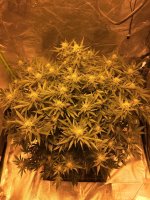
Hey DangerDan. Great information. I take from this information that there is a consensus that the foliage serves a purpose. But I also take from all of this that some of the lower flower sites suffer somewhat from loss of light as a result. I’m wondering if anyone has ever done staged harvesting. I am a hobby grower who does one plant at a time. Right now I have a Northern Lights plant that is in her 5th week of flower and is covered with buds. All of the top buds are benefiting from the 600w HPS. However, the foliage is so dense that the numerous lower buds are suffering somewhat. I’m considering harvesting all of the upper buds and seeing if the lower buds can fatten up any. That would mean reintroducing nutrients AFTER an initial flush. Any thoughts along this line of thought?

4x4x80 tent ⛺️
600w MH/HPS
4” in-line exhaust fan
4” fresh air intake fan
3.5 gallon DWC
Regulated temp. and humidity
Using General Hydroponic Flora Trio
supplimented with CaliMagic and HydroGuard
on R/O
Nutrients changed every 7 days
 

Attachments

  • photo40022.jpg
    photo40022.jpg
    1.3 MB · Views: 0
I researched and published this information a while ago, i now have consolidated this data and worked on improving its presentation. While adding more recent data.

No one is doing the method wrong because there is no one definitive standard. There are many ways to do it based on ones beleif or experience. As such based on what i know about the science of defoliation, there is no best way because in my opinion the idea of defoliation to increase yield is wrong.

When i talk about removal of leaves underneath the plant, i am talking about a more traditional form of "pruning" rather than leaf removal. This is called thinning.
 
I went through Nebula's defoliation during flowering tutorial again (http://www.growweedeasy.com/nebula-flowering-stage-defoliation-tutorial), and there's no denying the massive buds that she gets on her plants. Prior to switch to 12/12, at the time of lollypopping, Nebula's technique involves the removal of all large fan leaves, but she leaves on the plant "any small fan leaves as well as the top few pairs of big fan leaves of each cola completely untouched." She doesn't remove a single bud site--only leaves.

As we all know, with the switch to flower and the stretch, a healthy plant will pretty much completely releaf itself by the end of week 3 of flower. Nebula: "Usually by around week 3, a bunch of budlets have formed. At this point I remove all of the major fan leaves one last time. Make sure to especially take any big leaves with long stems.You're forcing the plant to focus on the buds during this crucial phase of their development."

She also makes the argument in this tutorial that colas don't develop all the way down if the plant isn't defoliated--that the main cola will be shorter without defoliation.

I'm curious to see that you think, Dan, of her statement that "You're forcing the plant to focus on the buds during this crucial phase of their development." Her results are undeniable, but it seems to me that a plant is inevitably going to be focused on bud development during flowering; that's its nature! But without defoliation, the colas don't go all the way down like hers do... ????
 
Yes exactly, indoor lights do not provide the same level of capacity compared to outdoor sunlight. For example, 600 watts HPS can produce roughly 700umols per square metre. Where as sunlight can provide upwards of 2000umols. You would need a sodium gas discharge of roughly 2000 watts per square metre to compare. With low wattage lighting, penetration is limited. So undergrowth is neglected. This is because source to sink priority is not equal. It is biased depending on several factors such as proximity, developement, translocation pathways.

If you harvest the healthy flowers and leave the underdeveloped, you can get added value from the leftovers. Care must be taken as the plant will undergo massive shock and could die. I have tried this before with success but it was not worth it because you leave very little plant material and waste a alot of energy in trying to recycle it. In the future it would be better to prune the lower canopy and force the plant to send this extra energy to more valueable sites rather than underdeveloped flowers.
 
Thanks for all the info guys . I'm a new grower and i'm more confused then i was before . I'll read again and decide what way to go.thanks rick
 
alltatup, I too defoliate in the same fashion as Nebula, been using this technique for quite some time. In the beginning I had learned that I was removing to little not making much of a difference. Now today it almost appears I may be too aggressive removing leaves. But NO. I think I have gotten closer to the max defoliation point, creating some of the largest colas I have ever produced. Regardless of the strain, I keep on doing the same thing to each individual plant. Here is what I get out of defoliating...
I noticed when I defoliated very little, the lower bud formations would cure a low grade THC, between 10-15%.
Aggressive defoliation would create percentages that compete in strength with the upper flowers. To a point where I could mix the lower cured buds with the upper and top section cured buds, and could not spot the difference, other than size. I then proceeded to have 3 THC testing done Lower, Mid and top..believe this or not, all 3 tests were 23% with a +/- of .03.
In the real world this would be considered impressive.
What Dan needs to know is basically, if you let the sun shine through, there is a benefit from top to bottom.
 
Morning BigPapa, of course you can harvest in stages, take what's ready, an wait for the rest to get ready, I would just feed them molasses at the end.
 
A great question but one which is partly already answered with the original post. First i have the utmost respect for nebula, i take nothing from her and i believe she provides fantastic learning material. Her expereince is nothing to take for granted of.

"Cannabis is wind-pollinated, so it doesn't fatten any buds except the ones that have access to wind. Defoliation exposes the more of the buds to a breeze. Cannabis buds seem to get fatter when they're exposed to strong, direct light and defoliation exposes the buds to light."

The section on floral morphology is practically dedicated to this. There is no morphological properties of flowers in response to light or mechanical sensations, such as air movement.

"It's possible the plant focuses on bud sites during the initial part of flowering because it simply doesn't have leaves to put energy into"

I also address this in Leaf Photosynthesis, but i will elaborate on this. In the early stages of leaf development, leaves act like sinks. In just a few days, leaves begin the sink to source transition where they start supporting themselves and begin exporting photosynthetic resources, as a source. Its at this point and for the remainder of its life until senescence that it stays as a source. Removing leaves does not provide more photosynthate for flowers, as leaves are providing energy, not requiring it. They are sources.

As to the development of the bud structure, exposing light down the canopy further would allow a more uniform developed flower. It has typically been observed that flower or fruit developement is more extensive in the proximal location of the plant. There are a few reasons for this, light is just one. I completely support the idea for providing a structure that enables a plant to do this, as this creates a higher quality product. But removal of leaves to expose light will only do just that, create a more uniform flower structure. The yeild will not improve because all you have done is shifted where photons will land. There is no improvement in photosynthetic efficiency or efficacy, the total photosynthetic yeild is the same.

I may add some of this to the main article but i have to be careful at this point not to overdo and already overdone writeup. But really great question, any more questions are welcome.
 
Dan, I don't understand this: "flower or fruit developement is more extensive in the proximal location of the plant. There are a few reasons for this, light is just one." This seems to contradict the stance against defoliation if light does indeed affect flower development.

What is "proximal location" of the plant?

Vitreous Fascinating about THC percentages!!
 
Last edited:
Im sorry, i was using terms from my human anatomy field. Although botanists seem to use it as well. Proximal and distal describe locations compared to a reference point. Proximal meaning the top of the plant, distal meaning the bottom.
 
rick, Welcome to the forum! One thing all the articles say: this is not a technique for new growers to try. So you might want to wait on it. Everyone also stresses that it's only to be used on the healthiest and most vigorous growing plants.
 
alltatup

"This seems to contradict the stance against defoliation if light does indeed affect flower development."

The developmental differences are associated with the source to sink movement. The flower itself does not cause morphological change, the leaves around it do through photosynthesis.
 
I think the information here is based on sound science and testimonials and is an amazing wealth of knowledge
i don't think anybody is telling anyone to defoliate or not to defoliate, just presenting the information to let people make a informed judgement
lots of people on this site and others defoliate with some amazing results, but after reading this they themselves may take a different approach to defoliation
some will continue with no change as it works for them
others will experiment and hopefully post their findings
either way this information can only benefit others and i myself thank you for taking the time to post it

Cam
 
Back
Top