
GrowWeedEasy.com
You are using an out of date browser. It may not display this or other websites correctly.
You should upgrade or use an alternative browser.
You should upgrade or use an alternative browser.
KingKush grow #2 - 3000w Bruce Banner in soil
- Thread starter KingKush
- Start date

KingKush
Guest
Campesino Locrian99
I don't think the stems have split. The mani folded plants have simply not revealed themselves to be superior in any way to my 'regular' plants. I'm doing a side-by-side comparison right now with the same strain topped/LST'd vs. Manifold. I have two manifolded and two regularly trained.
I may only see the benefit at harvest. Which is fine, I'm determined to see this experiment through to completion and I want to gather as much evidence as possible.
One of my manifolds lost 1/3rd of its branches after my cat rubbed against it and broke off a large portion so that is why I have a runt (the plant will be judged on what she DOES have, ) and the other manifold is performing nicely.
I won't try it again, justtopping and bending (LST) on thes next crop I'm going to try as big as possible. Big plant style next run.
Oh and Locrian99 : build a hood! There is a huge differemce in reflectivity and helps focus the light a little more to get it more
intense.
I don't think the stems have split. The mani folded plants have simply not revealed themselves to be superior in any way to my 'regular' plants. I'm doing a side-by-side comparison right now with the same strain topped/LST'd vs. Manifold. I have two manifolded and two regularly trained.
I may only see the benefit at harvest. Which is fine, I'm determined to see this experiment through to completion and I want to gather as much evidence as possible.
One of my manifolds lost 1/3rd of its branches after my cat rubbed against it and broke off a large portion so that is why I have a runt (the plant will be judged on what she DOES have, ) and the other manifold is performing nicely.
I won't try it again, justtopping and bending (LST) on thes next crop I'm going to try as big as possible. Big plant style next run.
Oh and Locrian99 : build a hood! There is a huge differemce in reflectivity and helps focus the light a little more to get it more
intense.
Last edited:

KingKush
Guest
March 13
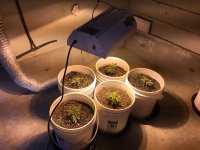
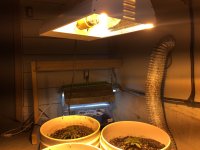
Veg Room & Seedlings
Using 150w HPS to veg 20/4 light schedule
- Read a quote from Nebula that changed my mind, "if you have the tools why not use them?"
-Had this 150w HPS collecting dust on a shelf so After reading that I decided to put it into use.
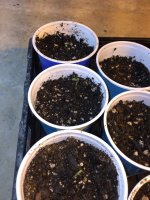
-24w t5 is now over seedlings I like the way the hood cups the humidity dome.
*EDIT - these 5 are my neglected clones so that's why they are all scraggly and ugly. It is what it is.
Germination Date: 3/10
-Popped 5 beans the other day, same Bruce Banner bag seed as this journal so all are sisters from the same batch. 3 sprouted thus far which is fine considering I somehow "lost" 3 beans trying to plant them? Stoned moment... I misplaced them somewhere in the soil in one or two of the cups so perhaps they will join the party a little later.
Veg Room & Seedlings
Using 150w HPS to veg 20/4 light schedule
- Read a quote from Nebula that changed my mind, "if you have the tools why not use them?"
-Had this 150w HPS collecting dust on a shelf so After reading that I decided to put it into use.
-24w t5 is now over seedlings I like the way the hood cups the humidity dome.
*EDIT - these 5 are my neglected clones so that's why they are all scraggly and ugly. It is what it is.
Germination Date: 3/10
-Popped 5 beans the other day, same Bruce Banner bag seed as this journal so all are sisters from the same batch. 3 sprouted thus far which is fine considering I somehow "lost" 3 beans trying to plant them? Stoned moment... I misplaced them somewhere in the soil in one or two of the cups so perhaps they will join the party a little later.
Attachments
Last edited:
KingKush
Guest
March 13
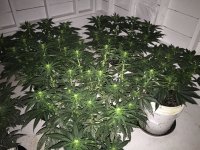
Day 19
Well there was a big storm last night and the girls exploded with lots of fresh energy.
Plant Morphology
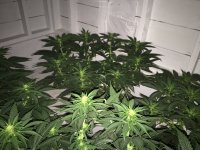
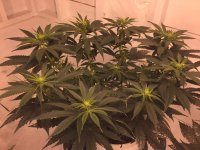
-Miss Regulars were gently spread apart and a handful of large leaves were plucked from the top middle in order to provide deeper light penetration and increase canopy depth. An example of pruning vs. defoliation. Controlling your canopy with physical manipulation is essential to a bountiful harvest. Coupling this with the proven horticultural techniques of pruning & leafing will increase yields.
-I also will take the top 1/3rd of the large upright branches and bend them over sideways, just up to the point of supercropping.
-Miss Manifolds were bonded a little more snugly, and received the same treatment of exposing the central canopy to more light with the removal of some larger leaves in the middle tops of the plants.
-Budset looks delayed by about 1wk. It's just a look and I think the plants are gaining momentum rapidly the upright stems are ultra thick which is usually an indicator of potential cola size.
The plants are beginning to speak for themselves.
H2O and Water Management
Water Timing
-"Don't put your girls to bed wet" -is this an agronomic principle?
Because lots of people tote this idea as being factual and real when in my studies of horticulture and agronomy, the best times to water are at night or just at dusk when the evapotranspiration rates are lowest and the stomata open at night to allow photorespiration to occur.
-I can't think of any crops that get watered in the middle of the hot sunny daytime as the primary irrigation cycle. Sure, supplementary and as needed to prevent wilting, but irrigation cycles at night are proven (with multiple decades of research) to be vastly more efficient at actually hydrating your crop.
-Early early morning would be second best as the water has time to infiltrate the soil before the sun evaporates it into the atmosphere (which is not entering the plant)
-Budrot? That's the only example of a situation where increased moisture inside the flowers during higher humidity at night may trigger fungal growth but again, it's usually due to the other causes in the disease triangle ( Host, Pathogen, Environment)
Anyways just some more things to ponder. As for me, I water in the morning during peak winter but as the night time temps start to stay above 50°F I change to watering in the evenings for the reasons I stated. This week I switched my schedule and I think that's why they exploded. The only time I get budrot is from exudes oozing from where I snipped leaves off, the remaining stub oozes sugars and makes budrot. That's one reason I just leave all the leaves on when I chop and hang.
Happy Growing
Day 19
Well there was a big storm last night and the girls exploded with lots of fresh energy.
Plant Morphology
-Miss Regulars were gently spread apart and a handful of large leaves were plucked from the top middle in order to provide deeper light penetration and increase canopy depth. An example of pruning vs. defoliation. Controlling your canopy with physical manipulation is essential to a bountiful harvest. Coupling this with the proven horticultural techniques of pruning & leafing will increase yields.
-I also will take the top 1/3rd of the large upright branches and bend them over sideways, just up to the point of supercropping.
-Miss Manifolds were bonded a little more snugly, and received the same treatment of exposing the central canopy to more light with the removal of some larger leaves in the middle tops of the plants.
-Budset looks delayed by about 1wk. It's just a look and I think the plants are gaining momentum rapidly the upright stems are ultra thick which is usually an indicator of potential cola size.
The plants are beginning to speak for themselves.
H2O and Water Management
Water Timing
-"Don't put your girls to bed wet" -is this an agronomic principle?
Because lots of people tote this idea as being factual and real when in my studies of horticulture and agronomy, the best times to water are at night or just at dusk when the evapotranspiration rates are lowest and the stomata open at night to allow photorespiration to occur.
-I can't think of any crops that get watered in the middle of the hot sunny daytime as the primary irrigation cycle. Sure, supplementary and as needed to prevent wilting, but irrigation cycles at night are proven (with multiple decades of research) to be vastly more efficient at actually hydrating your crop.
-Early early morning would be second best as the water has time to infiltrate the soil before the sun evaporates it into the atmosphere (which is not entering the plant)
-Budrot? That's the only example of a situation where increased moisture inside the flowers during higher humidity at night may trigger fungal growth but again, it's usually due to the other causes in the disease triangle ( Host, Pathogen, Environment)
Anyways just some more things to ponder. As for me, I water in the morning during peak winter but as the night time temps start to stay above 50°F I change to watering in the evenings for the reasons I stated. This week I switched my schedule and I think that's why they exploded. The only time I get budrot is from exudes oozing from where I snipped leaves off, the remaining stub oozes sugars and makes budrot. That's one reason I just leave all the leaves on when I chop and hang.
Happy Growing
Attachments
KingKush
Guest
I had 5 in a cup of water and I thought "oh just pour a little water out on the soil" so I did but when I looked in the cup I only had 2 seeds left and I spent and HOUR thumbing the tops of the cups looking around for them and didn't find even one. I'm like "geeze how am I going to survive in August bro??? lol"
-there was a double sprout yesterday. I gently lifted one out and put it into a *fresh cup of soil. Saved my ass!
-there was a double sprout yesterday. I gently lifted one out and put it into a *fresh cup of soil. Saved my ass!

KingKush
Guest
So I found my post above to be slightly in error when I mentioned "photorespiration" - that is an informal term that should be corrected with the following clarification:
Photosynthesis
So "photorespiration" is not really a textbook term. I was thinking about this concept:
"In C3 plants, under conditions of low soil moisture and hot, drying winds, the stomatas of the leaves will close in order to conserve water, which then blocks the flow of CO2 into the leaf. When this occurs, the entry of CO2 into the leaf is restricted, resulting in a dramatic drop in photosynthesis."
So "photorespiration" would be a bad thing if heat and/or drought is causing your plants to stop respiration. RESPIRATION is the correct term.
"Respiration is the release of energy stored in carbohydrates when the plant is making ATP for itself. In a sense, using the photochemical reactions of photosynthesis (CO2 + H20 + Light = C(H20) + O2) and using electrons (gained from electromagnetic light waves striking pigments in the chloroplast thylakoids) to make carbohydrates."
Did you know?
-"Glucose is the source of energy for metabolism and provides some of the "raw material" for other metabolites throughout the plant. Glucose can combine with other sugar molecules to form compounds such as sucrose, startch, and cellulose. Startch and cellulose are chains of glucose molecules linked together."
So, plants make carbohydrates and use that for energy (plants need Glucose as the starting molecule for respiration) in order to make the "ingredient list" for ATP. A plant uses glucose to basically make NADH & FADH. These pass through a cascade of enzymatic Electron Transfer reactions and ATP + O2 + H2O are the net energy product of respiration.
Plants are autotrophs, meaning they can make carbohydrates out of thin air and water. Literally! We animals and humans are not that capable and are labeled heterotrophs, meaning we MUST eat plants or eat animals that eat plants.
So in short, don't let your plants dry out and respiration is when the plant releases oxygen and water vapor due to making carbohydrates. Respiration comes to a halt if the plant runs out of water at the root zone or if the environment causes a defensive reaction (very dry and hot). No respiration, no carbohydrates are being made. No carbohydrates = no growth.
All sources and quotes taken from the text:
McMahon, Margaret , Anton Kofranek, and Vincent Rubatzky. Plant Science: Growth, Development, and Utilization of Cultivated Plants, 5th ed. Prentice Hall, 2011
Photosynthesis
So "photorespiration" is not really a textbook term. I was thinking about this concept:
"In C3 plants, under conditions of low soil moisture and hot, drying winds, the stomatas of the leaves will close in order to conserve water, which then blocks the flow of CO2 into the leaf. When this occurs, the entry of CO2 into the leaf is restricted, resulting in a dramatic drop in photosynthesis."
So "photorespiration" would be a bad thing if heat and/or drought is causing your plants to stop respiration. RESPIRATION is the correct term.
"Respiration is the release of energy stored in carbohydrates when the plant is making ATP for itself. In a sense, using the photochemical reactions of photosynthesis (CO2 + H20 + Light = C(H20) + O2) and using electrons (gained from electromagnetic light waves striking pigments in the chloroplast thylakoids) to make carbohydrates."
Did you know?
-"Glucose is the source of energy for metabolism and provides some of the "raw material" for other metabolites throughout the plant. Glucose can combine with other sugar molecules to form compounds such as sucrose, startch, and cellulose. Startch and cellulose are chains of glucose molecules linked together."
So, plants make carbohydrates and use that for energy (plants need Glucose as the starting molecule for respiration) in order to make the "ingredient list" for ATP. A plant uses glucose to basically make NADH & FADH. These pass through a cascade of enzymatic Electron Transfer reactions and ATP + O2 + H2O are the net energy product of respiration.
Plants are autotrophs, meaning they can make carbohydrates out of thin air and water. Literally! We animals and humans are not that capable and are labeled heterotrophs, meaning we MUST eat plants or eat animals that eat plants.
So in short, don't let your plants dry out and respiration is when the plant releases oxygen and water vapor due to making carbohydrates. Respiration comes to a halt if the plant runs out of water at the root zone or if the environment causes a defensive reaction (very dry and hot). No respiration, no carbohydrates are being made. No carbohydrates = no growth.
All sources and quotes taken from the text:
McMahon, Margaret , Anton Kofranek, and Vincent Rubatzky. Plant Science: Growth, Development, and Utilization of Cultivated Plants, 5th ed. Prentice Hall, 2011

Campesino
Banned
Well, not sure how this applies to original idea of watering at lights out, because C3 plants only take up CO2 during the photoperiod. C4 plants can absorb and store CO2 all the time, which is the main difference between C3 and C4 plants. With C3 plants photosynthesis and respiration required for it are inactive during the dark period, but the Calvin cycle continues, hence growth occurs at night, but it is driven by stored energy.
KingKush
Guest
@Campesino
Rambling in my own journal actually helps me in the grand scheme of things to figure out real truths and not be mislead. Reading it back to myself provides insight.
I was grasping for some sort of conclusive evidence but all I came up with was a reinforcement of cultural practices. I water at dusk because of these reasons:
1)The plant needs it most after being in peak temp / low rh all day
2) least amount of water loss due to evaporation
3) less loss equals more water at the root zone
Truthfully I got this from working on a golf course. It's called the water window: you gotta get all your irrigation completed between the last golfer and before you mow in the morning before the first golfer. So like 8 hours of watering gets squeezed into 6 in the middle of the summer.
I was trying I equate this principle to cannabis but I don't think we have to worry about that so much lol
Rambling in my own journal actually helps me in the grand scheme of things to figure out real truths and not be mislead. Reading it back to myself provides insight.
I was grasping for some sort of conclusive evidence but all I came up with was a reinforcement of cultural practices. I water at dusk because of these reasons:
1)The plant needs it most after being in peak temp / low rh all day
2) least amount of water loss due to evaporation
3) less loss equals more water at the root zone
Truthfully I got this from working on a golf course. It's called the water window: you gotta get all your irrigation completed between the last golfer and before you mow in the morning before the first golfer. So like 8 hours of watering gets squeezed into 6 in the middle of the summer.
I was trying I equate this principle to cannabis but I don't think we have to worry about that so much lol
Campesino
Banned
FORE!
Yes, I regularly apply knowledge from experience with horticulture and working with farmers. I think this is good practice, especially for the practices that truly transfer. I think the only problem with watering before lights out is humidity, but if that isn't a problem, go ahead. During flowering I do not go into the tent during darkness and I do not go into the tent when the light is on. That means I only have access at lights on and off. When I water 2x per day, I have no choice but to water at both times. When I water only once it is typically before lights on, because I want them to have water available during the day. Soil holds onto water so much better that I doubt there is much significance.
I liked reading your ruminations and ramblings. Good stuff!
Yes, I regularly apply knowledge from experience with horticulture and working with farmers. I think this is good practice, especially for the practices that truly transfer. I think the only problem with watering before lights out is humidity, but if that isn't a problem, go ahead. During flowering I do not go into the tent during darkness and I do not go into the tent when the light is on. That means I only have access at lights on and off. When I water 2x per day, I have no choice but to water at both times. When I water only once it is typically before lights on, because I want them to have water available during the day. Soil holds onto water so much better that I doubt there is much significance.
I liked reading your ruminations and ramblings. Good stuff!
KingKush
Guest
Electricity
Electricity is not cheap but running 3000w won't break the bank especially when you consider the yields.... I've seen people who don't grow have power bills higher than me but it's still slightly on the inefficient side.
Here is to transparency: my power bill for those who are considering growing a triple one thousand watt perpetual grow!
Roughly an extra $150-175 monthly additional cost on top of current bill.
Electricity is not cheap but running 3000w won't break the bank especially when you consider the yields.... I've seen people who don't grow have power bills higher than me but it's still slightly on the inefficient side.
Here is to transparency: my power bill for those who are considering growing a triple one thousand watt perpetual grow!
Roughly an extra $150-175 monthly additional cost on top of current bill.
Attachments

KingKush
Guest
So march '17 (2017) is when I bought all my stuff last year and started with this big grow in the new house. It's been about 1 year at the new address with 3000w so I thought it would be a decent representation.
It's looking like $260/mo for the whole bill so that's about 150 extra above 'no grow'. It's expensive man this January with the cold screwed my wallet BIG time.
It's looking like $260/mo for the whole bill so that's about 150 extra above 'no grow'. It's expensive man this January with the cold screwed my wallet BIG time.
Last edited:
KingKush
Guest
Campesino
Yea 2000+ kilowatts per month is my going rate lol. Even though it may look like a big grow it costs big too!
Oh I get what your saying.... yea only a $110 increase but I'm not running all lights this month. It's still not ridiculously expensive in Oregon to grow massive indoors!!! Move on over mates
Lol
Yea 2000+ kilowatts per month is my going rate lol. Even though it may look like a big grow it costs big too!
Oh I get what your saying.... yea only a $110 increase but I'm not running all lights this month. It's still not ridiculously expensive in Oregon to grow massive indoors!!! Move on over mates
Lol

Chefbjy
New member
Hmm is that including the space heater? It's not that bad still. My power was super high when we ran space heaters and electric heat pump. I got a pellet stove and the bill went down significantly. I added another 1000watt ballast but running at 600 an inline fan and 3 circulation fans to my bill. Will be able to tell on next months bill. Wasn't very much with just the 1@ 1000 watts and 2 fans roughly $35 more. But 5oz. @$115 dollars per oz was worth it for my first grow. Yield will be more this go and I have clones going so it will definitely be worth the cost.