What's new
GrowWeedEasy.com
You're browsing as a guest. Sign up to join the conversation, share your grows, and get help from thousands of fellow growers — it's free and takes less than a minute.

Some light spectrum and set up questions.

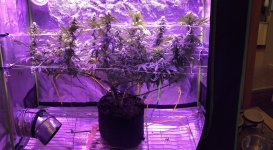
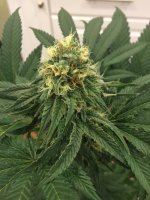
I believe it's all preference based on budget and getting the max out of your lighting purchase. I use 2 Vivosun 300 w $59 each led lights used as factory recommends for my grow needs and electric budget works just fantastic. Good Growing !!
 

Attachments

  • photo76160.jpg
    photo76160.jpg
    6.7 MB · Views: 0
  • photo76818.jpg
    photo76818.jpg
    1.6 MB · Views: 0
Toker1 , Not an argument, just a different perspective, money can be an issue. I only use LEDs, I have had minor problems at one time, nothing a soldering iron can not handle. Bulb replacement, if you actually need to replace an LED, is just soldering. Of course my LEDS were expensive, not Mars, Meizhi, I would prefer Blackdog, just way to expensive. I will admit that HID is much cheaper, and the technology is getting better. I am an enthusiast when it comes to LEDs, I am planning to build one at 600 watts. Just letting people know there are options out there and that investment is cheap or expensive.

 
My grow area is 3 ft by 4 ft and 5 ft tall I run my light at either 400 or 600 watts useing a hps light for flowering and Mh for veg I use nebulas manifolding guide and start flowering my girls when they are anywhere between 10 inch's and 20 inch's depending on what I'm growing I know my light should make huge 11 inch colas if I can keep her shadow off her bud spots but thats why I flower at 10 to 20 inch's that way my plants never break more than 40 inch's Max but normally I end up with about a good 18 inch tall girl and some thick colas leading down never tried led before tho just letting you know a 600 watt may grow a plant faster but you can always train her and bring her down
 
Any experience with the cree cob led? The grow videos I have seen with these are crazy for the small size of the light and how much power it uses. I almost bought one of the systems that use smaller cob lights mixed with regular led, but from everything I found the optic products seem top quality. Everything else in the 150$ price range had some sort of mixed reviews.

Let us know how the build goes on the 600w. While looking into what other light to get I ran across a few DIY websites and it looks like you can save a bit this way. Not sure how tough it will be, but starting small can't be too hard. It doesn't seem all that different from building guitar effects pedals.
 
The only experience I have had is with Meizhi 1200 watt led. I have used the same lamp for four years and I have seen no decrease in intensity or in bud production. Although that is the limit of my experience, I have grown two plants that leaned more toward the broadleaf side and grossed a pound dry. This was done in a 4x4x7 tent. LEDs today are way more advanced than they were 10 years ago, the investment is long term and well worth it after initial cost, I have seen the cree cobs, watched a guy grow one plant under it and had amazing results. As far as yield and quality, an LED is comparable, before everyone takes me for a hater, HID hands down has better light penetration, and can net massive yields. All in all, every plant I have grown would compare to my buddies HID, yield maybe smaller, just not that small, otherwise quality is consistent. My build will be a 600 watt cob driverless, well built in drivers anyways. Not for another year.
 
Toker1 , Not an argument, just a different perspective, money can be an issue. I only use LEDs, I have had minor problems at one time, nothing a soldering iron can not handle. Bulb replacement, if you actually need to replace an LED, is just soldering. Of course my LEDS were expensive, not Mars, Meizhi, I would prefer Blackdog, just way to expensive. I will admit that HID is much cheaper, and the technology is getting better. I am an enthusiast when it comes to LEDs, I am planning to build one at 600 watts. Just letting people know there are options out there and that investment is cheap or expensive.

While I prefer LED's what bugs me about a lot of the is how manufacturers lie about their wattage, for example the Meizhi 1200 watt lamp only pulls 420 watts at what they call 110 volts, two problems with that, 420 watts is not 1200 watts and in the U.S. we use 120/240 VAC not 110/220 VAC.
 
They are multiplying the chip wattage by the number of chips to obtain the par output wattage. But I understand completely about what you mean.
The US uses 110/220V still on older pieces of equipment that are most likely obsolete by now. I have seen them in action in this day and age. 110,115,120 people tend to use interchangeably...but you are correct anything that is modern in the US will use 120v. Most people just don’t realize this and say 110 anyway. It’s a fairly common misunderstanding.
 
But chip wattage, if fully powered, would equal lamp input wattage plus power supply inefficiency.

Example 10 LED's at 10 watts each equals 100 watts times power supply inefficiency 90% equals 110 lamp input watts or ,916 amps at 120 VAC..
 
The math isn’t working out because these are not actual output watts they are perceived. Imagine how many BTU would come off 1200W? About 3 times as hot as the 420w LED actually gets. Plus at 916 amps, you would be popping the circuit breakers and not growing anything at all. Not a good design feature.
Here is where the disconnect (no pun intended) exists. These are par ratings, meaning how they compare to non-LED lights (I believe that incandescent lights are the comparison being made). The data you are talking about is is more like attributive data and not continuous. Take it for what it’s worth (not much value added with this type of data), but don’t over think it. What you want to pay attention to is the actual draw at the wall. This will give you a better idea how to benchmark the specs.
 
Last edited:
They do lie, they do so by omission, they talk about equivalent, not actual. The market is very misleading. With that said, we are going into par and not lumen, someone also mentioned measurement by umols. Honestly, what I do understand falls under spectrum. not lumens, by which we define the measurement of perceived light. Even though "blurple" has been considered unattractive, by means is not inefficient.
 
The math isn’t working out because these are not actual output watts they are perceived. Imagine how many BTU would come off 1200W? About 3 times as hot as the 420w LED actually gets. Plus at 916 amps, you would be popping the circuit breakers and not growing anything at all. Not a good design feature.

I think you missed a decimal point there, 1200 watts at 120 volts is 10 amps , which is not enough to trip a 15 amp breaker so commonly found in residential.
 
They do lie, they do so by omission, they talk about equivalent, not actual. The market is very misleading. With that said, we are going into par and not lumen, someone also mentioned measurement by umols. Honestly, what I do understand falls under spectrum. not lumens, by which we define the measurement of perceived light. Even though "blurple" has been considered unattractive, by means is not inefficient.

I believe it is all about tossing out big numbers hoping no one knows better, I refer to them a Chinese watts.

And yes PAR is the correct measurement for comparing grow lamps.
 
Plan on sticking with a micro grow, then. Plan using around 50 actual watts/sq ft of floor space. That will provide adequate light levels to flower. Blurple leds like the panel you have aren't even as efficient as a HID lamp so you will need to use at least the same amount6 of power(and heat) to get the same light levels. Depending on where you live, it's quite easy to build a DIY fixture with light strips that offer current tech diodes(and efficiency) for about $1/watt. Using better diodes can reduce your power needs by about 1/3 because of the difference in efficiency.
 
Oh. Ok, got it. Thought that was a little funky. Saw a comma and didn’t realize it was a period. I was wondering what that power factor was. Lol. Makes sense now.
But think about the amount of heat that comes off the 420w actual draw. No where near 1200w. So that’s how you know the par output is a BS measurement. The BTU’s don’t lie.
 
Here is some good info on light availability recommendations for LED. DrPhoton really breaks it down to specific u-mols.
https://forum.growweedeasy.com/forum...-on-led-lights

Thanks, those are very helpful. The light arrives today or tomorrow. Planted seeds wednesday at 10pm, Friday morning they definitely were coming thru, but not there yet. When I got home saturday 11pm they were all fully sprouted up.

This is the worst part because I can't help, but to keep checking. They all have two sets of leaves since last night and still look about the same today. Put them 18" under the 40w led. The new light arrives tomorrow, not really sure if I should even use it until another 3 or 4 days.
 
The equivalent wattage listed by “most” LED manufacturers is the maximum wattage if each chip was driven at 100%. Most Chinese manufacturers won’t drive their chips over 40%, which is why you will find 300 watt fixtures that pull 135-140 watts from the wall. The important thing to understand about LED lights is that how hard the chip is driven is proportional to the longevity of the fixture. Any LED driven over 40% risks high failure rates. The higher you drive a particular led chip, the closer you get to Hid wattage, thus losing the benefit of using LEDs. The benefit of a 10 watt chip over a 3 watt chip is that you can get higher wattage from the fixture without driving the chip too hard, but it will pull more wattage. COB’s allow you to drive the chip at a higher rate without sacrificing the lifetime of the chip or using more wattage, but they are more expensive. The manufacturers are not telling outright lies when they say a fixture with 100-3 watt chips is a 300 watt light, their just not telling you that they are only driving each chip at 40% so they can say that it will last for 50,000 hours.
 
Back
Top