What's new
GrowWeedEasy.com
You're browsing as a guest. Sign up to join the conversation, share your grows, and get help from thousands of fellow growers — it's free and takes less than a minute.

root aphids 101

I spent an hour on the phone last week with PHD from university here. She said I knew more about them than she did.
 
I am surrounded by square miles of the plants that are their host. I would need millions and I am sure they are out there just overwhelmed.
 
Then I'm out. I am fortunate to have not had anything a little DE can't cure.

Your handle implies you are a dude in the desert named Dan desertdan. Lot's of types of deserts but I'll assume you live in one with lot's of rocks and more sand or DG than dirt? American like. Not big sand dunes with oil underneath. Or something like that. San Diego and our Cleveland National Forest are deserts. The Arctic is even a desert.

Enough trivia. If the dirt aphids you have can live through 80% of what is essentially glass to soil bugs, and you live in a stereotypical American desert, could the aphids you have be something more resilient to little glass bits? Something that lives in your local, natural dirt?

Maybe your bugs are snorting DE and smoking sand? And what about using food grade? It dabs to mind... can bugs eat food grade DE? I mean, it's food grade, right? Are you using food grade sand, too? Somethings to consider.
 
Sonoran desert here. I used to grow in the ground and they were not as bad, I think they have some natural enemies or other barriers that keep them a little in check.
 
I’m wondering if a rapid pH change to kill the root aphids followed by flushing to bring the pH back up quickly might be effective. Brainstorming here.
 
Dry desert plant's aren't as susceptible as wet weed?
What about using Sonora soil in your planter mix? Something from around established trees or shrubs?
How about using spent, outdoor soil with the 20% heat treated compost you use? DG from an amended, xeriscaped garden?
 
I don't even know what these things look like and I'm going to have nightmares about them. Earlier in the thread, you said the host plant is related to sunflowers. Do these monsters hangout near sunflowers? Or just the brittle bush?
Asking for a friend...she will chop those sweet-faced sun-goddesses down tonight in the dark and buy birdseed tomorrow, lol.
 
My testable hypothesis is that since the soils in the Sonoran Desert have pH that range from 7.0 to 8.0, neutral to alkaline pH, maybe the root aphids are adapted to higher pH, less acidic conditions. It could easily be tested without risking the plant by collecting some visibly infested soil in a clear cup, adding some pH adjusted water, say pH 5.5-6.0, letting it work for say one hour, then assess if the bugs were killed. If so, then it could be tested on a plant. After treatment for one hour, the container could be flushed with 7.0 water to remove the extra acid to achieve the desired final pH. Couldnt be any more traumatic than the methods tried by desertdan, much cheaper, and the downside is some browning on some leaves, not good but not necessarily lethal to the plant, According to the GWE tutorial concerning rapid pH fluctuations. If the problem is to be solved sometimes measures that could temporarily set the plant back should be considered. Pardon my scientific approach. Good luck! These root aphids are not a problem here in our sandy acidic soils. We deal with root knot nematodes here and they do the same root damage as the aphids. To combat them we use limestone or dolomite to raise the soil pH to around 6.5-6.8. Not sure if it kills the nematodes or causes them to flee the treated area but it does allow a crop to be harvested. Due to the tremendous buffering capacity of the acid sand soils, the limestone must be added every year before planting.

 
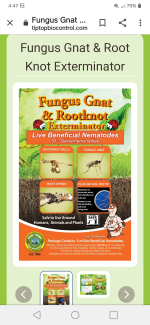
Tiptopbio.com obviously you are going to have a never ending fight if the little bastards surround you but it's my understanding with multiple release of these nematodes you can control the infestation of root aphids. It might be to late for this crop because you are already infested you'll have to take what you get, but if you start next season on the offense you should have a better outcome. Maybe you can try Korn trick with the ph before you plant next year to clean out an area then the nematodes as soon as you plant your crop. This would be my plan of attack.
good luck
 

Attachments

  • photo117758.png
    photo117758.png
    1.6 MB · Views: 1
  • photo117759.png
    photo117759.png
    655.1 KB · Views: 0
Me too! And i have several types. They are also known to move aphids around or even to another plant. Also a sign of these beasties!
 
I agree with Rwise. The only time it has worked fir me is if I use it to dust soft bodied insects and it must be dry. It is composed of the skeletons of diatoms which have sharp protrusions that can puncture critters like aphids and caterpillars and such. Once wet it cakes up and compacts and is much less effective.
 
I've used that tanglefoot on my fruit trees but never considered it on MJ plant but I'm sure it's another brick in the wall. A little dusting of DE powder is enough for indoors I would think but outside I would try it. Good idea for sure
 
Back
Top