What's new
GrowWeedEasy.com
You're browsing as a guest. Sign up to join the conversation, share your grows, and get help from thousands of fellow growers — it's free and takes less than a minute.

please help light saturation level

tyler_ hobbyist

New member
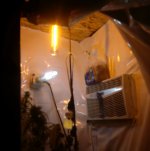
I am growing candy cane photo type and I have 1300-1500ppm of co2 lights 12/12 temp 65-75 and I'm running 2, 1000watt lights 1 eye hortilux hps and one solistek 10k finisher bulb. Now my question is how much of that light is being used and what's the percentage not being used? Is there a level of light that is max that is useable light? Also there hasn't been any signs of light stress either.
 
No Title

4x4x8
 

Attachments

  • photo22798.jpg
    photo22798.jpg
    2.3 MB · Views: 3
As for the co2. At any temp plants can obsorb co2 it's the stamota under the leaves that uptakes the co2 and yes temp does effect the stamota but it doesn't completly close it or ur plant would die without any co2 uptake normal air is 300-400ppm and wehn plants deplete there co2 to under 100ppm they have stoped growing and started to die. So yes at anytemp co2 can be used. Light has the biggest impack on co2 stamota glans. Stamota glands only open up if there is blue in the spectrum and yes all grow light bulbs have some blue even hps has blue, the more blue the more the stamotas opens. So light is the biggest factor to the uptake of co2 then temp 60degrees and lower will still uptake co2 but yes there's also a optium temp for co2 which is around the 85degree mark, but in flower to have high quality flowers u dnt want ur temp above 75. 80degrees and higher will slowly burn ur terps away and u will loose taste. Lower than 60and u arnt letting the plant grow at optium condistions for flowering and will yeild less.
 
I know there has to be a point where u max out everying enviroment (temp rh wind co2 light) and then also areogation in soil microbes and nutrients. Ect.. and once all of that is at there max. What is the maximum light the plants can use if everything else is perfect. Does any one have charts or somekinda reading material that I could check out on this subject?
 
Tyler I wish I could help you but I'm not to good with all that, Nebulas got a good article on co2 an lights an I think she said you go by how many lumens you have got per square foot of tent , but I might be wrong. Sorry if I am ,don't even know if this is what you want to know , got a heavy dose of medication going on right now ,it's raining here right now an that means staying medicated.
 
Thank u 69 :) iv read her articles she's very smart and knowledable but I can't find a. Saturation level lol hope the weather gets better for ya :)
 
I'm still waiting for a reply to the saturation question over in the biggest question about growing thread. 19 days since I posted it.
Nebula hasn't been very active lately, only 4 posts in the last 18 days.

Been waiting for a response to a different question in another thread for 23 days and I even tagged Nebula & Sirius in it. I guess they're just busy.
 
Tyler, I think you're going to have a hard time getting an answer to this. First because different strains react differently to light intensity and temperature. Its one of the issues I find myself dealing with when growing different strains. I would suggest to just keep lowering them an inch a day and keep a real close watch for any signs of burn or bleaching_ either is bad for the health of the plant and the quality of the THC.
But light IS food. It can be tricky towards the last few weeks of flowering especially, since you really don't want to decrease THC production but the plants want the light to produce maximum bud size. I favor erring on the side of caution rather than extremes_ my main objective is quality not quantity_ so that seems to work best for me. Cheers for an awesome finish!
 
In a few of my past grows I've had to fine tune the light heights for different strains in the same grow space by grouping them together (I have two lights so this is pretty easy to do). But you need to be able to check them every day for any signs of stress. If I have to leave for 2 days or more I raise the lights 2-6" to make sure I don't fry my girls! kinda like they get a few overcast days...then If they look like they need some "sun" I bring the lights back down to make them happy!
 
Plants can handle a lot of light.
When you talk about watts, you are measuring the amount of electricity that the lighting system is using. It can only be used very crudely to talk about lights.
​​​​​​There is obviously a point of diminished return. I think the question is what is optimal, and you might get a lot of different answers from different growers.
1 1000w HPS is usually sufficient for a 4x4 area, even with CO2.
That doesn't mean that the plants couldn't use more, but it might also be only marginally better.
Proximity from the lamp is also a big consideration. HPS gives off too much Infrared and heat, so you can only get so close.
Plants can use more light if the spectrum is balanced as well.
So there is no easy answer here.
When I test light intensity, I basically crank it up until it seems like the plants are being stressed, or until they don't grow faster. Then back down the light until they are happy again.
Not scientific exactly, but sometimes personal observation is all we got.
 
This is a really difficult question to answer, even with some understanding in plant physiology.
Co2 is only a limiting factor when all other variables are sufficient. With indoor enviroments, when a grow is well managed and healthy, light is usually the limiting factor before Co2 concentration. Studys show with current ambient Co2 concentration that outdoor plants often reach the compensation point (the rate of photosynthesis exactly matches the rate of respiration) daily when light intensity climbs to high levels. Greenhouse growers with feedback systems fluctuate co2 concentration with respect to radiant intensity. When the compensation point is reached and quantum yeild goes down (photosynthetic efficiency), co2 concentration is increased to maintain maximum quantum yeild.

So when you would want to supplement with Co2 would be at the compensation point, so that the photosynthesis rate and efficiency increases along a linear scale with respect to light intensity. Outdoors this is very simple to work out, as light intensity is linear in all directions. So the only thing you have to monitor is radiant intensity. Indoors however, not so easy.

Because artificial light is not uniform and we are able to manipulate it, it becomes more difficult to judge where one should add co2. As previously said, the compensation point dictates when co2 supplement will become beneficial. But because we have control of the light source, this could depend on what height a light source is. If a light source is close and so radiant intensity high, a plant could be forced to reach its own compensation point and photosynthetic efficiency would go down. Adding co2 at this point would be beneficial but unpractical. This is because getting light as close as possible does not increase "total" photosythesis. A light source has a specific radiant flux, which is the total energy a light source radiates. This radiated energy does not degrade (excluding specific variables) over distance, it only decreases in density because of more available space. What this means is that, as long as all light is reaching the grow, the amount of "total" photosynthesis is unchanged. This is where the judgement of when Co2 should be added is difficult.

At ambeint co2 concentrations, cannabis has been shown (chandra 2008 study) to reach its compensation point at around 500umls. This is actually similar to other high terrestrial species of plants. Beyond this point quantum yeild decreases, until it reaches a saturation level of around 1500-2000umls and photosynthesis rate actually decreases. At 1000umls quantum yeild levels off, this is about where any increase in light returns very little in growth. With indoor lights and ambient co2 concentrations, you would typically want to have light intensity at the canopy between 500-1000umls. Where exactly will come down to the type of light you have and the type of coverage from your refector or optical lenses (LED).
Where deciding when to add co2 suppliments indoors, will come down to two things. The radiant flux of the light source (total emmited power) and the footprint control. When more powerful lights are used, it gets harder to control the intensity at canopy. The further you raise your lights, the wider the distribution of light will be, this will cause reflection losses or non conctact (completely misses the plants). So the point of where co2 should be added, is where the power of the light exceeds the capability to maintain ideal intensity and light distribution. Now i understand that is quite unclear, unfortunatley its the best i can explain it. As i said, its really difficult to answer.

 
A wider spectrum does not enable a plant to increase its maximum photosynthetic rate. Other than the emerson effect between a very narrow range. The ability for a plant photosynthesize is limited (when all other variables are provided) by its photocenters and carbon fixation. Although a balanced spectrum is important, this is more because of photomorphogenesis than photosynthesis.
 
Thats correct, temperature is not directly connected with Co2. Higher temperatures with Co2 supplimentation allows the plant to photosynthesize at a higher rate. High temperatures up to about 86°F on its own will actually increase photosynthesis efficiency. Temperature is its own limiting factor but it does effect the point where co2 supplimentation stops working.
 
OzBud I thought i answered this for you in another thread ? I cant remember.
Anyway, a plant does not have a specific max DLI. if you look at DLI references online, you will find a lot of greenhouse articles. This is because the use of DLI is importent for assessing when light supplimentation is required. Greenhouse studys show a good deal of information on a plants minimal DLI for life sustination. However there is no real specific max DLI for plants because this is limited by a plants maximum photosynthetic rate. Plants do not take in photons and then just decide to suddenly stop because they are full (except in c4 plants). Photosynthesis will occur when variables are being provided to allow the process to continue. Some people may refer to outdoor plants mid day suppression and think a plant over time lacks the ability to continue to photosynthesize. However the midday suppression is caused by high intensity light at mid day causing photoinhibition and a reduced rate of photosynthesis. This is not a effect from too long exposure to light, but too high intensity. Indoors when enviromental conditions are stable, photosynthesis will occur as long as all life sustaining variables are met. With regards to 18 vs 24 hour photoperiods, this i answered in another thread and how it is a different question entirely.

http://forum.growweedeasy.com/forum...rements-on-auto-flowering-plants-indoor-hydro

As i had concluded there, the question is really not "does a plant benefit from more light over time" (continious photoperiod) but wether a plant benefits "more" from an absence of light over a specific period. That is more difficult to answer and really depends on the species of plant rather than the phyiological understanding. There needs more testing on cannabis itself to answer that question conclusively. However....Studies show that plants do respond positively to a dark period and apply physiological functions more efficiently than at light periods. My best guess, some dark is "more beneficial than continuous lighting. But no evidence to support it.
 
Thank u danofdanger, thats some article. Thank you. But I got a question for you I was flowering in a 4x4 with 1, 1000wat hps and my plants where doing awesome and then I addad another 1000w but instead of hps it's a solistek 10k metal halide finisher and my plants just took right off in growth and my lights are sitting around 10inchs from the plant now and temp is normal but the growth has been a lot? What would cause that? The light spectrum or the intensity?
 
Back
Top