What's new
GrowWeedEasy.com
You're browsing as a guest. Sign up to join the conversation, share your grows, and get help from thousands of fellow growers — it's free and takes less than a minute.

Get Help for Cannabis Plants Problems as Quickly as Possible!

HELP!!

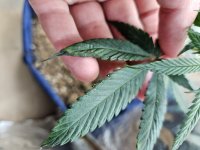
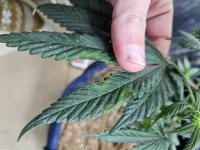
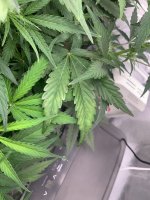
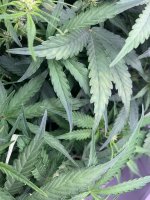
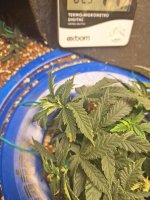
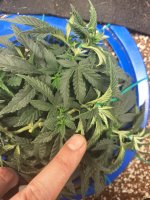
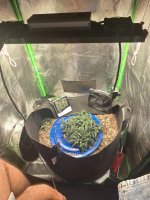
Leaves started looking like this after spraying with neem oil to fight septoria - i ignorantly used concentrated neem oil and then i rinsed it off after 2 days
 

Attachments

  • 20241231_014107.jpg
    20241231_014107.jpg
    2.5 MB · Views: 2
  • 20241231_014059.jpg
    20241231_014059.jpg
    2.8 MB · Views: 2
Ditto.. Don't use anything on flowers.

Having said that I can't see any flowers yet. She should recover so put her in to recovery mode by going conservative on light nutes and environment.
 
Help

Top leaves turning rusty
1 month into flowering
Feeding phosphorus maximum dose day in day out every other day
discovered maybe ph high alkaline problem ( soil slur 8.2) so gave white vinegar solution 5.5 with my feed two days ago
still no recovery happening
 

Attachments

  • photo178824.jpg
    photo178824.jpg
    3.1 MB · Views: 2
Dont think its still recovering xause its getting worse and this one wasnt even really harmed by the neem, she was one of the least sprayed

I have 5 plants and only this one is doing this
 
Looks like quite bad burn to me. Look at those keaf tips.

What dies the diagnose your problem pages say about leaves like that?
 
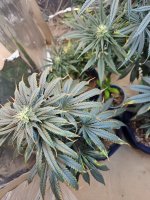
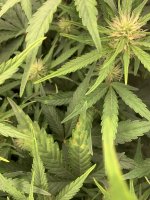
Got a bit of a deficiency, any thoughts from people would be appreciated.

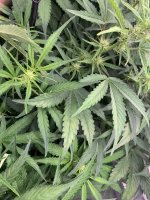
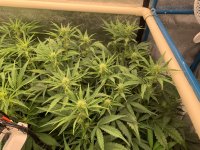
These are two different Autos , pics are a bit mixed up but looks the same to me on both plants. Discoloured Leaves are mid plant and some lowers are falling off, about 3 weeks into flower

Everything is pretty standard in the environment 77-78 F humidity is abit high, up to 75 but average about 65 I don’t think that’s it, I will be bringing it down for sure

I’m in living soil I forgot to check the soil PH but it’s always 6.6-6.8

I always have that bit of tip burn , and slight taco. not sure that’s the same issue.

thanks in advance
 

Attachments

  • photo179347.jpg
    photo179347.jpg
    2.3 MB · Views: 2
  • photo179348.jpg
    photo179348.jpg
    2.4 MB · Views: 2
  • photo179349.jpg
    photo179349.jpg
    3 MB · Views: 2
  • photo179350.jpg
    photo179350.jpg
    2.5 MB · Views: 2
  • photo179351.jpg
    photo179351.jpg
    2.9 MB · Views: 2
  • photo179352.jpg
    photo179352.jpg
    3.3 MB · Views: 2
I'll give it a go.

Tips on developed leaves under new growth have that bluish tinge and it progresses back from the tip into the leaf and I associate that with high levels of N prior to twisting occurring. Its happened to me a few times especially evident in my OZ x SD, an amazing strain bred by Franklin. It's sometimes hard to show it in pics but I think I can see it. Can you see what I mean?

New growth at buds seems to be very early days & ok but high N could be slowing growth there and/or giving it a bit of a weird look? Is the growth at the buds slower than when you've grown these before or looking a bit weirder?

There appears to be a cal deficiency and mag also showing up on a leaf or two in the earlier pics mid growth but doesn't appear to be much. Normally a bit low pH or too much potassium. This is when it starts to show in my sativas around week 4 from flip but I grow in coco. I also think intense LEDs can bring this on more in some strains than others.

I'd try and get the RH down as it's probably pushing a low VPD and not taking up what it needs in the quantities to stay healthy as it can. If your giving it any liquid nutes I'm not sure what approach exactly to take given its in soil and you'd hope N would be low now but who knows.

I think the edges of the leaf starting to curl up a fraction is also related to the blue tinge I see but t here is lots of things that can cause that inc nute burn but not seeing much of that elsewhere really.

Edit. You could try a high pH flush and suppliment with a little bloom suppliments. That would be my approach if things dont pick up soon or you think it is too high N.
 
Last edited:
Tacoing usually means too bright a light. High light energy will increase the photosynthetic process speeding up nutrient uptake. There's where your deficiency came from. Looks like cal/mag deficiency.
 
Thanks for the thoughts.
you’re probably right with your thinking. I haven’t grow these before so I have no comparison.
I don’t really see the blue tinge but I get what you’re saying about it.
I'm pulling the light back trying to get the temp and humidity back on point. I already top dressed flower nutes a couple days ago so I guess that could also be playing in, although two days is too fast for dry amendments to break down I suppose could still be reacting. Anyway, its done, with living soil you’re kinda committed. I defoliated significantly today hopefully that wasn’t a mistake. Life was forcing my growing schedule
 
Hi, first time grower here, i bought a super soil mix, filled the bottom 1/3 with it, filled the rest with perlite coco coir and some dirt with hummus. I believe my pH is too high, my reader seems to indicate 8 pH, I've already bought pH down and am waiting for it to arrive, regardless I'd like to confirm if (aside from pH) it looks like potassium or maybe boron defficiency? I initially thought caterpillars but its quite an isolated enviroment and there are these yellow/orange parts in the edge of some leaves. Also, do my leaves seem heat stressed, maybe too dark aswell? I've maintained temps between 26-29 °C like 80% of the time but it has reached some very high 32-35 temps for like 4-6 hours at a time sometimes. My super soil mix has kelp and sillica. thanks in advance guys, sorry for so many questions.

240W light 57 Liter pot strain nicole kush 2.0 from seeds genetics keeping the lights at around 40 cm distance, manufacturer says to keep at 30.

(pic showing "holes" in new and old leaves, with some showing yellowing around edge of holes)

 

Attachments

  • photo179496.jpg
    photo179496.jpg
    3 MB · Views: 2
  • photo179498.jpg
    photo179498.jpg
    3.1 MB · Views: 2
  • photo179500.jpg
    photo179500.jpg
    4.8 MB · Views: 2
Last edited:
Plant looks healthy. Media looks dry. Pick up a loupe to magnify your view. Looks like you have bugs.

Read this. I am not the author.

This will be a long read based on my personal knowledge, opinions, research and others work to consolidate information for our members. I'm not presenting my opinions as facts so take from this what you like. I will be putting it in subsection format for easy reference.

First I want to make an important point to take into consideration before reading. The tap root will grow directly downwards to the bottom of the container before spreading out.

PERCHED WATER TABLE

What is it?

The perched water table is basically the height of the saturation zone where capillary action and gravity cancel eachother out. This area will be saturated with water and will be responsible most growers issues with watering practices especially in soil grows.

WHAT IS CAPILLARY ACTION

CAPILLARY action is is the combination of the cohesive and adhesive properties of water.

In short adhesion is water clinging to the media (think of it like wicking or soaking up)

Cohesion is where the water clings to itself.

So as the water is wicked up (adhesion) it pulls more water with it through Cohesion and at the point gravity and these properties cancel eachother out is the perched water table.

This perched water table will always remain the SAME HEIGHT and will always stay saturated unless taken up by the plants or evaporates when the pot dries out. No matter the container height, depth or volume of media. So if a tall skinny container had a perched water table of 1" then a short wide one of the same media will also have a perched water table of 1". Which means the ratio of water to air in a wide pot will be higher than a tall skinny pot which will have a higher air to water ratio... keep this in mind as we get further.

Different media's have different perched water tables. A more absorbent media will have a higher perched water table than a less absorbent media... REMEMBER THIS as it makes a big difference on pot selection for your media.

DIFFERENT MEDIA

Water holding capacity is directly related to the height of the perched water table so soils with more clay or silt and less sand will have a higher perched water table than those with more sand because sand is a larger particle.

The larger the overall particles of the media the lower the perched water table and better the drainage.

By adding things like perlite or vermiculite (while vermiculite is good at absorbing water it also improves drainage so its helpful in keeping a more even level of moisture throught the media while increasing drainage due to its size) we can lower the perched water table by reducing the wicking (adhesion) ability and creating more space between particles overall reducing the cohesion effect and inturn the height of the perched water table.

Media's like peat based or coco have a much higher drainage and lower perched water table than soil and are therefore less susceptible to over watering but will require more frequent watering due to the lower water holding capacity.

Adding thing like perlite or hydroton to the bottom of the pots will NOT reduce the water table but instead raise it. This is because as I said the height of the water table will not change for a given media. So if you add things like that to the bottom you are essentially just moving the water table up.

Basically the larger the particles IN the media the better drainage and lower the water table.

If you want to see the height of your perched water table use a clear cup with drain holes fill with media and saturate it. Wait a few hrs for drainage and then come back and look. You can see the difference in the varying media's if you want to experiment.

If you feel you have over watered or your perched water table height is to high you can simply tilt your pot on a 45 degree angle and release more water from the media as runoff. To help visualize think of it this way if you have a perched water table of 2”. You can draw an imaginary horizontal line at that height, when you tilt the pot you have less media below that line and therefore you will have less water in the pot after tilting it.

POT SIZE

I have already covered this a bit but my opinion is if you are using a media with a higher water table you will benefit from taller narrower pots and if using a media with a lower perched water table the shorter wider ones may benefit you depending on your watering practices.

I prefer the taller over wider no matter the media as I choose to water often and have a higher air holding capacity and lower water table but that can work against you if you can't water as frequently and as plants grow it can greatly increase the frequency required as the roots will be pulling the water out of that saturation zone quickly. So you may want to use taller pots for small plants and transplant into a wider one as they grow.

You also don't want a pot that's to tall and the top portion of the media is drying out to fast while the bottom is wet.

Let's use seedlings as an example take a solo cup or a large container... the water table will be the same height in either. I see sooo often ppl trying to water a tiny bit in circles or mist the surface and for lack of other words IT DEIVES ME NUTS. Why because the roots are so shallow they are not at risk of being over watered. Remember though tap roots grow straight down so we to be mindful as they grow depending on the gas exchange of the media that the majority of roots are not sitting in the saturated zone with poor gas exchange because this will cause lack of oxygen that we incorrectly refer to as overwatering which is actually the cause not the symptom.

It's important to fill containers to the top to give us a good amount of space above the perched water table that high in o2. If you fill a solo cup halfway with soil it's likely to be sitting in the saturation zone and will not do well.


Also going to make the point that plants will be most susceptible to overwatering when the roots first hit the bottom and spread out until they fill the bottom and start moving back up out of the saturation zone. So again it may be more beneficial to use a taller narrow pot for the early stages of growth (2-4 weekss depending on growth) and transplant into a wider pot as you go. After the transplant almost all of the roots will be above the saturation zone and it become much harder to over water. New roots will again work their way down into the saturation zone but you will have plenty above so its less likely to over water and why uppotting as you go I see as a benefit instead of starting in a large wide container.

POT MATERIAL

Some prefer plastic others fabric, air pots etc.

This can affect the perched water table by evaporation as the lager the exposed surface area the more evaporation that occurs from the media in say fabric pots. This imo has a few benefits.... slightly reducing the perched water table but more so the exposure for gas exchange that's happening and that's a good thing for o2 levels in the root zone that I feel are directly related to growth rates and I'll explain why going a bit off topic for a second.

It's no coincidence that the fastest growing media's have the highest amounts of o2 and gas exchange.... for eg aeroponics have unlimited to rich o2 and water. Hydro similar with slightly less o2, soiless media's such as coco and I would possible include peat and last soil. If you notice they are in order of growth rates and its not hard to see the difference in thier air holding capacity in that order. And the fact that larger particles also have a better gas exchange rate. This is important because the plants take in oxygen and expell co2 in the rootzone as do the microbes on top of that so good gas exchange is important for both.

Just a note... air pruning has nothing to do with the benefits of fabric pots all it does is signal the roots to grow in a different direction.

But let's get back on topic of watering and how it's affected.

TEMPERATURE AND HUMIDITY

The warmer the temps the more evaporation occurs.

The lower your humidity the more evaporation occurs

The more surface area exposed to air movement (wind) the more evaporation.

Think those don't need an explanation. But the difference in pot material coupled with these environmental factors will have an impact on your watering needs.

The temperature of the media not only affects evaporation but also directly affect the temperature of the plant and leaf temps. This has a large impact on nutrient uptake and transportation.

First let me say that this next part is opinion and I will gives my reasoning for my opinions. With the exception of hydro (leaving this part out as this post is about watering not hydro) roots like to be about the same temperature as the leaves contrary to what's talked about from many prominent growers in the industry but not all like Mr.Bruce Bugbee. IMO ideal root temps are the same as ideal leaf temps and overall plant temps especially since the root temps have a large impact on the plant and leaf temps. What are ideal temps imo and many studies show that leaf temps (NOT AIR TEMPS) of around 77f are most efficient. So how does a cool rootzone impact the plants negatively? Well it's 2 fold because of the cool temps the viscosity (measument of flow rate) of the sap will decrease so its harder for the plant to move the nutrients through the plant. The other is absorption and one fact is that in a cooler rootzone the concentration of nutrients is higher (but aqua you just said it slows absorption) well it does as the nutrients build up in the roots it can absorb less and this has a direct impact negatively on the plant. It may appear to be overwatered because the plant is now struggling to take up and use oxygen. Add that to the slowed transpiration rates and you have the same symtom many refer to overwatering which againnos lack of o2. Now take a cold rootzone where the plants slow water uptake and then add the saturation zone to it and you can see the road to correction and recover is a long one and can have huge impact on growth and yields.

So get your pots up off the floor
1f601.png


WET AND DRY CYCLES

in soil and peat with higher water tables or with wider pots or combination of wet and dry cycles are important. This is to allow the dry back (including the uptake of water from the saturation zone) to prevent symtoms of over watering and help with o2 levels. Remember the majority of roots will end up in the saturation zone with these media's or with wider pots. Which can become depleted of o2 quickly as gas exchange is lower in water and media made up of smaller particles. This is where pot size and shape are important for the size of plant. You have a small plant in large container and there is no way it can take up enough of the water in the saturation zone fast enough to get air exposure in a media that has low gas exchange and majority of the roots. So it's important to choose a pot size that will allow for this. It's also why using the finger method to gage watering is poor and lifting the pots is much better... when they are light you know they have taken up a good portion of the saturation zone and are ready to be watered again.

This is much less of an issue when using soiless like coco or peat/perlite.
​
 
Back
Top