
GrowWeedEasy.com
You are using an out of date browser. It may not display this or other websites correctly.
You should upgrade or use an alternative browser.
You should upgrade or use an alternative browser.
Hi guys! First I have to say thank you for all the support.
So the example I gave was just to show what I was trying to say, it's not the circuit I'm building. And also I'm sorry cause I said something wrong, if I have two strips in parallel, they will receive the same voltage, no matter what I do, parallel the voltage is the same. But what I wanted to say is that if I have a power supply of 35V and 1.5A I can put two strips in parallel and both will receive 35V so I can have for example 10 chips of white leds in series where the total forward voltage will be 33V (they have a forward voltage of 3,3 each) and 10 of blue (same forward voltage) and the driver of each strip will pull out the source 700mA. The other 2V will be spend in the driver.
Basically what the driver does is to keep the current in the value you want using an NFET as a resistor that adapts to the voltage you are applying.
You can check it here:
http://www.instructables.com/id/Circuits-for-using-High-Power-LED-s/?amp_page=true
I'm kind busy this weekend, but on Monday or Tuesday night I'll post the full circuit so we can chat with something to make explanations easier.
About the heat sink, all the LEDs will be in the star one separately and also all them plugged in a large rectangular heat sink attached to 3 cooler fans. I'll also post the dimensions of the heat sink/fans.
But I have some questions before doing it. Do you guys think I should make an equal ratio of white/blue and red? Is it way better if I include green and yellow leds or just the white is ok to try to get the full spectrum?
So the example I gave was just to show what I was trying to say, it's not the circuit I'm building. And also I'm sorry cause I said something wrong, if I have two strips in parallel, they will receive the same voltage, no matter what I do, parallel the voltage is the same. But what I wanted to say is that if I have a power supply of 35V and 1.5A I can put two strips in parallel and both will receive 35V so I can have for example 10 chips of white leds in series where the total forward voltage will be 33V (they have a forward voltage of 3,3 each) and 10 of blue (same forward voltage) and the driver of each strip will pull out the source 700mA. The other 2V will be spend in the driver.
Basically what the driver does is to keep the current in the value you want using an NFET as a resistor that adapts to the voltage you are applying.
You can check it here:
http://www.instructables.com/id/Circuits-for-using-High-Power-LED-s/?amp_page=true
I'm kind busy this weekend, but on Monday or Tuesday night I'll post the full circuit so we can chat with something to make explanations easier.
About the heat sink, all the LEDs will be in the star one separately and also all them plugged in a large rectangular heat sink attached to 3 cooler fans. I'll also post the dimensions of the heat sink/fans.
But I have some questions before doing it. Do you guys think I should make an equal ratio of white/blue and red? Is it way better if I include green and yellow leds or just the white is ok to try to get the full spectrum?

Tazard
New member
My dad is an electrical engineer. I am a civil engineer with just enough solid state and digital electronics courses to get in trouble lol but I think a zener in parallel with each led (zener may have to be reversed) will allow a led to burn out without creating an open. Like I said I'm civil (structural at that) so I may be way off but my dads always happy to see me with any interest in electronics so having him check a schematic should not be an issue.
A zener would be a good idea but I'm not going for it tho. If a single led burns I won't notice it since I can't keep staring at the lights without harming my eyes. A whole string off would be easier to notice and I have to be aware of all the faults to make improvements.
About the schematic, I'll have it soon man, thanks a mill
About the schematic, I'll have it soon man, thanks a mill

DrPhoton
New member
The constant voltage power supply just sounds like a regular rectified and regulated dc power supply like most typical low voltage appliances these days no ?.
If you are going with a constant current driver, then you would be looking at making the arrays yourself rather than buying prefabbed strips or star type chips. Why i say that is because these types of premade arrays are usually made to be run by constant voltage drivers and they include inline resistors to control the current. Just make sure you dont add any resistors, otherwise you defeat the whole purpose of CC Drivers and might as well use constant voltage.
I am very eager to learn more about wiring toplogy so looking forward to further discussions.
If you are going with a constant current driver, then you would be looking at making the arrays yourself rather than buying prefabbed strips or star type chips. Why i say that is because these types of premade arrays are usually made to be run by constant voltage drivers and they include inline resistors to control the current. Just make sure you dont add any resistors, otherwise you defeat the whole purpose of CC Drivers and might as well use constant voltage.
I am very eager to learn more about wiring toplogy so looking forward to further discussions.
DrPhoton
New member
Yes tazard, thats correct. Implementing zener diodes or switching circuits is used in small applications to prevent a complete open circuit. However doing so can get complicated and costly when you are dealing with larger arrays. It really depends i think. However i think with large array light solutions such as we are talking about, we are looking at a parallel series configuration that arranges segments into clusters. Allowing more robust failure prevention and diagnostics. I am looking further into these topology's, there are many ways to go about configuring it.
Oh yeah man, I'll make the arrays myself with those 3W Epistar LEDs. I have been looking for a power supply of around 54V/5A but since this one is a trial version I'll get some notebook charges that I have at home, they are around 20V/4A each so I can have about 150W with two, hope will be enough.
After reading your article and watching some videos from growmau5 I can make a better choice of amount of LEDs. Do you recommend how much PPFD for a 2x2 sq ft for a single plant?
After reading your article and watching some videos from growmau5 I can make a better choice of amount of LEDs. Do you recommend how much PPFD for a 2x2 sq ft for a single plant?
DrPhoton
New member
Haha the good ol reuse the lying around power supplies. Brilliant.
With working out how much light you want, ideally you will want to use PPF. PPFD is a measurement of photons per unit area. Which is ok for things like outside, where light is uniform in all directions, but a crapshoot for artificial light that measures differently depending where you measure. PPF is a measurement of all photons emmited from a source, giving you the best information on what a light source is going to do for a plant. Because after all each photon is importent for photosynthesis.
Now.. the problem is, i dont think led manufacturers provide specs in radiometry and i am quite sure they wouldnt provide PAR measurements either. You also cannot easily measure PPF yourself as that requires special equipment such as an integrating sphere. So without that, it makes it hard to 'calculate' what you will get from certain solid state lighting components before hand.. This is where the complexity comes in for making perfect lighting for growing.
Thing is, if you use units like lumens, you will get inconsistent results trying to compare it with other lighting technology such as HPS/MH. This is because depending on what spectrum the light produces, it effects the efficacy in photometry. Its pointless
Upon writing this i found an article that was so damn accurate i was surprised, very rarely i find articles that are as accurate as these. This details about comparing LEDS to other light technologies and some simple rules to follow. One specific rule is to not use a single PPFD measurement when comparing lights. This was for the same reason i previously said about artificial light uniformity.
I would say the best way to measure your light capacity, is taking several samples accross horizontally. Then averaging your sample results. The more samples you take, the more accurate it will be. But again this can only be discovered once the panel is built. Perhaps by building your prototype, then measuring it, you can estimate perhaps how much more LED chips you would require to reach the desired result.
Here is a video of how the method is done.
You would want an average canopy to be between 400-700umols. But this is for optimal to max growth possible. You can get away with as low as 200umols.
Theres a heck load of math that i wanted to include but i suck at math and am now dragging on too much. You let me know if you need to know anything further, this is really interesting to me and i cant wait to tag along with you.
With working out how much light you want, ideally you will want to use PPF. PPFD is a measurement of photons per unit area. Which is ok for things like outside, where light is uniform in all directions, but a crapshoot for artificial light that measures differently depending where you measure. PPF is a measurement of all photons emmited from a source, giving you the best information on what a light source is going to do for a plant. Because after all each photon is importent for photosynthesis.
Now.. the problem is, i dont think led manufacturers provide specs in radiometry and i am quite sure they wouldnt provide PAR measurements either. You also cannot easily measure PPF yourself as that requires special equipment such as an integrating sphere. So without that, it makes it hard to 'calculate' what you will get from certain solid state lighting components before hand.. This is where the complexity comes in for making perfect lighting for growing.
Thing is, if you use units like lumens, you will get inconsistent results trying to compare it with other lighting technology such as HPS/MH. This is because depending on what spectrum the light produces, it effects the efficacy in photometry. Its pointless
Upon writing this i found an article that was so damn accurate i was surprised, very rarely i find articles that are as accurate as these. This details about comparing LEDS to other light technologies and some simple rules to follow. One specific rule is to not use a single PPFD measurement when comparing lights. This was for the same reason i previously said about artificial light uniformity.
I would say the best way to measure your light capacity, is taking several samples accross horizontally. Then averaging your sample results. The more samples you take, the more accurate it will be. But again this can only be discovered once the panel is built. Perhaps by building your prototype, then measuring it, you can estimate perhaps how much more LED chips you would require to reach the desired result.
Here is a video of how the method is done.
You would want an average canopy to be between 400-700umols. But this is for optimal to max growth possible. You can get away with as low as 200umols.
Theres a heck load of math that i wanted to include but i suck at math and am now dragging on too much. You let me know if you need to know anything further, this is really interesting to me and i cant wait to tag along with you.
DrPhoton
New member
Oh snap, i just checked a few cree chip documents, they do aparently have radiometric data. With that, you could potentially estimate how much light will be produced from so many chips. There is a rough formula for radiant flux to umols, 1w = 4.6umols.
So if a single chip say produces 1w in radiant flux and we were after around 400PPF, 400 ÷ 4.6 = 87 LED chips. Of course, variables may differ the result.
Maybe helpful, perhaps ?
Il keep you posted if i find anything further.
So if a single chip say produces 1w in radiant flux and we were after around 400PPF, 400 ÷ 4.6 = 87 LED chips. Of course, variables may differ the result.
Maybe helpful, perhaps ?
Il keep you posted if i find anything further.
That was helpful indeed. I'll follow your call and make the measurements after building my first grow light. And nice article, great knowledge to acquire. Soon enough I'll be posting a schematic plus an image of how it will look like and then we can discuss a little more.
Thanks for all the support till now man! It has been great, learning a lot in here.
Thanks for all the support till now man! It has been great, learning a lot in here.
No Title
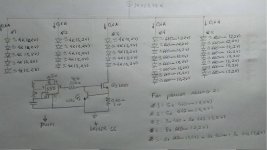
Basically,this is the circuit. I've drawn the cc driver only once,but it repeats 5 times for each power source (1 for each array of LEDs). At the bottom on the right side is written the disposition of the LEDs for the second power source. The PWM which dims the LEDs will be the same for equal wavelenghts, thus I can dim different colours through the stages of the plants. I'll wait for some opinios in here before working out the disposition of the LEDs on the large heatsink.
I decide for 600mA so I can have a better efficiency (thanks for this info Dan) than 700mA. I was thinking about adding a couple IR (850nm) LEDs and UV (390 nm), would be a good idea? How many?
Any suggestion about the spectrum? I'm thinking about changing some 620nm and 660nm for 595nm to get a better spectrum.
I'll include separated heatskins for Q1 and Q2 also.
Sorry about my handwriting haha!
Basically,this is the circuit. I've drawn the cc driver only once,but it repeats 5 times for each power source (1 for each array of LEDs). At the bottom on the right side is written the disposition of the LEDs for the second power source. The PWM which dims the LEDs will be the same for equal wavelenghts, thus I can dim different colours through the stages of the plants. I'll wait for some opinios in here before working out the disposition of the LEDs on the large heatsink.
I decide for 600mA so I can have a better efficiency (thanks for this info Dan) than 700mA. I was thinking about adding a couple IR (850nm) LEDs and UV (390 nm), would be a good idea? How many?
Any suggestion about the spectrum? I'm thinking about changing some 620nm and 660nm for 595nm to get a better spectrum.
I'll include separated heatskins for Q1 and Q2 also.
Sorry about my handwriting haha!
Attachments
DrPhoton
New member
At first i was not sure multiple drivers was the way to go, it adds cost and complexity. Running the LED strips in parallel series with a single driver as i had previously described would be more ideal. Because they are arranged into clusters you still get the same benefit but higher efficiency and lower cost. But then i assume that the higher voltage concerned you like stated here.
Also for deciding on the amount of LEDS to buy, i would buy as many as your budget can. Regardless if it will produce more radiant flux than you require. Reason being because, the lower you dim them, the more efficient they become. Just dimming them by only 5-10% might not make a huge difference. But if your budget allows enough chips so that you can dim down down say 50%, then this would but a much more efficient.
Personaly i would ignore IR, i dont see any benefits. Nothing i know or understand suggests a purpose. I do not know why they are being implemented. As for UV. Use then if you are after quality, for yeild. Leave them out.
Also for deciding on the amount of LEDS to buy, i would buy as many as your budget can. Regardless if it will produce more radiant flux than you require. Reason being because, the lower you dim them, the more efficient they become. Just dimming them by only 5-10% might not make a huge difference. But if your budget allows enough chips so that you can dim down down say 50%, then this would but a much more efficient.
Personaly i would ignore IR, i dont see any benefits. Nothing i know or understand suggests a purpose. I do not know why they are being implemented. As for UV. Use then if you are after quality, for yeild. Leave them out.