Snipped from the Ontario Cannabis store info section:
…..If you are like most people, you want to understand the cannabinoid content in the products you consider. Every product is different in its variations and levels of cannabinoids, so it’s a good thing that every product label must state its THC and CBD contents.
However, cannabis product labels can be difficult to understand because they list THC and CBD contents in two ways and use different units of measure depending on the product format.
So, how do you know what’s in what you are buying? Read on to learn how to demystify cannabis product contents and labeling.
Every product label lists cannabinoid content levels two ways.
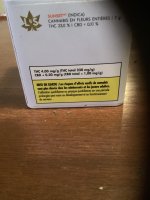
Image of a product label displaying cannabinoid content and product name(sorry no pic)
THC and CBD active content levels are expressed on labels in two ways and it’s important to know the difference. The first reference is a base number, and the second is shown as a percentage. These are listed as “THC†and/or “CBD†and “Total THC†and/or “Total CBD†respectively.
What’s the difference?
“THC†and “CBD†refer to the quantity of active cannabinoids contained in the product as purchased.
“Total THC†and “Total CBD†refer to the levels of active cannabinoids when the cannabis is prepared for consumption. The “Total†cannabinoid content numbers are most helpful in predicting the potential potency that the product may have when consumed.
When buying dried cannabis formats, there will be a difference between these two content numbers, but when purchasing oil or capsule products, the numbers will be the same. Read on to learn why.
Not all cannabis has fully activated cannabinoid content.
The cannabinoids in cannabis products are only activated through a process called decarboxylation. This is the process of heating the cannabis to a temperature of 150 degrees Celsius or more in order to “activate†the cannabinoids. Dried flower products are not fully activated when purchased, because they are heated in time for consumption. This means there will be a difference in the two numbers on the label for each listed cannabinoid, and typically, the first number will be considerably lower than the “total†number because it represents the inactive state of the purchased product.
In oil and capsule products, the cannabinoids have been activated through processing, and are ready for consumption. Therefore, the two numbers listing cannabinoid content on their packages will be exactly the same.
Every format has its own unit of measure for cannabinoid content.
All of the label content information is intended to be helpful and clear to consumers. To be precise about the cannabinoid content within each product, it is measured differently by format. Dried flower products list cannabinoid content in percentage relative to the total cannabis purchased. Pre-rolls and capsule content is measured in totals per unit, and oil content is listed in milligrams per milliliter.
To understand and compare the information on the different product formats, use the chart below. Understanding product labels and cannabinoid content will help you understand and compare products. Use our chart below as a quick reference guide.
DRIED FLOWER
Cannabinoid Unit of Measure
% - Percentage of total weight
Example:
Image of full packaging for dried flower displaying warning label and all other required content on the outside of the box.
THC 0.7%
Total THC 14.3%
CBD 0.0%
Total CBD 0.3%
Consumption Information
Sold before decarboxylation so the two stated levels of cannabinoid content will be different
“Total†cannabinoid numbers are the best way to determine the potency potential of the product
PRE-ROLLS
Cannabinoid Unit of Measure
mg/unit - Milligrams per individual pre-roll unit
Example:
Image of a pre-roll package
THC 4.1 mg/unit
Total THC 146 mg/unit
CBD 0.43 mg/unit
Total CBD 26.8 mg/unit
Consumption Information
Sold before decarboxylation so the two stated levels of cannabinoid content will be different
“Total†cannabinoid numbers are the best way to determine the potency potential of the product
Did that make sense ?? Maybe read it twice it took me a minute ðŸ˜
Eg. 146 mg/1000mg (1-gram pre-roll) = 14.6%