Managing the System
My system has really been very easy to manage and maintain, but it didn’t start out that way. I suffered a bacterial infestation in the res during the first two weeks and had to change my practices. Since then, I have a firm handle on the tank and the numbers are stable. I also dealt with some tip burn as a result of poor water distribution in the media. I have rectified that situation as well, and hope that you can learn from my experience!
Finally, I provide the information that I looked everywhere for before figuring it out. How to time multiple fertigation events.
Managing the Res:
To prevent bacterial infection, it is important to use a couple of products that you may not have been using with hand watering. It is also important to keep your water oxygenated and this usually requires also keeping it cool.
1. In the tank: In addition to my normal nutrients I add H2O2 and SM-90.
The Hydrogen Peroxide (H2O2) that you need is not the stuff that you use for first aid. The first aid stuff is 3% the horticulture stuff is 29%. You need to use the 29% stuff. 2.5ml/gal. Add it last, just prior to adding to the res.
SM-90 is going to play several roles, but critically here it is an antibacterial and will keep the tank smelling fresh and clean. 2.5ml/Gal
2. It is important to oxygenate the water.
You need to have an air-stone, fountain pump, or electrolysis to provide O2 to the water.
Oxygenating the water not only makes it difficult for harmful bacteria to grow, it is also great for your plants!
3. Chill the Res: Ideal temperature range 65-68f; 18-20c
It is easier to oxygenate water that is cooler. This is why many hydro growers use chillers for their tanks. I do not use a chiller, but I do try to keep my tank around 68f or cooler. I do this the cheap and simple way, dropping frozen water bottles in the Res 1 hour before fertigation events. This is a potential source of bacteria, so be aware of cross-contamination (keep your frozen water bottles clean).
4. Keep the Res covered and protect it from light
It doesn’t have to be light sealed, but the less light the better. I like the lid on my Res because it creates a nice seal and is easy to remove. Be sure to keep the lid on and keep the Res as dark as is practical.
5. Topping-Off or Cleaning out
The tank should be completely drained and cleaned about once per week. I have had no problem going up to 9 days between tank clean-outs. The one time it went to 10 days, I thought that problems were starting!
There will be nutrient solution left in the tank when it comes time to clean out. Plan this so that there isn’t a lot! I save this water and use it to hand-water the plants. This accomplishes two things: It uses up the water and it helps water distribution.
During the week: You can simply top-off the tank with fresh nutrient solution. Always measure both the EC and the pH in the tank before adding top-off water. Top-off water should be adjusted to bring the tank back to your EC and pH targets. Neither my EC nor my pH drifts considerably now, but they used to. Knowledge is power!
At the end of the week: Drain the tank, remove the pump, air-stone, and thermometer probe. Soak these in a solution of diluted H2O2. Use H2O2 also to clean out the tank. Be careful with this stuff! It will burn the crap out of your hands. Use gloves! Rinse everything and reassemble.
6. Monitor EC and pH in the Res: I take daily samples from the Res to measure both EC and pH.
A bacterial infestation will cause pH to rise and EC to drop. If you notice this pattern in your res it is likely that you have a bacteria problem. When I first started using the system I was using neither H2O2 nor SM-90 and I consistently noticed this pattern. I also noticed that the res started to smell like a poorly maintained fish tank. These are sure signs of anaerobic bacteria (the bad kind). I caught it early and it did not harm the plants. H2O2, SM-90 and weekly clean-outs have eliminated the problem. Monitoring EC and pH are the best ways to get an early read on these issues. Since pH can potentially drift out of range, it is also important for plant nutrition to keep tabs on the pH in your Res.
Adjust EC and pH issues to bring the res back to your targets. For pH, add pH up or down. For EC, add stronger or weaker nutrient solution. But then look for the underlying issue. Ideally, your EC and pH should be pretty stable.
Water Distribution: Hand-Water once per week
Regardless of the drippers/halos/or soaker hose that you are using, the distribution of water in a drip system is always less than perfect. Do your best and be sure to use at least four points of fertigation as I discuss above. SM-90 is also a surficant and will help distribute the water more effectively. However, you should still plan to hand-water at least once per week. This will act as a mini-flush that will remove salt build-up from areas that do not get much flow. Use a little more than the normal amount of water. I always do this on tank clean out day with the water that was left in the tank. It is still clean enough to feed the plants, but I don’t want to put it back in the clean Res, so it is the perfect option for hand-watering.
Fertigation Event Timing:
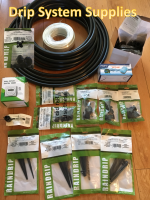
Duration: You need some way to adjust the flow to individual plants. If using the same drippers as I use, this is done by twisting the heads of the bubblers. If using Halos, you will need barbed valves on each line to regulate flow. These are pictured in my supplies photo above, but I wrote that “I did not use these†over their image.
Once the system is installed run it and wait for run-off. Run-off should appear from all pots at about the same time. Adjust flow to accomplish this. Note the time it took and establish fertigation event durations. My events are all 2 minutes long, which is about 1 quart per plant.
Frequency: You set event frequency based on factors that I describe in
my Coco guide. Generally, 2x during Veg and 3-4x during Flower. For timing events, one hour of “lights on†is equivalent to two hours of “lights offâ€. So, on my current 4x schedule, the interval between events during “lights on†is 4.5 hours, and during “lights off†is 9 hours. Timing for these events works best as I describe below:
- 1x daily: At Lights on
- 2x daily: (for 18/6 lighting) At lights on and 12 hours later
- 2x daily: (for 12/12 lighting) At lights on and 8 hours later
- 3x daily: (for 12/12 lighting) At lights on, 6 hours later, at lights off
- 4x daily: (for 12/12 lighting) At lights on, 4.5 hours later, 4.5 hours later, 6 hours later (9 hours before cycle repeats)
As always,
I welcome your questions, comments and/or suggestions. I have really loved having this system in place and I hope it makes your grow run better and smoother as well.
Grower Love!



 Aloha!