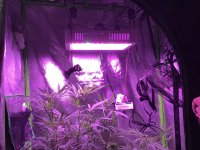
Two fixtures is almost always going to be better, as long as certain factors such as too much light or heat do not prevent it.
The main reason is light uniformity. With a larger surface area of light sources, the better light is distributed over a surface area.
Buzzers advice about true watts is correct. Because of the similarity in photon efficiency between economical LED fixtures and traditional HID light technology, means we can roughly asses an LED fixtures efficacy based on its total power consumption.
When looking at LEDs, 90% of your decision making will go towards a lights photon flux or total light energy. Rather than spectrums. 5% of that decision making will go on spectrum with respect to photosynthetic efficiency and the other 5% on plant morphology to that spectrum. But knowing that this extra 10% makes such a small difference and requires some complex understanding in photobiology to make the right decisions. It can be neglected.
Choosing how much light is important. Too little light and plants will favor a type of morphology that is not ideal for indoor environments, such as stem elongation. But too much light will lower the efficiency of light utilization by plants. So you have to find the right balance.
For optimal light efficiency, one would strive for an average of 500umols of photon flux density (not single center measurements). Which is around 30 watts per sqaure foot. For tight nugs and optimal growth but slightly less efficiency, you will aim for around 700umols averaged, which is around 35 watts per sqaure foot. The absolute maximum plants can tolerate before serious photodamage occurs is around 1000umols average. You can obtain the maximum return in this way, but at the lowest efficiency. Which is around 50 watts per sqaure meter.
Feel free to ask any further Qs and check out my articles if you havnt