
GrowWeedEasy.com
You are using an out of date browser. It may not display this or other websites correctly.
You should upgrade or use an alternative browser.
You should upgrade or use an alternative browser.
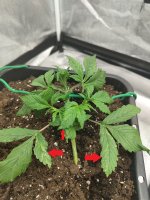
HELP! What is this on the leaves?
- Thread starter MBS1337
- Start date

Blowdout2269
New member
I'd be checking for bugs.

ChubbNugg
New member
Looks like PH. Take a run-off reading. Adjust soil PH if needed. Wait a week and see what happens. Next you can do a soil drench for any bug larvae attacking the roots. Mix 1 Once Hydrogen Peroxide to 4 Ounces of water. After the drench, Wait a week. The plant should merge to rapid growth after the drench. If it don't, I'd try a root dunk in compost tea and re-pot it. Looking closer there may be some scale bugs on the stalk. I treat those with neem oil and a toothbrush. lightly scrub the scales with the neem oil mixture.

SoOrbudgal
Well-known member
Thrips check the soil

AGH
New member
I also agree with the problem being caused by pests. Thrips are the most likely culprit or leaf miners. Look closely at your leaves, especially on the underside of them, to see if you can find anything crawling around. Then take a very close look at the top of the soil. My guess is you'll find some pupae/larvae/immature pests. But you'll have to look closely and quickly as they move pretty quick, especially on the soil since they can hide very effectively - yay evolution!
Don't feel bad about having pests though - it happens to every grower and it's often nothing that you've done on purpose. It could have been from the soil when you bought it, could have come in on your clothes, or any other number of ways.
Not knowing how you're growing, there are several very easy solutions for pests. As mentioned, if you're growing with synthetic nutrients, you can use H2O2 to kill the pests and their eggs in the soil. There are many other ways as well. However, if you're growing organic, that will destroy the soil biome since H2O2 kills everything both beneficial and detrimental. If you're growing organic, you'll want to use a multi-pronged approach (although for synthetic growing, you should as well): alternate using insecticidal soap, Neem Oil (use caution on both of these and don't use when flowers are present, especially Neem Oil, and follow all the directions on the bottles!) apply these to the top of the soil as well as the leaves as a foliar spray using all the precautions you would with any foliar spray so you don't harm the leaves, and apply Diatomaceous Earth to the top of the soil.
There are some critical points to pay attention to regardless of your method of growing: 1) You need to take action sooner rather than later - the population of pests grows exponentially! 2) Continue your pest treatment even after you think everything is dead and gone. Eggs can continue to live in/on the soil and on leaves and they just so happen to hatch when you think you've gotten everything under control then it's back to square one. Learning about the timing of pests lifecycle is pretty neat, even if they're a pain to have in your garden. 3) None of this matters if you're not maintaining a correct environment. Make sure you're managing Temperature, Humidity, Ventilation, Circulation, and Watering Practices. If you manage all of these to stay in range, it inherently creates an environment where pests and diseases can't take hold. Again, yay evolution!
You got this!
Don't feel bad about having pests though - it happens to every grower and it's often nothing that you've done on purpose. It could have been from the soil when you bought it, could have come in on your clothes, or any other number of ways.
Not knowing how you're growing, there are several very easy solutions for pests. As mentioned, if you're growing with synthetic nutrients, you can use H2O2 to kill the pests and their eggs in the soil. There are many other ways as well. However, if you're growing organic, that will destroy the soil biome since H2O2 kills everything both beneficial and detrimental. If you're growing organic, you'll want to use a multi-pronged approach (although for synthetic growing, you should as well): alternate using insecticidal soap, Neem Oil (use caution on both of these and don't use when flowers are present, especially Neem Oil, and follow all the directions on the bottles!) apply these to the top of the soil as well as the leaves as a foliar spray using all the precautions you would with any foliar spray so you don't harm the leaves, and apply Diatomaceous Earth to the top of the soil.
There are some critical points to pay attention to regardless of your method of growing: 1) You need to take action sooner rather than later - the population of pests grows exponentially! 2) Continue your pest treatment even after you think everything is dead and gone. Eggs can continue to live in/on the soil and on leaves and they just so happen to hatch when you think you've gotten everything under control then it's back to square one. Learning about the timing of pests lifecycle is pretty neat, even if they're a pain to have in your garden. 3) None of this matters if you're not maintaining a correct environment. Make sure you're managing Temperature, Humidity, Ventilation, Circulation, and Watering Practices. If you manage all of these to stay in range, it inherently creates an environment where pests and diseases can't take hold. Again, yay evolution!
You got this!
ChubbNugg
New member
I really like your comprehensive comment here. After reading yours, I can see how much info I left out of mine. It was like I automatically assumed people already know so much. I'm now feeling more educated from it and can see how low the quality of my comment is. Very interesting to me! It was not my intention to mislead, but reading back over my post, well, it kinda looked like that. sorry. I'm new to forums. I'm sure my writing will improve, even if it weren't one of my strong points.
