Preferably a 3x3 grow space.
I grow in a 4x4, and can fit four 3gal containers in there (with fairly large plants). A 3x3 simply has 6" less all the way around. You could probably do the same (but, not quite as large.). Your yield will depend on the strain, the soil/nutrients, the light. I stopped weighing my harvests a few years ago. I could get a pound and a half. But, (those are strains like Big Bud, that are heavy yielding.).
IMO light is one of the biggest factors. Your two "1000w" fixtures use 185w each. That gives you 41w/sq ft. That sounds reasonable for that type of fixture. But, in mid to late flower, if you can supplement with sidelighting to bring it up to 50w/sq ft, you can get *a lot* of bang for the buck. Spreading the watts around the plants that way creates an efficiency you simply can't get by adding more watts to the top. Better coverage, angles. Plus, the inverse-square rule is powerful. If you use lower-watt sources of light (like 9w LED lightbulbs) you can put that light very close to the plant. Compared to light from the top reaching lower leaves, that can be 8 times as much light reaching the plant (simply due to the inverse square). For example, if you had a 9w bulb attached to a tent leg, and 6" from the plant, and moved it to the top, which would be 24" from that same location (where light might is needed more), moving it 12" from that location results in on 1/4th the amount of light reaching that location. Move it anther 12" and it's 1/4th the light *again*. 1/16th the amount of light. (In reality, the light will fall on the upper most part of the plant. It won't really be lost that much. But, it's not needed there as much. Those leaves are already being driven by top-light. If you can get light to the underutilized leaves, it's *leverage*. I grow plants entirely with lightbulbs (sometimes, I'm doing one now). I can get great results with just 20w/sq ft. Not because lightbulbs are great. But because I'm spreading the light around, distributing the watts, at lower levels from more places, closer to the plant. It really compounds that way.
So, I would try doing that if I were you. Attach two 9w LED lightbulbs to your tent legs as sidelighting. It sounds hokey. Lightbulbs aren't sexy. But, it works well. In this case you'd be adding 8 bulbs to the tent, 72w total. That would put you up to 49w/sq ft. In mid-flower use one bulb per leg. In late flower turn on each leg's 2nd bulb.
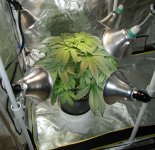
Attached is a photo showing how I do it using $7 USD clamp-on reflectors from the hardware store attached to 3/4" PVC couplers (which slide up/down the leg, and the reflector sockets can pivot and recess into the corner for maximum space conservation). I have that documented in a PDF, how to make it. (I add addtional "legs" in the midway point between the tent's legs. You can see one on the right side of the photo. It's a PVC "T" cut in half and sliding on the lower part of the frame. 1/2" PVC pipe going to the top where another "T" rides on the frame.). I don't think I can attach the PDF here. If you want it, PM me.
Sidelighting (whether ligtbulbs, or single-tube T5HO, or DIY strip lighting) will improve your yield greatly. Also, I should mention that I cut the plastic diffusion globe off the LED lightbulbs. That's what makes them works so well for me. The diodes are surface mounted to the base of the bulb. Removing the diffuser is *instant* directional light (for 15 cents per watt). You don't even need a reflector. It helps a little. But, not like it would an omnidirectional bulb like a CFL. It's really decent light considering the watts, cost and directional nature.



 but ill do my best to pitch in if you have any more questions
