
GrowWeedEasy.com
You are using an out of date browser. It may not display this or other websites correctly.
You should upgrade or use an alternative browser.
You should upgrade or use an alternative browser.
Spots
- Thread starter RyanT
- Start date

Canyon Grower
New member
Are all the leaves like this one? If its just a scattering and low on the plant, meaning older leaves, I wouldnt worry much.
yamiacaveman
New member
Hi Ryan T,
I had two leafs on one plant get a few brown spots on them, they looked like your spots but mine were less but a little bigger. Anyway the next time I watered I did add a very light dose of cal-mag, the rest of plant good. I don't know if the cal-mag helped but it was just those 2 leaves. But of course I worried and waited, nothing happened, and about a week ago I cut them off cause they were blocking the light to the buds.
My girls are in Kind Soil.
I'm also new at this, so I suggest you seek others advice.
I had two leafs on one plant get a few brown spots on them, they looked like your spots but mine were less but a little bigger. Anyway the next time I watered I did add a very light dose of cal-mag, the rest of plant good. I don't know if the cal-mag helped but it was just those 2 leaves. But of course I worried and waited, nothing happened, and about a week ago I cut them off cause they were blocking the light to the buds.
My girls are in Kind Soil.
I'm also new at this, so I suggest you seek others advice.

Have you checked for bugs? Another thought is perhaps you spilled something on the leaves or used a foliar spray when the lights were on? That might cause small brown spots.
If it's a deficiency, have you been checking the pH? The pH being too high or too low is the most common way to get nutrient deficiencies. In soil the pH should be between 6-7.
Is is possible to post a picture of the whole plant in the setup? Sometimes that has some extra clues
If it's a deficiency, have you been checking the pH? The pH being too high or too low is the most common way to get nutrient deficiencies. In soil the pH should be between 6-7.
Is is possible to post a picture of the whole plant in the setup? Sometimes that has some extra clues

PigSquishy
New member
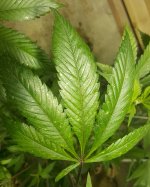
When I blew up the photo to really take a closer look at it, there is a very clear point that those aren't just spots, that is a crater in your leaves and there is actual depth to the removal of the leaf itself, I would take this 100% very seriously because it means one thing... YOU HAVE A BUG! Just a personal guess here looking at it and knowing its on the lower leaves, I am going to guess Aphids and the way to know for sure is to look when it's dark. I like to wait until the hour before lights on and go in there with a flashlight, keep in mind they are extremely small creatures and will try to run when the lights hit them. That is what you watch for, depending on the type they can vary in colors, but they will run for the base of the base and hide under the leaves. There is a few ways to attack them, when I read a good book on them it pointed out to use a different product each time you spray for them, which is where I always ran into a problem with them. The short of it is that aphids will learn to adapt and neutralize toxic chemicals to them, so if I use one product to kill them this time, then I use a different type of a product to kill them the very next time I spray, so it's never the same thing twice in a row.
The other thing which it could be is some sort of a mold, but when mold strikes it can sometimes look what you have, but it is more common to hit the entire plant, where aphids tend to hit the lower leaves and keep working their way higher and higher. If memory is correct one aphid can lay 10,000 eggs a week... so it may not be an issue for you today, but in a couple of weeks it could be a huge issue if you don't kill them outright. Just make good and sure you don't just listen to me and not make good and sure first you confirm I am right when it comes to a pest or mold, better to pull out a magnifying glass, take an up close detailed photo of the pest and double check to make sure you are treating for the right pest, right problem so you can go at it as aggressively as possible early on verses having a real issue to fight with later on.
The other thing which it could be is some sort of a mold, but when mold strikes it can sometimes look what you have, but it is more common to hit the entire plant, where aphids tend to hit the lower leaves and keep working their way higher and higher. If memory is correct one aphid can lay 10,000 eggs a week... so it may not be an issue for you today, but in a couple of weeks it could be a huge issue if you don't kill them outright. Just make good and sure you don't just listen to me and not make good and sure first you confirm I am right when it comes to a pest or mold, better to pull out a magnifying glass, take an up close detailed photo of the pest and double check to make sure you are treating for the right pest, right problem so you can go at it as aggressively as possible early on verses having a real issue to fight with later on.
PigSquishy
New member
As you can see the damage from them is very concentrated, and you can clearly see in this enlargement of your photo that the "spots" are in fact craters of removed plant material.
Nice... thank guys.. and green thumb. . . I'm pretty sure you're right. My friend runs a dispensary grow in Washington and he said the same thing when i posted the image on fb .. right of the bat he just said .. root aphids... and that i need to do some flushing and spraying. I have an all purpose spray that i made myself.. it's neem oil, rosemary oil, tea tree oil and isopropyl alcohol mixed with water... normally i spray preventativly ever since i got mites about a year ago.. once a week but i haven't used it in a month or so... ofcourse i started spraying a couple of days ago... im pretty sure i found some microbug carcasses last night when i went to water.. im gonna go ahead and say it's root aphids.. and I'm pretty sure my all purpose spray will kill them off. I will repost in a week or 2 and let u guus know if any new spots pop up.
Thanks everyone!
Thanks everyone!
PigSquishy
New member
I tried a few things, but then I tried Ed Rosenthal's Zero Tolerance which covers the molds as well as insects, wiped out my aphid issue and it says it will take care of mites too by spraying 3-times 3-days apart... All I know is the last thing you want is aphids getting a foundation in your growing area, when I read up on them in detail I learned some crazy things about them. Such as one when it comes to aphids their natural defense is to taken in toxins and neutralize them, they can adjust their DNA over time by generations eating the harsh toxin to become immune to it, other toxins they can eat and then neutralize inside their bodies... it is their natural defense in nature. Thus why you can spray your spray and kill them off this time, and maybe only one of a million might survive it, but the one who survives will then create offspring who can survive it and in no time you'll be faced with a force which your spray could have no effect on, which is where I myself ran into an issue this year as I've never had any personal long term dealings with them before. I assumed and thought after a couple sprayings they all died, little did I know they didn't and when I would see them again my sprays would have ZERO effect on them! Hence what brought me to do so much more detailed research on them and why I do strongly encourage you to do the same, as I wished someone would have told me at the onset of these insects.


Is it possible to get a picture of the bug? That makes it so much easier to treat. Can you see any bugs or eggs under the leaves or in the soil if you check closely with a magnifier? I've not seen root aphids before but it doesn't really look a whole lot lot like spider mite damage (one of the most common pests). Maybe thrips?
PigSquishy
New member
When I got hit by aphids myself I searched high and low for the pest that did this exact damage to me, all I could ever find was the damage, because unlike thrips, mites, etc... the aphids are soft bodied and have no real protection from predators. In fact they are commonly herded by ants to get the sweet byproduct the aphids leave behind, but when not accompanied and protected by ants, the aphids will really hide seriously well. So well in fact that I've learned if they aren't out at the time I am going to spray them, I won't even spray for them. I'm not sure exactly how long after lights out before they come out in hoards, but when they are out and everywhere they are still super hard to see and find. I shine an LED flashlight on all the leaves about an hour before lights on and really look for them on all lower leaves for 5-10 minutes over and over the same leaves... suddenly you think you might have seen something move, and sure enough you'll see a tiny little fleck of glitter in the light moving towards the plant's stem... then you will have confirmation you got aphids. I've tried taking photos of mine to help show others for situations like this, but because the two I've dealt with are transparent or green (green peach aphids) they didn't show up in the photos, according to the book "Marijuana Pest & Disease Control" by Ed Rosenthal he points out there are thousands of types of aphids, and they aren't longer than 1/8" or 3mm long. I trust Ed Rosenthal as a source because he has written scientific papers on other things such as the preying mantis and other insects, so I do trust him not just as a well known and well respected cannabis author, but also as a scientific author and source for information as well.
Part of what makes aphids so overwhelmingly powerful is you don't typically spot them early enough until the next step is going to be curled leaves for no apparent reasoning, the leaves will just start curling and when you look there isn't any real apparent issue, which tends to lead people to think it's to high in fertilizer concentration. I know once a leaf curls they are swarming that leaf and others near it, so I will remove them as soon as I spot anything like that. Now when I've removed leaves I have learned to put them into a bowl of super hot soapy water so anything doesn't escape, that is the only time I've ever seen them wake up during the light and move, but if you don't have the hot soapy water they try to escape the bowl and get back into the environment to get back to the plants. Because they are so small and like to hitchhike, I will take off all clothing to go straight into the wash, and then go shower making sure you treat your clothes like you were contaminated by something horrible, because they are truly great hitchhikers. They will even grow wings to fly to find the next food source and start a new colony, they are determined.
Once I know I have seen signs of them, I wait until an hour before lights on I check for them and even if I don't see them but just have a gut feeling I think I see these little spots of honeydew on the surface of the leaves, I know enough to start treating and spraying for them. The best thing you can honestly do is study up on all your pest for cannabis crops, because it is better to avoid them, prevent them, and kill them really early on if you get them or suspect you might have them, than it ever is to try to wipe out an infestation once its found a way to get set in.
Part of what makes aphids so overwhelmingly powerful is you don't typically spot them early enough until the next step is going to be curled leaves for no apparent reasoning, the leaves will just start curling and when you look there isn't any real apparent issue, which tends to lead people to think it's to high in fertilizer concentration. I know once a leaf curls they are swarming that leaf and others near it, so I will remove them as soon as I spot anything like that. Now when I've removed leaves I have learned to put them into a bowl of super hot soapy water so anything doesn't escape, that is the only time I've ever seen them wake up during the light and move, but if you don't have the hot soapy water they try to escape the bowl and get back into the environment to get back to the plants. Because they are so small and like to hitchhike, I will take off all clothing to go straight into the wash, and then go shower making sure you treat your clothes like you were contaminated by something horrible, because they are truly great hitchhikers. They will even grow wings to fly to find the next food source and start a new colony, they are determined.
Once I know I have seen signs of them, I wait until an hour before lights on I check for them and even if I don't see them but just have a gut feeling I think I see these little spots of honeydew on the surface of the leaves, I know enough to start treating and spraying for them. The best thing you can honestly do is study up on all your pest for cannabis crops, because it is better to avoid them, prevent them, and kill them really early on if you get them or suspect you might have them, than it ever is to try to wipe out an infestation once its found a way to get set in.
PigSquishy
New member
I would freely share everything I know with others in as great of detail as I can use to describe with the hopes of driving important points across, so as long as I know I've been able to help someone else with it. The one year I got hit with tent caterpillars and I was just going to spray for them until I had a friend take me for a drive and show me what they can do to an entire tree, suddenly I realized that it was much cheaper and easier to kill and lose what I did than ever chance one of those things from finding the slightest foothold anywhere near anything I am trying to grow.
Perhaps I should have told you this before, but understand this clearly... You will have to do more research on your own to understand this, I got my information from Harley Smith's Grow Class and some other lectures (some of them are on YouTube) I've taken in of his to help me understand the important role of "Silica" plants in battling insects and how important of a role a Brix Meter can also be in reading a plant. I'm going to try to sum all this up for you and if you want to know more I encourage you to do some Google searching for yourself, I am seriously learning myself.
Okay so what I learned is that Silica strengthens a plant's walls making it harder for insects to attack, when I wanted to look for proof to back up this claim I looked to a products like Rhino Skin and others and sure enough I found the word "Silica". Interestingly enough I got that, and understanding how a plant can get to much of a good thing and get sick or not get enough of another and get sick I do understand the proper balance of nutrients for a plant. When Harley started talking about a Brix Meter and anything over a Brix of 12 is said to be "Not even seen as a food source anymore to an insect" I serious was all ears. What a Brix Meter is basically is it measures the sugars inside the sap of a single leaf you cut off and squeeze the juice out of to measure to find the Brix Level. The level then tells you how happy or not happy the plant is, and the only other thing you can do is determine the Nitrogen Levels in the plant by how foggy or firm the line is on the Brix Meter that forms to tell you your level. All in all it sounded so good in all honesty I ran out to try to get one, but things didn't work out that way for me so I took it another approach which I am comfortable enough doing after a lot of years working with plants.
So what I did was I begin to plant with the individual nutrients for some of my plants to see what would happen, in my case I was able to battle off grasshoppers, thrips, sweet ants, and another pest I saw only one time and I am not sure of the name of. What I do know is I was able to do something right on the plants I was playing around with based off from what I learned about nutrients in Harley Smith's lecture on "Full Plant Nutrient Rundown by Harley Smith (Parts 1/2)". I did not get aphids on any of these plants, and what happened is this... I had a peach tree and suddenly in the late spring, early summer it just one day lost all its leaves and died, shortly after I would start learning from Harley's lectures. By fall I would see the grasshoppers and such all over the plants, neighbors were losing all kinds of stuff to them, they were on my plants but not a single bit of damage, those who tried weren't even breaking the surface of the leaf to get the first bite, I watched them move on and I couldn't believe it. Late fall I would see what I would find are "green peach aphids" on the apple tree, wanting to see if they could do anything I left them it was getting cold and it would kill them so I didn't see the need to take further action against them at the time.
What I did not know is they are hitchhikers and came into other indoor buildings and moved onto other plants until they could get onto a plant they would much rather prefer. Something I myself did not know at the time, so everything I was trying to kill them on one house plant they hitched a ride to the next looking for something more to their liking, and by the time I discovered them I would have no idea how many would actually already be there having themselves had millions and millions of babies. When I saw damage from something I sprayed the same insecticidal soap mixture I've been trusting and using for years to combat anything I face as a primary first step, never did I realize they were building up a tolerance to it.
Since they are clear and only come out at night, freeze in the light unless it stays on them for too long then they make a run for it to go back and hide... when was I supposed to be looking for this clear glitter all over my plants that walks? You see dew on a plant before the sun rises, you don't exactly go running for the pesticides... but now that I've learned the hell they can cause, I know if they or any other trouble maker shows up in my gardens go after them with everything you have. Seriously that insect/bug sees its single food source as your crop, it will fight to the death for that food source, the question is do you want to come to the battle intending to win the battle or the war? I learned some painful lessons to go after and kill this pest, unlike slugs who I just pour a can of beer into a pizza pan on the ground and let them come drink themselves to death during the night.
Perhaps I should have told you this before, but understand this clearly... You will have to do more research on your own to understand this, I got my information from Harley Smith's Grow Class and some other lectures (some of them are on YouTube) I've taken in of his to help me understand the important role of "Silica" plants in battling insects and how important of a role a Brix Meter can also be in reading a plant. I'm going to try to sum all this up for you and if you want to know more I encourage you to do some Google searching for yourself, I am seriously learning myself.
Okay so what I learned is that Silica strengthens a plant's walls making it harder for insects to attack, when I wanted to look for proof to back up this claim I looked to a products like Rhino Skin and others and sure enough I found the word "Silica". Interestingly enough I got that, and understanding how a plant can get to much of a good thing and get sick or not get enough of another and get sick I do understand the proper balance of nutrients for a plant. When Harley started talking about a Brix Meter and anything over a Brix of 12 is said to be "Not even seen as a food source anymore to an insect" I serious was all ears. What a Brix Meter is basically is it measures the sugars inside the sap of a single leaf you cut off and squeeze the juice out of to measure to find the Brix Level. The level then tells you how happy or not happy the plant is, and the only other thing you can do is determine the Nitrogen Levels in the plant by how foggy or firm the line is on the Brix Meter that forms to tell you your level. All in all it sounded so good in all honesty I ran out to try to get one, but things didn't work out that way for me so I took it another approach which I am comfortable enough doing after a lot of years working with plants.
So what I did was I begin to plant with the individual nutrients for some of my plants to see what would happen, in my case I was able to battle off grasshoppers, thrips, sweet ants, and another pest I saw only one time and I am not sure of the name of. What I do know is I was able to do something right on the plants I was playing around with based off from what I learned about nutrients in Harley Smith's lecture on "Full Plant Nutrient Rundown by Harley Smith (Parts 1/2)". I did not get aphids on any of these plants, and what happened is this... I had a peach tree and suddenly in the late spring, early summer it just one day lost all its leaves and died, shortly after I would start learning from Harley's lectures. By fall I would see the grasshoppers and such all over the plants, neighbors were losing all kinds of stuff to them, they were on my plants but not a single bit of damage, those who tried weren't even breaking the surface of the leaf to get the first bite, I watched them move on and I couldn't believe it. Late fall I would see what I would find are "green peach aphids" on the apple tree, wanting to see if they could do anything I left them it was getting cold and it would kill them so I didn't see the need to take further action against them at the time.
What I did not know is they are hitchhikers and came into other indoor buildings and moved onto other plants until they could get onto a plant they would much rather prefer. Something I myself did not know at the time, so everything I was trying to kill them on one house plant they hitched a ride to the next looking for something more to their liking, and by the time I discovered them I would have no idea how many would actually already be there having themselves had millions and millions of babies. When I saw damage from something I sprayed the same insecticidal soap mixture I've been trusting and using for years to combat anything I face as a primary first step, never did I realize they were building up a tolerance to it.
Since they are clear and only come out at night, freeze in the light unless it stays on them for too long then they make a run for it to go back and hide... when was I supposed to be looking for this clear glitter all over my plants that walks? You see dew on a plant before the sun rises, you don't exactly go running for the pesticides... but now that I've learned the hell they can cause, I know if they or any other trouble maker shows up in my gardens go after them with everything you have. Seriously that insect/bug sees its single food source as your crop, it will fight to the death for that food source, the question is do you want to come to the battle intending to win the battle or the war? I learned some painful lessons to go after and kill this pest, unlike slugs who I just pour a can of beer into a pizza pan on the ground and let them come drink themselves to death during the night.