

GrowWeedEasy.com
You are using an out of date browser. It may not display this or other websites correctly.
You should upgrade or use an alternative browser.
You should upgrade or use an alternative browser.
So, what all happens during the stretch after start of flowering?
- Thread starter growsomebuds
- Start date


growsomebuds
New member
So, does this 'stretch' refer to the limbs getting thicker, and the distance between nodes increasing. But, no actual new nodes or any new leaves?

Chefbjy
New member
There will be more leaves...they tend to stop growing new leaves at around 4 weeks into flowering. Here's some more info. https://www.growweedeasy.com/flowering-stretch
growsomebuds
New member
Thanks for the link.
Chefbjy
New member
I love watching time lapses. Campesino you should put them all together from start to finish.... I'd love to watch. There's a lot of them on YouTube but a lot has to do with the grower and how well they maintain their grow. Under optimal conditions they are fun to watch.
https://youtu.be/GL5BNwkjj68
https://youtu.be/GL5BNwkjj68

Greengringo
New member
I just want to start off by saying congrats to campesino on his silver haze making it on gwe's newsletter last week great job mate and as for the stretch topic everything everyone said before me is accurate and my two cents... temp variations will give you a larger stretch between nodes 4c difference if what I'm reading is accurate.


DrPhoton
New member
I dont actually know the science of the stretch, if anyone has any resources detailing this phenomenon i would be much interested. However because it appears to happen in most environements and strains, although with variables on how much. I would say that this is a genetic expression that haopens to promote sexual reproduction. This would make sense as research has show that certain branching structures are more efficient at sexual reproduction than others.
However it could also be from the reduced light cycle from the flower cycle. More dark means less blue, so the photoreceptors responsible for certain morphological properties has changed. Less blue means the plant will elongate more in search of this wavelength of light. Its only natural.
Certain factors that effect the flowering stretch are lighting. Many people switch lighting equipment to a spectrum with less blue. This is especially the case with sodium discharge. The lack of blue or less blue compared to vegetation spectrums, promotes less suppression of elongation. Because blue wavelengths are highly responsible for photoreceptors that create photomorphological changes. So keeping the vegetation spectrum on for another two weeks can help to prevent further stretching due to blue light wavelengths. But low intense light can also promote elongation, so make sure your not exchaning high intense light for more blue that has low intensity. You could take it a step further by adding additional blue light sources to promote less elongation, but just be careful not to over saturate your plants with light.
Genetics might obviously have a role to play, so choosing a strain that might not stretch as much during this switch could help prevent elongation even more.
Ventillation may help to promote strenthening of stems and directing energy into stocking and thickening rather than cell division with elongation.
Nutrients could also affect how a plant responds, as during elongation plants consume large amounts of macro nutrients, specifically nitrogen and phosphorus. So by reducing nutrients available to plants you could potentially reduce stretching.
Training and pruning are techniques that can br used to reduce the effects of stretching by manipulating the plant into a shape of your choosing. Also reducing the vegetation time can help to maintain a ideal height for your environement.
Another factor that affects stretching is temperature differences between day and night. When daytime temperatures within our grow space are much higher than those at night, plants are induced to produce more gibberellin, causing them to elongate considerably. By reducing the temperature difference you can downregulate the production of gibberillin and reduce elongation. You can take it even further by creating a negative difference where night temperatures are higher than day temperatures.
Hope this helps any
However it could also be from the reduced light cycle from the flower cycle. More dark means less blue, so the photoreceptors responsible for certain morphological properties has changed. Less blue means the plant will elongate more in search of this wavelength of light. Its only natural.
Certain factors that effect the flowering stretch are lighting. Many people switch lighting equipment to a spectrum with less blue. This is especially the case with sodium discharge. The lack of blue or less blue compared to vegetation spectrums, promotes less suppression of elongation. Because blue wavelengths are highly responsible for photoreceptors that create photomorphological changes. So keeping the vegetation spectrum on for another two weeks can help to prevent further stretching due to blue light wavelengths. But low intense light can also promote elongation, so make sure your not exchaning high intense light for more blue that has low intensity. You could take it a step further by adding additional blue light sources to promote less elongation, but just be careful not to over saturate your plants with light.
Genetics might obviously have a role to play, so choosing a strain that might not stretch as much during this switch could help prevent elongation even more.
Ventillation may help to promote strenthening of stems and directing energy into stocking and thickening rather than cell division with elongation.
Nutrients could also affect how a plant responds, as during elongation plants consume large amounts of macro nutrients, specifically nitrogen and phosphorus. So by reducing nutrients available to plants you could potentially reduce stretching.
Training and pruning are techniques that can br used to reduce the effects of stretching by manipulating the plant into a shape of your choosing. Also reducing the vegetation time can help to maintain a ideal height for your environement.
Another factor that affects stretching is temperature differences between day and night. When daytime temperatures within our grow space are much higher than those at night, plants are induced to produce more gibberellin, causing them to elongate considerably. By reducing the temperature difference you can downregulate the production of gibberillin and reduce elongation. You can take it even further by creating a negative difference where night temperatures are higher than day temperatures.
Hope this helps any
growsomebuds
New member
How much stretch depends on the strain, I've learned.
growsomebuds
New member
growsomebuds
New member
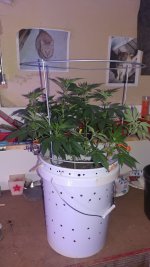
I may have to top one or more inner colas to control their height. Or try super-cropping for the 1st time. Right now, there are 15 colas.
buffalobuds
New member
DangerDan got it right. Every factor can influence the final outcome. I am growing 4 of the same auto, all came up same time everything identical. They range in inches at 7 weeks old - 19- 22- 27 - 32. Also every nite the tallest one's leaves droop at sundown, to be up reaching for the sun in the AM.