What's new
GrowWeedEasy.com
You're browsing as a guest. Sign up to join the conversation, share your grows, and get help from thousands of fellow growers — it's free and takes less than a minute.

HELP! PPM runoff lower 2 feedings in a row! Yellow leaves signs of nute burn?! What gives?

rangerjake

New member
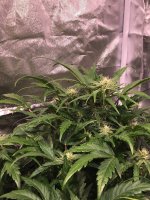
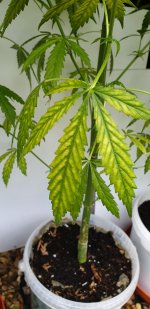
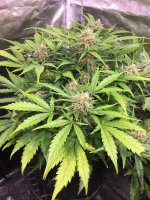
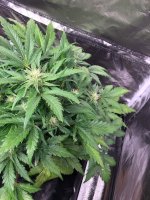
Getting a touch spooked here. My WW autos are about 3-4 weeks from harvest window, about 4 weeks into flowering (day 50 overall) and have seen some rapid yellowing with brown spotting.

The feedings were about every other day alternating nutes and H2O but I have moved to daily nute feeding until I feel comfortable that these plants are getting what they need at this crucial moment.

Yesterday the feed was at 540ppm with runoff at 508 and 366 for my two plants.
Today the feed was at 690ppm with runoff at 585 and 534 for my two plants.
Runoff pHs are in suitable ranges; 5.6 for the greener one, 6.2 for the yellower one.

Grow details:
60/40 coco perlite

GH suite currently feeding:

2.5ml calmag
2.5ml micro
4ml bloom
4ml Koolbloom

just transitioned to this schedule from

1.5ml ArmorSi
2.5ml calmag
2.5ml micro
.6ml gro
3ml bloom
1.5ml koolbloom
2.5ml Nectar
1ml Rapid start
 

Attachments

  • photo81954.jpg
    photo81954.jpg
    947.1 KB · Views: 1
  • photo81955.jpg
    photo81955.jpg
    1 MB · Views: 0
  • photo81956.jpg
    photo81956.jpg
    912.8 KB · Views: 0
Really? Two weeks would have me keeping .6ml/gal until my ripening week and flush week. I am more or less on target for two different coco/GH schedules, and this yellowing started fast about 5 days ago- though the more yellow plant was always a lighter green. I figured with the minor clawing (visible in 2nd photo) and the fact that there has not been any N deficiency so extreme that it has caused any leaf loss except for the very first serrated leaves at the bottom that it would be something else.

N has been added into every feeding up until 2 days ago. Yesterday was the first aggressive bloom feeding.
 
If I'm looking at two plants, the one with yellowing is starving and the dark green plant has toxicity.
According to your ppm's and ph the yellowing plant needs more nutrients, around 800 to 900ppm and is in the right ph. Most likely the low Ph (5.6) is contributing to the dark green plants toxicity.
Even with the plant being the same "strain" it doesn't mean they have the same cookie cutter nutrient needs.
Just my opinion from the pictures and details.
Good luck.
 
I agree with @mr furley. When I grew with GH Flora series in peat, my runoff ppms were much higher. My nutrient solution itself was 1000-1200 at your stage of growth.

I followed the so-called "Useless schedule." I'm new here and don't know if I can post links. But, if you google for it, you'll find it on "growkind" titled "GH 3 part - Useless' formula."

I followed that schedule precisely. I got some nute burn at times. If I did it again, I would back it off 10%.
 
Last edited:

That looks like mg def (and maybe the soil is too poor draining, staying too wet. Or, you're watering it too frequently instead of letting it go through complete wet/dry cycles). I would add 1/2 to 3/4 tsp Epsom salt per gallon next time you feed. But, if the soil is slow-drying and you don't want to wait till the next feeding, you can mix 1/2 tsp/gal and spray it on the leaves (foliar application). Don't do it under strong lights, the droplets will act like a magnifying glass and cause burned spots.

The damage won't recover. It will just stop getting worse.

PS: It's probably better to start a new topic instead of adding onto someone else's.
 
I appreciate your take, I am just trying to distill down how to best rectify two plants that have been operating under the exact same variables and have moved to opposite ends of the spectrum. Hardly saying every plant is cookie cutter and needs the same as every other, but up until the last week or so things have been relatively par between the two. So am trying to get a handle on why one plant is one way and another is another. Here is results from feeding this morning:

2.5ml Calmag
2.5ml Micro
.6ml Gro
4ml Bloom
4ml KoolBloom

687ppm.
Yellowing plant got 687ppm @ 5.7ph with runoff at 6.4ph and 608ppm
Greener plant got 687ppm @ 6.4ph with runoff at 5.6ph and 550ppm

I guess I will bump up the ppms next go around across the board. Maybe at 1.5x where it's currently at to yield around 900ish. See what that does at least for the yellower of the two.

For the greener one when you say "toxicity" what are you referring to? Blanket nutrients? Specific nutrient? Clearly from runoff it is retaining the least nutrients in the medium. According to nutrient uptake charts only Manganese gets utilized above 5.5 but below 6. All others either get taken across the 5.5-6.5 spectrum, or just below 6.5, or are 6.0 and above (Cal Mag). So do you think this is a Manganese toxicity? I plan to keep feeding it with higher ph nutrients to try and drag that root ph back up, but I have found (and read the same from others) that in coco it is really hard to dramatically move the needle with root ph.
 
rangerjake, I have a spreadsheet which lets me figure out the NPK ratio resulting from mixing multiple products. (I actually made it back when I was using GH Flora 3-part. I wanted to see how the so-called "Useless" schedule compared to GH's recommended "3-2-1" schedule -- or 1-2-3 in flower. This playing around with things got me to start growing in soil and managing my NPK ratio using various inexpensive soil fertilizers.). I plugged your last feeding (in your comment above) into my spreadsheet. Assuming you use the liquid Kool Bloom, and Botanicare's Cal-Mag+, the NPK ratio is 1-3.2-3.2. (Or, if you purchase a product mixed the way you've mixed these things, it would have a label 1.4-4.4-4.6.). My calculated strength of your mix is 401-536ppm. (This calculation is a bit dubious. The lower value is elemental P & K. The higher value reflects the compounds those elements are bound up in as P2O5 & K2O. The reality is somewhere in between. I just use these numbers for comparing strengths mixing things the other way. I don't expect it to actually measure either way. Just for eyeballing in the spreadsheet. Your water starts with some ppm. That would explain why your result is higher than either of these calculations.).

Anyway... that's not a good NPK ratio for your stage of growth. That's pretty high PK. Like, "booster" level.

The "Useless" schedule calls for 3 or 4 Grow, 8 Micro & 16ml bloom.

That's NPK ratio: 1-1.52-1.7 (705 to 875ppm)
or 1-1.48-1.75 (729 to 903ppm)

(depending on whether you use 3 or 4ml Grow)

I wouldn't use Koolbloom. If I did, I'd use it near the end of flower, once or twice. Cut the base nutrients in half.

I also wouln't use "calmag." I think that stuff's overused. If you're using RO water as your base, then perhaps a small amount of calmag would be wise to put minerals back into the water (make it about 150ppm). But, you can do the same thing with epsom salt and disssolved gypsum. (I can tell you more about how to do that). It's cheaper, won't add nitrogen (which may not be bad, but the nitrates typically in "calmag" products are acidic.). Maybe since you're growing soilless, calmag makes sense. In real soil, I wouldn't use it. I'd use epsom and dissolved gypsum.

=======================

Regarding one plant looking nitrogen toxic: maybe that strain isn't as heavy a feeder. You might have salt buildup in the medium, causing it to have more acidic runoff. (I got some N toxicity from the "useless" schedule, probably due to how strong that schedule is. Not necessarily the NPK ratio being too high with N.). I wouldn't worry about it. That extra N stored in the leaves is probably helping that plant from the too-high PK you're feeding now. You could continue to feed that plant weaker. But, if you follow the "useless" schedule, the N is going to go lower (as a ratio).
 
I would not doubt that more then one Nute is the problem, I'm looking at nitrogen for that dark green shiny leaf plant with the clawing. Nitrogen can be absorbed below 5.5 and above 6.5

I remember your were asking about ph abit ago, did you flush? Did you use a flushing agent? And how much runoff do you get every watering, 10%? 20%? Were your plants doing bad before you moved your watering schedule?
 
Mr.furley yeah I flushed all plants with FloraKleen and it did a lot to restore some nutrient buildup that was happening in my Autos and Blue Mystic. All those numbers are now actually showing more deficiency than buildup. For the first time ever today my BM came out below the feeding ppm (835 going in and 718 coming out). Usually (and as recent as yesterday) my runoff from plain ph water was 1195 for BM. Rasp Cough has been solid and consistent in the zone throughout. pH always around 6.2-6.6, runoff always between +5 and +300 ppm.

I water to runoff almost every time. I achieve no less than 10% when I do, and usually 20% easy. The plants have been mostly fine. Some leaf damage from running too much of a breeze, some issues related to heat and humidity, but nothing as widespread and uniform on a given plant as the yellowing on that one auto. Which started within the week.

I changed my routine from the "fertigation" plan about 3 weeks ago, when my nutrient buildup issue was at it's worst, to an alternating feed/plain water. Up to this point the new routine (which was the old routine for the earliest stages) has been only beneficial. But maybe I just need more nutrients per feeding if I am going to do plain water every other time. Or do a few feedings in a row and then a plain water. Potentially the plain water strips too much from the medium at that frequency for my current nutrient quantities to replenish? Hard tellin.
 
rangerjake

I know that you are far alone in this grow and at a point trying to change too much will cause more work then need plus the possibilities of more harm then good.
You will get to the finish line here and most of this advice is for a point of hashing out the bumps In the road in hopes to help it from happening again.

Changing up the styles of watering has probably not been the best for the plants, cannabis is a little picky and likes to stay with a regular environment. Watering different ways in Coco has its advantages as well as its disadvantages for the environment they live in and neither one of them are wrong. Either way you try will work but you should try and stay with one style though a grow to rule out that being a problem.

When you flush, with or without a flushing agent make sure to use a ample amount of water in one go.
Examples: I have a 5 gallon pot, feed only Day's is 1 gallon and a half, water only is always 2 gallons, if I flush for a problem I will use up to 6-10 gallons of plain PH'ED water in one go checking each gallons new runoff, catch the first bit you can.
Cannabis has a little hiccup about the second or third week of flowering for autoflower and at about week third to fourth week for photoperiod. My opinion on this matter is that the plant is changing gears and it's need for nutrients swing leave the coco with unwanted nutrients and sends the Ph out of whack.
I found that a good Ph water only flush in the 2nd/3rd week helps strip the medium clean for a restart, you csn use your flushing agent at this point as well. I will double up on bloom and drop my grow the following feed then resume my normal schedule for the flowering need.
I see a lot of PH problems on plants in the 4th week of flower and after fighting ph problem in Flowering a couple grows, I have just add this flush and feed shift to my routine. Call it Cannabis puberty.

I do want to remind you that I practice Strip and feed with my grows, so I alternate feedings with water every 2 to 3 days. depending on how you are going to finish this out I would think a good flush would help the plants with the toxicity and the up and down ph problem but I still stand by the upping the nitrogen for a week on the yellow plant.

The micromanaging has its place but is a lot of the reason I have stop messing with ppm's and just started looking at the plants over all health, if I see a problem I start digging or add/take way/flush. a lot of problems stem from people trying to change something in anticipation. Not knocking the style, it has its place with large grow opps. And what not, my style has just been simplified to look at the plants for they need and keep a regular schedule..


Hope this chat at least gives you some ideas to ponder and most importantly I hope this helps.
 
Last edited:
Mr.furley I do appreciate the time and thoughts. Also totally understanding of shifting feeding regimens throwing the plants off a bit. That could totally be the case. One thing I haven't had an issue with is a fluctuating root pH. Not to say that my root pH's have been on point throughout, but each plant seems to have held solidly within .2 to .4, the latter being the most extreme swing any plant has done throughout the grow.

As for the ppms and whatnot this is my first grow where I have taken careful time to document this stuff. Really it is just a way to gauge roughly what I am giving my plants compared to others who have used similar schedules/GH line. Last year I was outdoors, in soil, and using Fox Farm. This year indoors, in coco, using GH. Anyway, the ppm is less gospel for me than just a quick way to explain and document my feeding, what's too much, not enough, etc.

I think I got a couple ideas for how to rectify things and will be employing them over a few days. Will be interesting to see the results, come what may.
 
So it's been a bit over a week and here's how things have gone:

The strength of feed for the AFs has been increased, N added back in, and following the Useless GH forumla. I won't get into the "stress" of changing things for the plants- I wanted to up the PPMs to see if I could make these things runoff greater than their feed.

3 different feeding dates all with PPMs of 1100 +/- and not one of the plants ever runs off more PPM than is input. One feeding the WW #1 (yellower bigger buds) came close to even. But by and large both fall between 200-400ppm under their intake. WW #2 always the lowest runoff #s.

After getting some runoff pH numbers for #2 that were too low; 5.4 and 5.3 on consecutive feeds, I flushed the plant with 2 gallons of H2O with FloraKleen (5ml/gal). The immediate feeding after this restored a healthy pH of 6.0 (still 1/2 PPM runoff of what was going in).

WW#1 has had steady and healthy pH runoff of around 6.1 each time, with one exception of 6.4.

Yesterday's feeding was upped again from 1100ppm to 1400ppm. Again, runoff way lower despite better pH numbers.

Feed was: 6.3 1413

WW#1: 6.1 1082
WW#2: 5.6 740

I have now dropped N from the nutrients as it's addition over three feeds didn't really change much and now we are 14-20 days from harvest.


Probably most concerning to me now is that the same chain of events that has befallen my WWs over the past 2 weeks seems to be happening to my Raspberry Cough.

As recently as 1 week ago it was only running off higher than what went in. Now over 3 of 4 feedings have been below the input.

7/12: in- 6.2 822 out- 6.4 577
7/13: in- 6.2 1065 out- 6.4 977
7/16: in- 6.0 945 out- 6.3 972
7/17: in- 5.8 1300 out- 6.0 935

As you can see, yesterday I upped the strength to try and feed what has always been my strongest eater. To get that higher PPM I also moved to the Useless ratio- much heavier on the N. But we still are seeing the advancing of yellowing leaf damage from the lowest leaves right now. This plant (and my Blue Mystic) are within two weeks of getting flipped to flower- and probably becoming monsters (they are already pretty big).

Blue Mystic- which had been the problem child for the first half of the grow- is now the steady one. 6.1 pH runoff each feeding this past week. PPMs coming out have typically been 200-300 higher than inflow. Except yesterday was about 90ppm lower (a 1st).


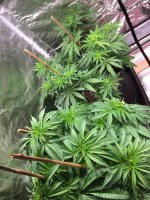
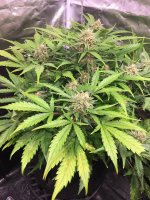
Anyway. I need help to isolate what's going on here. Without focusing too much on the data, the AFs don't look great. Suggestions I had received (adding in N, upping the PPMs, flushing #2) have all been done and not much has changed. My concern though is less with them atm.

My other two photos are most concerning now. I feel like there may be something endemic to the tent, the water, who knows what, that is starting to enact this odd chain of events first on my AFs and now on my photos. I have seen no signs of disease or major pest infestation. Thought I saw a few fungus gnats so have places sticky traps and sprayed foliage with Neem Oil.

I appreciate as many ideas as I can get.
 

Attachments

  • photo82549.jpg
    photo82549.jpg
    973 KB · Views: 0
  • photo82550.jpg
    photo82550.jpg
    1 MB · Views: 1
  • photo82551.jpg
    photo82551.jpg
    1 MB · Views: 0
  • photo82552.jpg
    photo82552.jpg
    1 MB · Views: 0
  • photo82553.jpg
    photo82553.jpg
    745 KB · Views: 0
  • photo82554.jpg
    photo82554.jpg
    936.1 KB · Views: 1
  • photo82555.jpg
    photo82555.jpg
    1 MB · Views: 1
  • photo82556.jpg
    photo82556.jpg
    1 MB · Views: 0
My current best guess is that there is a root rot/pythium. I have no observable evidence of root rot- this isn't hydro, I can't "see" it. But the biggest, observable unideal conditions in my environment are:

-consistently higher than ideal humidity. During dry spells it's 50-60%. During wet/dark periods it can climb to 70-90%.
-some algae formation on surface of the medium
-potential overwatering; where the top layer of coco after a full day off will be dry, but the bottom of the fabric pot will still be moist. Usually water daily, or every other day at worst.

I am getting to this guess mostly by process of elimination.

-I have run a healthy amount of nutrients on a mostly consistent basis for the entire grow and monitored my input/runoff accordingly. The dramatic shift of runoff results has only started within the past 2 weeks, and that has been concurrent with the visible stress evident in the leaves.
-I have seen no inordinate number of pests (fungus gnats, spider mites, etc). Maybe a gnat or two- and now as a precaution I have added in sticky traps and treated the foliage of the photos with Neem oil. No evidence at all of spider mites, nor any other pest.
 
I don't think they look bad. It could be the underfeeding. It's also typical for lower leaves to be sacrificed as the plant gets older.

I've never grown in coco. But, the GH 3-part with "useless" schedule worked well for me. I've read others say the same thing. Maybe 10% less strength.

Being in soilless, I don't think you'll see high-runoff ppms. (It's good you're watching them. I wish more people did, especially in soil. I think it's key to seeing salt buildup occurring. When buildup/lockout manifests in the leaves, it should be apparent in the runoff ppms.). In soilless, I think the nutrients wash out each time you pour new nutrients in. The coco is just something to suspend the roots as these nutrient baths flow through. If you were in soil, the nutrients would bind with the soil, microbes woul participate with the roots to breakdwn and supply nutrients (assuming the fertilizer used with soil would be from organic sources, not synthetic for hydro).

I don't think I'd be watching runoff ph, flushing with sugars, etc. Runoff ph (to the extent it's accurate[1]) is more for soil. In soilless there's not any significant buffers to affect the nutrient soluion. In soilless, you just ph your nutrient soluion, pour it in. I suppose if you see the runoff ph being substantially lower, you can raise the nutrient solution's ph to compensate. But, I never did this. Maybe I was luck with my soilless.

If I felt like I should "flush" soilless, I would mix a larger amount of nutrient solution (for more runoff). In soilless, I think this would be better. Not as much swing from feeding and deficiency. (In soil, the way salts retain in the soil, pouring water through is like diluting those salts. It's not like the roots experience no nutrients at all. But, with soilless, I think I'd keep the nutrients flowing. Just more volume if I felt something was stuck in the medium and needing to be flushed out.

If you're new to growing, you may be suffering from the very-common "kill them with kindness" compulsion. The effects of nutrient deficiency may not disappear. But, it may cause you to keep doing things thinking the plants need your help (like using neem oil when you haven't seen a gnat?). It's usually better to step back and let them do what they'll do. (After you're certain you're feeding a reasonable strength.).

If I really thought my peat-based soilless were acidifying, causing problems, I might sprinkle 1-2 Tbsp dolomite lime on top. Rake it in with a fork. Let it percolate through the medium. That might help (but takes some time). However, I don't know if that would be a good idea with coco. Never used it.

Regarding runoff ph. Google for "NCSU Pour-through extraction procedure." IMO, measuring runoff ph is next to useless because it depends upon the length of time the solution sat in the container. The amount of runoff created (dilution). Also, in the case of soil (and perhaps soilless media), the ph swings a full point from wet to dry (when testing with a relatively credible soil probe: Control Wizard Accurate8). A ph of 5.2 wouln't bother me a lot because it will be 6.5 when dry. That range allows for uptake. It may not be optimal. But, it's far from lockout. Again, I don't know how this applies to soilless.
 
az2000

I hear what you are saying re: killing with kindness. Frankly the addition of Neem oil as a foliar prophylactic seems pretty innocuous to me, probably a good thing to do with minimal drawbacks. As for PPM/pH monitoring; I'll look into your runoff pH resource. I think a lot of coco growers would take issue with the idea that runoff ppms don't matter- there seems to be a lot of takes that it is very important to measure especially to keep track of excess salt buildups.

I think it is important to note here that I haven't started to freak out over nothing, but rather a dramatic change that has taken place in the past 3 weeks. Check the photos below. The group shot (with AFs in back) was 6/28. The two shots of the biggest AFs were 7/17. On 6/28, and many measured runoff ppm numbers before, I was running a much higher runoff than feed. Even when feeding at modest EC (550-800ppm) I was getting occasional runoff at 1000-2000ppm! These results led me to abandon the high frequency "fertigation" methodology for alternating fertilizing feeding with pH'd H2O. This worked to bring more stable and sustainable runoff numbers. But literally right after we fell into a pattern of negative runoff ppms- and in turn the visible plant health issues. All of these "remedies" - reintroducing N, upping PPMs, flushing, neem oil, have all been efforts to restore plant health. I'll allow that maybe my altering of feeding style/frequency created "stress" on the plants. But the type of stress these plants are showing seems a bit much for the type of change they endured- especially for a strain so widely regarded for it's heartiness and resilience from among the most reputable seed banks.

I am aware that the final stages of flowering will create yellowing leaves as they utilize the last bits of N available. But that should not be happening with 4+ weeks of flowering left. And happening on one plant, while the other exhibits leaf coloring more indicative of N toxicity.
 

Attachments

  • photo81210.jpg
    photo81210.jpg
    1,006.9 KB · Views: 1
  • photo82554.jpg
    photo82554.jpg
    936.1 KB · Views: 0
  • photo82555.jpg
    photo82555.jpg
    1 MB · Views: 0
I think they look good except for autos. They can degrade as they reach the end of their life. I would feed them more N.

I definitely believe runoff ppms are useful in soil. In soilless, I would just mix a large volume (20%) and get a lot of runoff each feeding. That should be self-correcting.

But, I've never used coco. Maybe it doesn't work that way. (I like a light soil with soil nutrients each watering. Something between force-feeding soilless and the mystery of amended/complete soil. The "best of both worlds," for me.).

BTW: You can foliar spray household ammonia on that auto to get N to it immediately. Being in flower... I don't know if I'd do that. If you're in a humid environment it could contribute to mold. It might also affect the taste. But, it's definitely a way to get N to a plant that needs it. You have to be careful not to inhale it. You can burn your lungs.
 
Back
Top