What's new
GrowWeedEasy.com
You're browsing as a guest. Sign up to join the conversation, share your grows, and get help from thousands of fellow growers — it's free and takes less than a minute.

Please, Help with mold issue!

Honestly the best thing you can do is to first do some of your own research, learn what places like here teach you about the need for air in your plant's root zone. I actually found these forums because of the main site and the amazingly well written articles they offer for free which are totally top notch. Do some digging into it, learn everything you can about it, talk to people like me who themselves have tried it. But honestly at the end of the day its really you who has to give it a try and the best way to save yourself money if you are going to experiment with things like this is to do your own research. For example I tried this with one airstone cost me $2 and a $10 air pump I had laying around, so for $12 I tried an idea it worked so well I was able to see where I went wrong by not doing mine on both sides of the pot. If I was going to aerate multiple tanks I wouldn't keep going with $10 air pumps, it simply wouldn't be cost effective, instead I would go to a commercial pumpe something like the Model-5 which puts out 1380-GPH and start crunching the math to figure out how many air stones could that supply with air every minute, and having used my earlier experiences of simple trials I would deduct whether or not I would want to go with a bigger air pump still or not and those cost $40 I looked on Ebay. You could also get a 12-port divider for that air pump as well to drive at least 12 air lines.

At the end of the day it's okay to experiment with whatever, it's your plant(s) and your money... you just have to roll the dice and do what you think is going to work and if it does work or doesn't work then it's really got to be you to figure out what is or isn't working or it will never be worth the time to experiment in doing it and trying something new. In all the articles I've read and all the types of aeration stuff being sold for soil growers to aerate has been 1/4-inch "soaker hose" which you can buy by a 100-foot roll I believe for about $10-$15, and then some tee's and connections will set you back $10... so for under $20-$30 you should be able to try this. When it comes to using an air stone, maybe it would work in soil the way you want it too... honestly I don't know I've never seen anyone who has done it that way in all my research, hence why I encourage you to do your own research here, because I wouldn't feel comfortable saying it will or won't work as I haven't seen anyone try it who has claimed it either way. I just know from my personal experiences with air stones they don't seem to work unless they are under water, because after all that is what they are designed for.
 
Last edited:
Honestly the best advice someone is going to be able to give you is going to be to go back to the basics and really sit down and read about the basics of growing, the main site here with all their articles in my personal opinion is an amazing place which is more loaded with useful information than any other place I've found over the years. I am telling you this because you can easily answer your own question... What are the three limiting factors a plant needs at all times to be in balance and grow?

Light - Nutrients - CO2

Each of those three things must always be in balance, and as so many people fail to realize adding CO2 for most growers won't do much if they aren't already maxing out their lights and Nutrients, which then the CO2 is what is holding them back. So you could increase the amount of light inside your tent, but are you really ready for what that is going to in turn do for you? More light means you will draw more electricity on that circuit and I've no idea if that will overload your circuit. Even if you were okay doing that, next more light means more heat are you set up to handle that much more heat, how will that extra heat also change the RH (humidity) inside the growing area. Not sure how much CO2 your plants are already using and how much you are able to replenish the CO2 with your fresh air recirculation and if that is outside air or inside air which again would determine the CO2 levels for your plants and depending on how big they are and how much light they are getting they can use more CO2. If you increase the light but can't keep up on the CO2 levels I've heard it can cause a plant to get light burn, I just read that some place the other day. Oh and then my favorite any time you increase light - CO2 little do you think of pH and EC-TDS but we think of nutrients, as the plants can then get more of the nutrients they need the more it can also leave behind in the soil too, making flushing even more important than when you ran with less light.

Thus hopefully you see my point that it would be best to go back to the basics, because making a change that big could set you up for a whole lot of changes you may need to be making to get your system dialed in again, and I also know that is recommended by the professionals not to make changes during a growing cycle. The reasoning is because you can set yourself up for a problem, by changing something during a grow cycle you could cause new issues and stress your plants for a period of time until you are able to fix it and that could in turn lead to the plants death. Personally I would rather be honest and address things on paper to avoid potential issues you didn't see or think of until suddenly you are in the middle off the project and find you have a problem.
 
The other thing I wanted to touch on was the temp of your root zone, you may not realize this but the temp of your root zone is very important the same as it is for hydro growers, you want a root zone temp around 68-degrees, once you move past 72-degrees you are making the water hard to hold oxygen and believe it or not roots need oxygen to be healthy and to survive. Once you pass 75-80 degrees water holds no oxygen anymore and that is where you get stagnant water and the smells of sour or sewage from the water or soil. If the plant canopy temps were cooler than you wanted them to be, then you can raise the root zone temps to compensate to prevent stressing the plants. If the plant canopy temps were to be 90+ and you couldn't get the temps down, then someone could even lower the root zone temps to 60-degrees to prevent stressing the plants I've read with great success. The closer you keep your root temps to 65-degrees I do know will greatly increase how much your plants can take up for nutes, even if you oxygenate your root zone even with some 1/4-inch soaker hose and connect it to a fish aquarium pump in a soil grow. No, I am not kidding, I wondered this for years and then a couple years ago I saw the AD in a magazine for this basic concept being marketed by someone and it won all kinds of awards because this idea and concept really does work, will help the plant to uptake even more nutes and grow faster yet.

Just got done fixing another disaster, though this time didn't lose any plants except for 4 cuttings that got knocked over and too damaged to save. $40 surge protectors, 2 of them. I have one plugged into another. Not overloading the circuit, more of the fact that I can only plug 4 items into each because the timers and transformers are too bulky and cover several outlets. Anyway, for a surge protector that's meant to be used outdoors, someone was not to smart and used glue that is water solvent. One of the surge protectors came out of their frame and just missed the good plants.

Anyway, the reason for my reply was while I was fixing up the tent, I took temperatures and remembered your comment about root temperature. While the tent itself is 76 degrees average, caused by the lights, I took soil temperature from all the way down at the bottom of several plants. The temperature was 62 degrees. To fix this, I connected my new thermostats to both heating mats and set both to go on when temperature hits 67 degrees and to go off should the temperature hit 72 degrees and I placed the probes into one plant on each mat all the way at the bottom so the root temperature should be accurate.

When I put together my Aero Hydroponics system, should I use heating mats under each plant or should I get a mat for the main water tank that will be supplying 12 plants each, or mats for both tank and buckets?

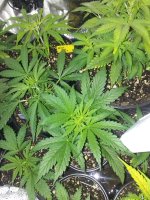
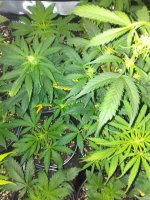
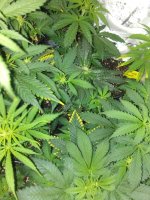
BTW, here are some updated pictures. Only 4 days from the ones above, and as you can see, after all the tweaking to PH, temperatures, and fertilizers, the place is a jungle. You can't even see the pots now.
 

Attachments

  • 20170126_052515.jpg
    20170126_052515.jpg
    3.1 MB · Views: 1
  • 20170126_052504.jpg
    20170126_052504.jpg
    2.9 MB · Views: 1
  • 20170126_052458.jpg
    20170126_052458.jpg
    2.8 MB · Views: 3
Last edited:
From everything I know about aeroponics to date it is my understanding that you want your water at a set temp, the mist at a certain micron, the timers set precisely with a recycling timer, and if you go all the way with pressure tanks, regulators, etc... I've seen some of the demo's at the big conferences with people wanting to show you why their system is so big and great and honestly those guys are the one's with the high pressure pumps and all that, I've seen where the plant was well over 14-foot tall and the roots seriously took up a 20-gallon res where the multiple sprayers were at with a video camera in there to watch everything happening. Seriously the roots were like spaghetti, there was just so many of them, some bigger, most just like strands of hair everywhere, I paid attention to the two most important things he made a point of sharing. One the high pressure sprayers and nozzles were they never lost but a micro second in the cutting off the pumps to the spray heads not allowing water past a certain pressure... and beyond all the technical stuff I noted that he commented and recommended a good clean hydroponic-aeroponic fertilizer, and told which one he reccomended for his system. Clearly they made it a point in their system to have the water temp set both heating and cooling in that type of a system.

As you may already be aware there are different types of aeroponic systems out there and I am unclear as to how exactly you plan your aeroponic system, will it be fogging, low pressure or high pressure?
 
From everything I know about aeroponics to date it is my understanding that you want your water at a set temp, the mist at a certain micron, the timers set precisely with a recycling timer, and if you go all the way with pressure tanks, regulators, etc... I've seen some of the demo's at the big conferences with people wanting to show you why their system is so big and great and honestly those guys are the one's with the high pressure pumps and all that, I've seen where the plant was well over 14-foot tall and the roots seriously took up a 20-gallon res where the multiple sprayers were at with a video camera in there to watch everything happening. Seriously the roots were like spaghetti, there was just so many of them, some bigger, most just like strands of hair everywhere, I paid attention to the two most important things he made a point of sharing. One the high pressure sprayers and nozzles were they never lost but a micro second in the cutting off the pumps to the spray heads not allowing water past a certain pressure... and beyond all the technical stuff I noted that he commented and recommended a good clean hydroponic-aeroponic fertilizer, and told which one he reccomended for his system. Clearly they made it a point in their system to have the water temp set both heating and cooling in that type of a system.

As you may already be aware there are different types of aeroponic systems out there and I am unclear as to how exactly you plan your aeroponic system, will it be fogging, low pressure or high pressure?

I been looking at fog heads and made changes to original plans to have it run 24/7 where the water will be pumped back to the main tank, but not before going through a skimmer to clear out debris. I plan using a high powered pump. I already have read where the heads get clogged easily, hence the skimmer part, plus will have screens in the head so hold back anything that gets past the skimmer. As it will be a fogger/mist spray, I'm considering 3 to 4 heads per 5 gallon bucket.
 
I haven't myself used foggers, but I have looked up plenty of fogging systems on YouTube and it is my understanding that you would want to run a pressure system or a fog system. When I did a lot of digging into the foggers I learned there is a big difference in how long they will last by how they are built, and then when I learned more on how nutrients and salts can eat away at the very metals of the foggers which cause them to stop working, and looking at the idea of them suddenly failing... well I got a clear picture that perhaps this isn't the way to go. Outside of YouTube I haven't seen or heard of anyone using foggers to be completely honest. I've looked at this style of growing and yes it does seem to have its place, but it looks very costly with a high chance of equipment failures happening at all are going to common.
 
I haven't myself used foggers, but I have looked up plenty of fogging systems on YouTube and it is my understanding that you would want to run a pressure system or a fog system. When I did a lot of digging into the foggers I learned there is a big difference in how long they will last by how they are built, and then when I learned more on how nutrients and salts can eat away at the very metals of the foggers which cause them to stop working, and looking at the idea of them suddenly failing... well I got a clear picture that perhaps this isn't the way to go. Outside of YouTube I haven't seen or heard of anyone using foggers to be completely honest. I've looked at this style of growing and yes it does seem to have its place, but it looks very costly with a high chance of equipment failures happening at all are going to common.

Thanks Greenthumb !!! Actually, you reminded me of something as when I was a kid back in the 80's I used to work for a sprinkler company installing systems. I was actually going to run a business in CA installing systems until I found out the black PVC is illegal over here and most tubing in many of the counties had to be the white PVC which you have to glue the connectors and risers on which meant I could not use a pipe puller to put in the plumbing and to have to manually dig an entire system for even a half acre property, is was out of my league with my disabilities. My reason for starting this grow is to get off the morphine I been on for 16 years and onto something else that has already proven to not have the effects the morphine has, not to mention might cure some of my issues as well. (crosses fingers!) Anyway, you brought up a point which actually isn't entirely accurate. The reason foggers fail, and fail a lot isn't because of the chemicals eating away at the heads, though I'm sure that contributes to the issues, its the small particles that pass through the screens. I had to fix 38 fog heads at a restaurant out of 50 that stopped working because just one grain of sand made it through both the filter and screens and clogged the hole in the heads. Because the hole was so tiny, pipe cleaners nor pins would fit into the head to get that grain out and had to use a fine pointed hyper dermic needle. Some heads that had the sand really jammed in, ended up getting tossed. Bigger heads I was able to use my drill press without damaging the heads to clear out. Using them in a hydroponics system, with all the tiny root pieces that pass through the skimmer and head screens will most likely clog the heads in less than a day. So now that you reminded me, I might have to go back to the normal sprays which I will then have to use 6 per 5 gallon pail. Which now brings me back to my original question of using 3 gallon or 5 gallon pails. I want the best yields, but don't want to use 5 gallon is using 3 gallon produces the same yields in hydroponics. I might stay with 5 gallon only because I found them to be a lot cheaper than the 3 gallon. More of $3.00 each compared to the $4.25 on amazon. Not to mention, the lip screens are made for the 5 gallon buckets and are cheaper as well. Even though I can place one bucket per square foot, I believe I might need to leave a foot in between to allow for outward growth once I get my shed up. Actually, how much room should I leave between buckets? Thanks again for your help Greenthumb . Your help these past few weeks have been extremely helpful, especially in reminding me of very old issues. I suddenly feel like House MD bouncing off ideas on everyone to help remind of what I really need to do. And checking out YouTube again as you said you did. Take care. Btw, what makes that orange bar go up? (prepares for funny answer by dontknownuttin )
 
Thank you for that education on foggers, I clearly do not know nearly as much as you do on them, I have seen them in YouTube videos and listened to those guys, beyond that I've looked at using foggers in some counter top aeroponics systems I am working on designing for herb gardens as such used for cooking. I can also certainly understand your need for a high plant count as I am sure you will be going with something like a CBD oil, and that will require a lot of plants and yields to keep up with what I can only assume your needs will be. I didn't understand why you would be pushing for aeroponics so hard, but clearly in light of this I understand much better. I keep up on cannabis industry news as much as I can and try to find out what all is going on in the fastest growing industry right now, which has been changing even the face of Big AG. As such I've been studying on how commercial hydroponics and aeroponics growers are growing, learning how they set up their systems and the reasonings behind why, and so much more including how the overall cannabis industry will affect medical growers and even the commercial industry. I've even been learning how commercial growers are building things a little different to save money in the operations costs later on when they set everything up and running. Perhaps this might interest you to help you design your system?
 
Greenthumb Foggers should actually be used for watering lawns only, not a circulatory system where there is a risk of constant clogging by debris like tiny pieces of roots. It took your previous post to remind me of that. I'm now also not in trouble for space at the moment. (knock on wood, or my head, same thing I think). The pharmacy knew of someone who needed plants and he stopped by and bought enough so I would have space for my others. Took mostly fems and I threw a free normal into the lot, though took cuttings to verify if M or F in 3 weeks. Also just a precaution in case the one I gave out just happened to be the only female Neville haze. Now I can train. I have made so many constant changes because of costs and because I found out that I might need other things once I move things into the shed. I'm actually considering doing a regular garden as well. Will be the one place those bloody gophers can't get to. Unless they can gnaw through 6 inches of concrete. The one year I tried gardening, was supposedly supposed to be my last as I worked for almost 3 months growing a lot of corn, and towards the end, I would find 5 stalks cut down with the unripe corn untouched. every day. It was then I figured out what has been making all those holes all over town. Its a gopher infestation. Those bloody annoyances for some reason would gnaw from underground through a bunch of corn each day and instead of just working on what they cut down, they kept cutting more and not even using it. Reminded my of Caddy Shack. Nothing will get inside this shed. No animals, no bugs, just me =) Also I put a barrier where the shed is supposed to go that will keep the ants away. Last thing I need is for those things to bring their little workers. I can't grow in the open, the plants would disappear then lol. I been watching the videos too. Its why I thought a fogger would be great, but then the issues. It's why I come here a lot.
 
You think a lot like me, plan and plan ahead... work it out on paper and in your head before you spend lots of money and time in a design you build and then realize you screwed up way back at step one. I've been gardening a long time and then one day a friend asked me for help with some "tomato" plants he had growing and it took me back a little bit there is a lot more information that goes into growing cannabis than any other food item, including corn as I am sure you well know yourself. While I have dealt with a long list of issues, never had a gofer issue, somehow I always work out a way of balancing the environment to get rid of or keep away my pests in most cases. I do what is called "Companion Gardening" a couple of names of two books are Carrots Love Tomatoes and Garlic Loves Roses, one example is planting horseradish at the four corners of a potato patch to keep away the potato bug. Another is planting different things at the bottom of a fruit tree can change the taste of the fruit, which obviously has some friends begging me to know if this works on cannabis as well, which I don't know.

So this past spring I watched a video on YouTube by a guy named Harley Smith who works for NPK Industries / NPK University and does these class 100% for free on all kinds of amazing information on plants, beneficial bacterias, discusses all the nutrients in great detail that you can understand and actually learn something from. Just his two part lecture on YouTube for a total of like an hour and a half I learned more in 2-hours of my time, going back to write some things down, that helped explain so many things I've never understood in all my years of gardening. One thing he brought up was how the nutrient Silica will toughen a plant against biting insects, and a bunch of other stuff, so I decided to listen to him since he really does check out when you dig into his name and what he says he does for a living being this big scientist in the hydroponic industry who nations turn to his company to do these big tests. I have fought the aphid issue indoors and out for years, this is the first time I have ever found a way to actually win against them, as mine are herded by ants as well. Seriously though when it comes to ants, I'd love to hear what you did to create a barrier for them to keep them out.
 
No Title

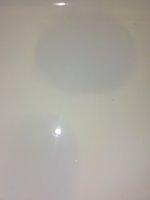
I have a new mold issue that's slightly off topic. If anyone remembers a post I did back in December when my clear solo cups were messing up the roots where they were just massing at the bottom of the cup, so I ended up taking regular solo cups and cut out the corners for drainage and just dropped the clear ones into the solid color ones which allowed me to take them out easily and view the root growth. Anyway, I had left one of these solid color ones on my new $300 bathroom vanity which is where I do my work when taking clones, then drop them into a cup and then spray my clone food and then it would be put in the clone box with my other cuttings. When I went to clean up after this mornings work, I discovered to my horror two huge dark marks. One from the cup, the other from the spray bottle that has been sitting there for about 5 days. It actually looked like someone had picked the items up and pressed them onto an ink pad then pressed them on the counter. My wife got extremely upset, more so because she was worried the landlord would use some excuse to take money from our deposit to cover repair or replacement which was when I reminded her that I had purchased it and installed the unit along with a lot of other things which our landlord never paid me back for, not to mention in two months the place will be bulldozed anyway. The two dark blue spots were actually mold. Due to the broken drain line under the home, mold spores spread quite quickly here which is why I use SM-90 and Peroxide on my plants quite often. Surprisingly spraying SM-90 and Lysol bathroom cleaner on the area every two hours and letting it sit an hour each time cleared up about 90% of the mold. Nothing was used hot enough to permanently bake the mold stain in. The problem is, the mold somehow managed to get under a thick layer of finish which the chemicals can't penetrate. Which means the moment my kids leave anything damp on the sink even a single day, will allow the mold to regrow back. I don't want to have to sand the sink down. For all I know, the vanity could easily be stored and reinstalled later in the new home or just installed in one of the many other houses my landlord owns. Is there some kind of chemical that can kill mold or help the cleaners I am using to get through the finishing to kill the mold left without damaging the finishing? Picture below.
 

Attachments

  • photo11135.jpg
    photo11135.jpg
    1.2 MB · Views: 2
Well I have had my personal battle with black mold, which by the way is what you have just by your description... When I learned I myself had "black mold" as there are different types, some much more serious than others, I learned some black mold is "black toxic mold" and the only way to know is to do the test. Thankfully mine was negative, but all the same do some of your own research and see what the difference between the two is and why it's worth the money to do the test to find out which one you might have. As far as just killing the basic types of molds, including black mold I use a product "Mold Armor" Menards carries it, I've also see it at Walmart too, comes in a hand spray bottle and also in a bottle for House Wash to connect onto your garden hose. Safe inside and keeps the mold at bay from trying to grow back, it really kills it has been my experience with it and I have a lot of hours of mold removal under my belt dealing with black mold among other types as well.
 
Im moving from here within the next 60 days. Otherwise I would most likely get it tested. Its the top of the counter Im trying to clean the last remnants of. The products I normally use cant get through the coating to get to the last of the mold. Was considering opening all the bathroom windows and using my other charcoal filter to pump out any fumes and try using a small amount of propane to help penetrate that small spot which is the size of a silver dollar. Figure I ask here before trying. Figure I follow my old shop teachers saying for once of measure twice, cut once instead of cutting 5 times, measure once, throw out blunder, then follow instructions ;)
 
I think Mold Armor costs me $5 - $10 a bottle, and I know this... IT WORKS! The short of it is this, I had my entire inside of my house filled with an indoor garden for a couple of years, 98% of it was all on hydroponics. I was gone 3 full weeks and the electrical had gone out early on and took out the entire houses electrical so nothing was running in the heat of late summer, I came home to black mold in and on everything! Took me 5-years to clean it all up, and even doing serious renovations to get to some of it to kill it, black mold can survive heat and use the dryness of the heat to become further airborne and spread even more. You want to get it wet and let it soak in to kill it, that stuff is serious stuff, I learned when researching it, black mold has even been found growing and thriving off from the X-ray radiation on the inside the type of dome they put over Chernobyl to try to contain the radiation. So yeah that put black mold into perspective for me when I read that, but I still had to find some video of a team that went in there and saw it for themselves to actually believe it as they went looking for the answers inside as they need to replace that old dome.
 
Back
Top