I think there is a difference (and a balance between) yield and efficiency and as growers, we all get to decide the balance between them. The measurement of grams per watt is more of a general rule of thumb comparison for different kinds of lights.
You can measure yield as the total grams per watt of the fixture. This is a pretty easy way of doing it and it factors only the final harvest compared to the strength of the fixture.
However, if you want to measure a Cost of your grow, aka efficiency, you would need to add the total amount of electricity used for the entire grow. You could limit this to just lights, but to truly measure the cost per gram, you would want to take into account your lights, exhaust fans, circulation fans, as well as any heaters or dehumidifiers that might be used to control the environment depending on how detailed you want to be.
With the above distinctions, if cost of electricity doesn't matter, you could veg until your tent is completely full by using LST and other training techniques. Different training techniques temporarily slow growth for different amounts of time (depending on technique used, strain, and 'art' of the grower) which will add days or weeks to the vegetative stage. This adds to the final harvest (up to a point) but also adds costs since you extend the amount of time you're using lights, fans, etc.
So really, they're two different measurements that measure two different outcomes. If one is looking to grow larger harvests, it takes time. While that increases grams/watt at the end of the grow, it may not be the most efficient (total grams/total amount of electricity used). If one is looking to be efficient with energy use, you might settle for a lower final yield grams/watt.
Here is a great calculator where you can play around with different lengths of time in veg to see the difference in costs:
https://www.growweedeasy.com/electricity-cost-calculator-for-growing-cannabis
Using the above calculator at the default settings and not adding in the cost of anything other than lights, adding a week of veg at 18/6 adds an extra $1.50 per 100w of light.
Really, it all boils down to the different goals of different growers. Some may say the extra time in veg (with the goal of increasing yields) is worth the electricity costs. Whereas others may find that a few extra grams (or more) isn't worth the extra time paying for electricity.
In your case, if you can increase your yield by 25% (using the numbers you mentioned) and assuming that most LST will add an extra week or two (let's assume somewhere in the middle - 1.5 weeks) then:
Your lights are total 350w (if I'm reading your original post correctly)
Previous yields with NO LST: 690g
Expected yield with LST: 690*1.25 = 863 which is an additional 173g
Extra cost for lights for extra 10 days (assuming defaults in above calculator): $8.32
This means that the extra cost per extra gram is $8.32/173g = $0.05 per gram
Now this is leaving out all the extra electrical devices so it's not REALLY only 5 cents per gram, but even if you quadruple the cost, 20 cents per gram seems pretty worth it. Now these are based on several assumptions, namely that without LST you get 690g and with LST you get a 25% increase in yields and that it delays the flip to flower by 10 days. But you can see that LST is often worth it.
Let's see if it were only a 10% increase in yields:
Additional yield (based on 690g with no LST): 69g
Additional cost: $8.32
Extra cost per gram: 12 cents
Again, even quadrupling that cost it's less than 50 cents per additional gram achieved by LST.
The above math is why many growers who aren't in a rush to get to harvest often use some sort of training to increase yields. While it does increase total time and total electricity and costs, the additional yields are very worth it when broken down by cost.

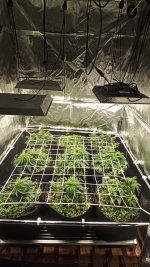


 It was a slow day so I had time ;-)