
GrowWeedEasy.com
You are using an out of date browser. It may not display this or other websites correctly.
You should upgrade or use an alternative browser.
You should upgrade or use an alternative browser.
Light meters
- Thread starter DonnaRK
- Start date

Catfish22
New member
Try this. It came off a YouTube video for a Viparspectra test. I think it's close enough.
If you look at the drop down for description under the video it has a link to the ppfd calculator. About minute 6:00 or shortly after he uses the calculator to convert lumens to ppfd.
https://youtu.be/NECyFXZdxhE
If you look at the drop down for description under the video it has a link to the ppfd calculator. About minute 6:00 or shortly after he uses the calculator to convert lumens to ppfd.
https://youtu.be/NECyFXZdxhE
Last edited:

grouchyoldman
Well-known member
Hi DonnaRK, I faced the same dilemma, wanting to get a handle on the light energy actually delivered to my plants. I found that the "really good" meters like Apogee were too expensive and the cheap ones measuring Lux didn't do the job.
So I was delighted to find a solution (hat tip to @Davetrish) in the form of a free App for iPhone & Android devices. I downloaded the iPhone version and first tested in against the published specs for a ViparSpectra 1500 LED grow light. To my surprise the PPFD measurements were spot on!
The free version of Photone measures PPFD, DLI & Foot Candles. You can unlock Light Temperature measurements in degrees Kelvin for a small fee. The program is simple to use and comes with a User's guide. You can also calibrate it using a known light source.
It takes all the guesswork out of adjusting your lights for best performance so you can hit that Sweet Spot of Daily Light Integral, or PPFD by adjusting the height of the lights or using the dimmer. The DLI reading can be adjusted for 24, 18, or 12 hour light cycles.
In short, it provides everything I wanted and, did I mention that it's FREE! *Whoots*
So I was delighted to find a solution (hat tip to @Davetrish) in the form of a free App for iPhone & Android devices. I downloaded the iPhone version and first tested in against the published specs for a ViparSpectra 1500 LED grow light. To my surprise the PPFD measurements were spot on!
The free version of Photone measures PPFD, DLI & Foot Candles. You can unlock Light Temperature measurements in degrees Kelvin for a small fee. The program is simple to use and comes with a User's guide. You can also calibrate it using a known light source.
It takes all the guesswork out of adjusting your lights for best performance so you can hit that Sweet Spot of Daily Light Integral, or PPFD by adjusting the height of the lights or using the dimmer. The DLI reading can be adjusted for 24, 18, or 12 hour light cycles.
In short, it provides everything I wanted and, did I mention that it's FREE! *Whoots*
Attachments
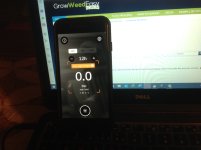
I have also heard that when using the app that it is better and more accurate if you use a diffuser of some sort over the camera. A sheet of white printer paper works well. Parchment paper is suppose to be the best. I have a quantum meter but it is not an apogee (I would love to have one). When I get free from the family for a bit, I will go down and do a comparison. I just downloaded the app. I will download it on 2 devices to make sure the difference in cameras doesn’t make a difference. I’m sorry if someone else has done this. Not trying to step on anyone’s toes I just really like to see the numbers. ✌ï¸
edit = if you bought a meter I am assuming it already has a diffuser. I overlooked that. My apologies. I will still run the test to see. ✌ï¸
edit = if you bought a meter I am assuming it already has a diffuser. I overlooked that. My apologies. I will still run the test to see. ✌ï¸
Last edited:

Smallgrow
Well-known member
Have a look at MIGRO on YouTube Shane is the light Guru, and has a few videos on the light meter topic. Search his other videos to find them all, I know he’s working with at least one app developer too. I think he’s the best source for that info around.
I also followed Nebulas advice to get a meter , I was able to find one that claimed to work with LEDs, of course I have no way to test it.
I also followed Nebulas advice to get a meter , I was able to find one that claimed to work with LEDs, of course I have no way to test it.

grouchyoldman
Well-known member
What is the "Grow Light Sweet Spot?"
So, what is this cannabis lighting "Sweet Spot" we are using our light meters to dial in?
Here are some guidelines that I encountered doing research. I've lost track of where these came from, so credit to the sources wherever they may be.
https://www.youtube.com/watch?v=ID9rE5JewVg
So, what is this cannabis lighting "Sweet Spot" we are using our light meters to dial in?
Here are some guidelines that I encountered doing research. I've lost track of where these came from, so credit to the sources wherever they may be.
- "Cannabis has been shown (chandra 2008 study) to reach its compensation point at around 500umls. This is actually similar to other high terrestrial species of plants. Beyond this point quantum yield decreases, until it reaches a saturation level of around 1500-2000umls and photosynthesis rate actually decreases. At 1000umls quantum yield levels off, this is about where any increase in light returns very little in growth. With indoor lights and ambient co2 concentrations, you would typically want to have light intensity (PPFD) at the canopy between 500-1000umls. Where exactly will come down to the type of light you have and the type of coverage from your reflector or optical lenses (LED)."
- "The daily light integral, (DLI) its the total daily amount of photon energy over the PAR range. PAR is not a metric unit but a unit set. PPFD is the metric system measured in umols that uses PAR to define its testing parameters. With cannabis, the max DLI a plant can receive before co2 supplementation, is around 40-45 mols a day. This is about 1000umols @ 12h light schedule. In nature plants will typically not receive more than 60 mols."
- "I have tried many schedules and combinations and use 20/4- not for any of the reasons mention, but for my plants to get the maximum light per day @ 45 moles/m2/day without CO2 (range 25-65) which is considered the amount most cannabis plant can utilize in 24 hrs."
https://www.youtube.com/watch?v=ID9rE5JewVg
Last edited:

TOKABIGONE
New member
Thanks for sharing that grouchyoldman , very good info. Lots of numbers but written so even I can understand, lol. While waiting on the girls to open their eyes, I'm working all day for the last couple weeks getting my environment dialed in under hot and dry conditions before planting yesterday plus I want to maximise my DLI as well so I will be using my PAR/PPFD meter app on my Android S7 to determine the proper level.
grouchyoldman
Well-known member
TOKABIGONE, I'm glad that it was helpful. I mostly use DLI because it's an average of useable light energy per day based on your light schedule (12/12, 18/6...) My lights are powerful enough to cause light burn, foxtails or even hermi, but as long as I dim them down into the 40 - 60 DLI range it's all good.
If your light manufacturer publishes a PPFD map showing the intensity at spots around the coverage grid, one fun thing to do is to compare your readings with theirs. I was surprised that my readings with Photone App were an almost perfect match with the Viparspectra data.
If your light manufacturer publishes a PPFD map showing the intensity at spots around the coverage grid, one fun thing to do is to compare your readings with theirs. I was surprised that my readings with Photone App were an almost perfect match with the Viparspectra data.
TOKABIGONE
New member
Thanks again grouchy! I have 3 100w actual quantums spread across my 30"x48" space perfect footprint all over. Last grow I brought them down to 12" in bloom and they were ok for their 12 hr period. Then I
experimented with 10" and found after 4 or 5 days they were stressing to the point of slight foxtail so I know the limit of my light. I'm thinking I will be at about 15" this grow as I am running 24/0 on auto Sativas so more time for my DLI without heat stress. These lights raise the temp in my cab by about 2 to 3 degrees each. 10" fan at intake, 6" clip on mid level and a 190cfm extraction on low which changes the air once a minute. Cant go much higher without lowering humidity too much.
experimented with 10" and found after 4 or 5 days they were stressing to the point of slight foxtail so I know the limit of my light. I'm thinking I will be at about 15" this grow as I am running 24/0 on auto Sativas so more time for my DLI without heat stress. These lights raise the temp in my cab by about 2 to 3 degrees each. 10" fan at intake, 6" clip on mid level and a 190cfm extraction on low which changes the air once a minute. Cant go much higher without lowering humidity too much.
Last edited:
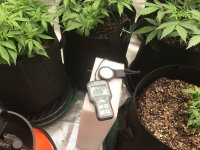
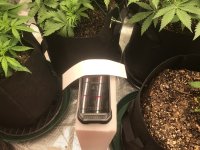
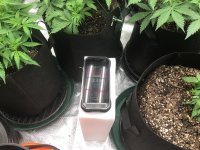
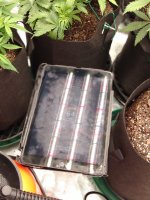
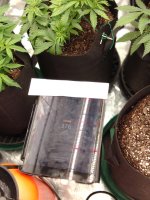
TOKABIGONE grouchyoldman MeEasy PLreef Smallgrow DonnaRK Catfish22 I had a chance to do some testing and found some interesting results with the Photone app. My phone did best without the paper as a diffuser compared to the quantum meter. My iPad did best with the paper as a diffuser and was closest to the actual quantum meter readings. Not the results I expected. Use the way that best fits your camera (with or without a diffuser). Just use it as a gauge and not for exact readings. See how your plants respond. ✌ï¸Hope someone else can use this as helpful info.
Attachments
-
 47819E2C-C0B2-4FB0-A909-241029DA9465.jpeg1.9 MB · Views: 11
 -
 0F302197-E1A1-46D6-90EC-68147BDCFA74.jpeg1.9 MB · Views: 14
 -
 A577925B-35AE-4DD2-887A-877C84B596B0.jpeg1.8 MB · Views: 15
 -
 705C5AC3-0A85-4347-A567-5A9704DDBE87.jpeg1.4 MB · Views: 12
 -
 17B721B1-EFEE-4C49-9DBF-77F6B62F2795.jpeg1.3 MB · Views: 14
Last edited:
