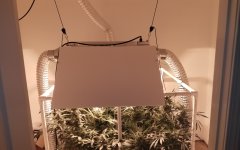
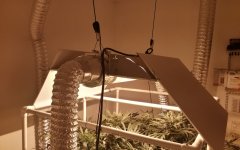
Light uniformity is difficult with light sources that are small. Light behaves like electromagnetic waves and the characteristics of light through space, exhibit wave light propagation. When energy is emitted from light sources with a small surface area, such as from a sodium bulb or LED, light will diverge with low uniformity with respect to the horizontal plant canopy.. This is because of the geometry and size of the source with respect to the observation points.
Reflector hoods are a way of utilizing the light from light sources where light is emitted in wide angles. By using reflective material or optics, the light that would otherwise be directed away from the desired area is directed towards it. Allowing the maximum use of the light source possible. This applies to both old and new technologies where either reflective or optical products are used to control the direction of light.
With reflector hoods on gas discharge systems, there are many design choices that are used to help decrease hot spots and provide better light uniformity. Such as multiple reflective points, diffusive surface geometry, size etc. But this can only do so much, as the potential for improving the uniformity through light reflective means is ultimately limited by the size and shape of the light source. With gas discharge sources using reflective hoods, the best quality designs are those that implement the previously mentioned properties with size being the major difference between designs. The larger they are, the more light can be spread out evenly. The best measured hood for uniformity and performance is the XXXL dominator.
To improve uniformity further, you either have to do one of two things. Either match the shape of the plant canopy to the geometry of the light source or match the geometry of the light source to the canopy. In our case it is more practical to do the latter. This is done by increasing the surface area of the light source. With gas discharge this is not possible because the whole technology design relies on the concentration of energy to reach optimal temperatures. LEDs however are able to be designed to increase the surface area that light is emitted from and match the geometry of the plant canopy. Such fixtures that do this well are the nextlight mega LED and fluence spydr X. The large surface area allows superior uniformity and proximities as close as 12".
With all that said. When talking about light proximity with typical light sources. The main concern is balancing the light source proximity so that light is not attenuated through radiative and reflective losses by having the fixture too high. But also making sure energy is not lost through having it too close and reducing the photosynthetic efficiency through photochemical quenching and other quenching mechanisms that channel excess light energy that cannot be processed. With my research on light technology and plant science. I have calculated that the best height is when the center square foot is at around 80,000 lux in a 4x4 with a 600w source (does not apply to differnce sized sources and grow areas. Any higher or lower and you introduce losses that deteriorate the light utlization efficiency.