What's new
GrowWeedEasy.com
You're browsing as a guest. Sign up to join the conversation, share your grows, and get help from thousands of fellow growers — it's free and takes less than a minute.

First time grower needs help

fannatic

New member
Hi,

First time grower here, no experience whatsoever.

I planted a few seeds some weeks ago and my plants are slowly progressing into something that is starting to look like weed :) Read a zillion tutorials before planting.

Currently I have 2 questions:

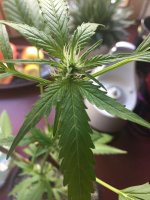
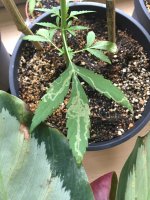
- What's wrong with the leaves in the first pic? The plant had stopped growing for a period of time and looked weak, then I transplanted it and gave it some fertilizer (NPK 6-4.5-5.5), which helped a lot with the growth. Then flushed it, and several days later gave another fertilizer (NPK 8-3-4). After another few days the leaves started showing some marks, as you can see in the pic. Is this nutrient burn? I have the same marks on both autoflowers and regular plants. Four plants total, all of them have the same kind of strange leaves, mostly at the bottom.

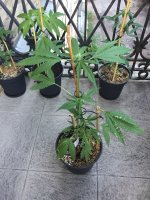
- Is the plant in the second picture in the flowering stage or not? I am not quite sure when to switch to flowering stage nutrients.

thanks!!
 

Attachments

  • photo82022.jpg
    photo82022.jpg
    1.5 MB · Views: 4
  • photo82023.jpg
    photo82023.jpg
    1.4 MB · Views: 4
Howdy, fannatic. The plant in picture one shows leaf miners. They're insect larvae that burrow inside the leaves. They are non-insect specific (could be any of a number of insects). Check your plant and soil for insects.
The plant in picture two shows a plant in flowering stage. Nutrients should be added when you switch.
 
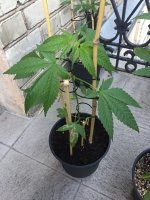
I agree with Gingerbeard - second pic must be your autoflower as she is shooting up pistils or preflowers. You would get a better assessment if you showed us pics of the whole plants..
 
attached a few images of whole plants, as requested.

I assume it would be a good time to start feeding the autoflower with something like NPK 5-10-10 or 5-15-10, and continue giving the regular one NPK 10-5-5?

Is there anything I can do to get rid of leaf miners?

thanks!
 

Attachments

  • photo82024.jpg
    photo82024.jpg
    1.9 MB · Views: 6
  • photo82025.jpg
    photo82025.jpg
    1.6 MB · Views: 5
If you're not experienced growing, I wouldn't play around with boosting PK. Cannabis grows just fine with a 1-1-1 ratio (e.g., a product labeled 8-8-8, or 12-12-12). If you do play with the NPK ratio you want to ease into it. Like, a ratio of 1-1.2-1.8, then 1-1.4-1.8, etc. Finish at a ratio 1-2.2-1.8.). If you go to high too fast, you'll have yellowing leaves due to nitrogen def. You can get those custom ratios by mixing you 10-5-5 with 5-10-10. It's just an average of the two. But, the latter is stronger than the former. So, you have to be careful not to make something too strong.

But, I wouln't complicate things. Just use a balanced product (1-1-1 ratio) through flower.
 
Very interesting info and thank you for taking your time to write it. Could you elaborate more about "the latter is stronger than the former"? I would assume that mixing equal parts of 10-5-5 with 5-10-10 would produce something like 7.5-7.5-7.5? So in order to ease into it, I would mix 50/50 first, then 40/60, then 30/70 etc?

I will probably try giving half plants 10-10-10 and try to adjust NPK as you described for the other half, and see which ones do better in the end :)
 
If the leaf miners are only on a few leaves, spend some time and find them. It's easy. Their mines start narrow and widen towards the end. If the larvae haven't already hatched, you can see a small black head to the mines. Give the black head a squeeze with your fingernail. If you're lucky you'll hear a, "Noooooooo…" and pop like a .22. My go-to spray is a combination of hydrogen peroxide, dish soap (Look for biodegradable. You might even have some under the sink.) baking soda, and water. Look for proportions online. I always add a little extra so wouldn't want to give you a bum recipe. You can soak the plants without worrying about using poison.
This is supposition on my part about what bugs you might have. If the bugs are in the soil, the larvae would be in the soil. Look for something flying or hopping around on the leaves. If it's growing outdoors, perhaps you have other plants to look at as well.
 
fannatic, It can get confusing. The NPK label can be thought of as a ratio. So, your 10-5-5 veg-friendly product is a ratio of 2-1-1. But, so is a product that is 20-10-10. Same ratio -- but *twice* as strong. You'd feed half as much of that to get the same strength.

A good example of what I meant about mixing two products: let's use Grow More's Hula Bloom product which is 0-50-30. (I don't think you can express that as a ratio because there's no N.). This is a good example because it's so strong.

Let's say you normally use your veg-friendly fertilizer (10-5-5) at a strength of 6g/gal. That will give you a strength of about 350ppm (assuming it has a normal amount of mg, ca, s, trace minerals).

In late flower you might want to create an NPK ratio of 1-3-2. You could mix 2g of Hula Bloom with 4g of your veg-oriented fertilizer (10-5-5). That produces a *perfect* 1-3-2 ratio. And, you're using 6g total (still). But, the strength will be about 460ppm. Because, by weight, the Hula bloom contains more minerals than your veg-friendly fertilizer.

If you bought a product containing that blend of two products, the NPK label would be: 6.67-20-13.33. That reflects both the ratio *and* the strength. You can see how much stronger it is than your 10-5-5 product.

So, to feed the same strength of that, you'd need to scale the total amount down by 75%. That would be 3g of your veg-oriented fertilizer, and 1.5g of Hula Bloom. Now the PPMs will be about 345.

The [hypothetical, new] NPK label will be the same. The % of weight of each nutrient is the same. It's just a smaller amount. Instead of selling 6 grams packaged as a product. You're selling 4.5g of that same mixture (which has an NPK label of "6.67-20-13.33."

Let me know if I should try to explain it differently. I have a spreadsheet that figures this stuff out for me. (I do a lot of my own mixing. And, unravelling the secret-sauce multi-bottle "lineups" to see what NPK ratios result from "4ml of the green stuff, and 6ml of the red stuff." I could give you my spreadsheet. But, not sure I can post a link here. Not sure where I'd put it for you. If you're not in a legal jurisdiction, I don't want to cause a privacy breach.).

But, honestly: if you're new to growing. Just use a 1-1-1 ratio through flower. Wait till you get a couple grows under your belt. I you reduce N, you're going to introduce variables that will confuse what's already a confusing experience. (You risk burning if you're not aware of how the strength changes.) If you feed a balance nute all the way through, then you have something to compare to next time.

Keep it simple! You have a whole lifetime to overcomplicate things. :)
 
az2000 I understand what you are saying, and it doesn't seem too confusing so far. The only question I have is:  How do you come up with a number of 350ppm from NPK 10-5-5 and 6g/gal? How is ppm calculated and what the target ppm should be for autoflowers / regular plants? Thanks again.
 
I was able to find enough info about how to calculate ppm online, so I guess the only question left is what ppm values I should target in different growth stages.
 
I don't exactly trust calculated PPMs. (It's more for comparing different mixtures, and getting close to the right strength. You can start with 20% less water than you need, and add water until you have the strength you want.). For example, the P & K (of the NPK label) are shown as P2O5 and K2O. Elemental P and K are less (0.4364 and 0.8302, respectively).

I don't know if there is a target ppm. It may depend on the nutrient and soil.

I grew soilless using Pro-Mix HP + 25% perlite and GH Flora series 3-part. I followed a schedule I found on the internet which was higher than the customary half-strength of the manufacturer's recommended dosage, but lower than the manufacturer's recommended dosage. I was routinely creating 900-1200ppm solution.

I turned that soilless into a light soil by adding 25% potting mix, and began feeding a soil nutrient (not a hydro nutrient). My veg mix is 250-325ppm (calculated, depending on whether you count elemental P&K, or the compounds the labeled weight refers to. It typically measures somewhere in between). I fed stronger initially (thinking my soilless experience was representative). But, I got really bad salt buildup in early flower. I think hydro nutrients in organically inert media can be "force fed." In soil, less is more.
 
The funny part is that I spent like 4 hours today in several shops trying to find ingredients for the 5-15-10 mix, and.... there were no products with enough P content to get the mix done. Neither liquid nor powder. I can buy "superphosphate" granules which are 0-19-0, but I have no idea how I would mix the granules with liquid or powder fertilizers. So in the end I will probably have to go with 10-10-10 and see how that works out.
 
That bonsai product sounds good. Cannabis likes high K throughout the grow. A ratio of about ?-?-1.7 or 1.8. For example, 2-1-1.7 in veg, and 1-2-1.8 in late flower. (1-3-2 or 1-4-3 might be a "booster"). If you unwind the multi-bottle "lineups", they're often like this. I bought some potassium sulfate (0-0-50 & 17 sulfur). You can find it online. I use that to tweak my custom NPK mixtures.

I use a high-P bat or seabird guano. Bone meal (it's not as fast-acting. I use that mid flower with the expectation that it will have more effect in late flower).

But, honestly, I think adjusting NPK ratios desn't d that much. And, that's why I'd encourage you to just use a 1-1-1 ratio in flower. Then you'll have a baseline to compare your future grows to. If you start playing with high PK, how will you know whether it does anything? I don't think it does. I personally think kelp (I use Pennington Alaska Pure Kelp) in mid to late flower acts as a bud hardner. I think it has auxins (growth hormones). It can make for stretchy plants in veg (and especially transition). But, once the plant is focusing its growth on buds, it seems to make the buds denser, harder.

But, I wouldn't even do that. You're a new grower. Keep it simple. People tend to do too much the first couple grows. They might get lucky, but often they don't (and have a disaster). If they are lucky, they won't know what it compares to (versus just letting the plant grow by itself). I know it's tempting to be the master grower and mad chemist. But, I promise: if you refrain from that you'll thank yourself later when you delve into those things (and have a baseline to compare to).

If I could post a link to my spreasheet, that would help you if you wanted to play with these things. I don't know what's allowed here. (I don't see a terms/rules page anywhere).
 
I forgot to mention something. When I looked at that "bonsai" product you linked to, it appeared you're in Europe. I have read that Europe's NPK labels represent a percent of volume, not percent of weight. Everything in the US is percent of weight (even liquid products, which means you need to know the "liquid density" to calculate how much nutrient it has. I.e, how much the product weighs, and extrapolate from that 1ml = ?g. Pure water is 1ml=1g. But, fertilizer products can be lighter or heavier. It's probably not enough to matter. But, still.

Anyway, you should verify what the NPK labels in your country mean. I may heard wrong about Europe. I'd like to know what you learn about this topic.
 
This year I experimented with 2 different soil formulas. One worked much better then the other. I am going to plant all new seeds using the "better" soil from now on.

Today I started sprouting 4 new seeds, all of the same kind.

I am going to make the following experiment:
- divide them in 2 groups of 2 plants each.
- water group 1 with regular tap water and use 1-1-1 fertilizer all the way till the end.
- water group 2 with ph-adjusted water and proper NPK ratios according to the tutorials I found online. Also measure PH of runaway water and try to make sure it stays somewhere around 6.

At the end of the experiment I will know if there is a significant difference between the 2 approaches.

Next year I will use the strategy that gave me better results this year and do other experiments. Each grow must give me some valuable information for the next grow, thats my logic so far :)

I plan to log everything I do from now on, because I forget things so quickly...

And I love this forum and your help is very much appreciated. I will try to find out about the NPK differences that you mentioned.
 
fannatic, since you posted a link (to the Bonzai fertilizer), I suppose it's safe for me to post a link to the "Product Mixer" spreadsheet I mentioned.

https://jmp.sh/b/H0tiju0cuJVZPXBM22xe

That's Jumpshare, a file-upload place. You can read the .PDF file which explains the spreadsheet. If you wish, you can download the spreadsheet. (It contains no macros. It does everything with cell formulas. You can disable macros in your spreadsheet software to be safe.). The other spreadsheet contains a couple dozen pre-defined products you can copy.
 
OK, so I planted another 4 plants: 2x AutoBerry on Jul 13th, and 2x Sour Diesel on Jul 17th, both ordered from MSNL.

I divided them into 2 goups (A and B). Both groups consisted of one sour diesel and one auto berry.

The soil is the same for all 4 plants:
- 3 parts peat moss (says PH 5.5-6.5 on the package)
- 3 parts compost (package doesn't tell ph)
- 2 parts perlite
- 1 part vermiculite

I watered them all with PH adjusted water, around 6.5. Our tap water is around PH 7.5-8.0, so I add 2ml of vinegar into 1 liter of water. I bought a decent PH meter for around 50 Eur :) I didn't calibrate the meter, but I measured water that I know is PH 7.8, and the meter was almost accurate, showing PH 7.7.

First couple of weeks i gave them no nutrients at all, and didn't pour any water into the soil. I just lightly sprayed the leaves and soil with ph-adjusted water 1-2 times per day. During those 2 weeks, the plants looked healthy and grew fast.

After 2 weeks i watered the plants until I saw some runoff water for the first time. I gave group A only ph-adjusted water, and group B got a very light nutrient soliution of around 28ppm (NPK 5.6-2.8-2.9). Basically that was when the growth slowed down (of both fed and unfed plants). Both AutoBerries showed yellow tips on the bottom leaves, and tiny light dots on the upper leaves. Sour Diesels didn't have those signs, but slowed down growing as well.

At the end of week 3, the plants were still growing slow and didn't look too healthy overall. So I gave them a bit more fertilizer. I gave group A a solution of NPK 5.6-2.8-2.9 @1ml/L, which should be 113ppm, and the other 2 plants received NPK 3-3-3 @ 1.3ml/L, which should be 117PPM.

3 days later, the plants didn't look any healthier at all :) So I transplanted them into bigger pots. During my previous grow, I also had a similar slowdown after a few weeks, and transplanting helped a lot.

I don't use grow lights. The plants are sitting there by the window, and once the start smelling I will take them outside into the terrace.

My questions are:
- any ideas what is wrong with the white spots on the AutoBerry leaves?
- Is this rate of growth normal for autoflowering plants? Anything I can do to improve it? I have a feeling they could be doing much better, but I can't figure out the reasons for slow growth so far.

The grow diary is here:
https://growdiaries.com/diaries/36634-2nd-run

You can see white dots on AutoBerry very clearly in week 4 pics.

Thanks a lot for all the help that I am getting here!
 
Back
Top