What's new
GrowWeedEasy.com
You're browsing as a guest. Sign up to join the conversation, share your grows, and get help from thousands of fellow growers — it's free and takes less than a minute.

Emmerson effect

SirSmksAlot

New member
Good morning all. I was at my local grow shop yesterday and was talking to someone about the emmerson effect. This was my first time hearing about it. It has to do with the wavelength of the light, (750nm and above). Supposedly makes a drastic increase in yeilds. Has anyone experimented with supplemental lighting and the emmerson effect before? I found some light bars online for around 100 bucks a piece. Very curious if this would be worth the investment?
 
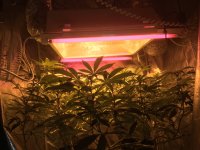
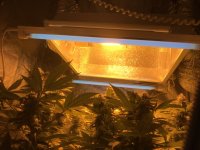
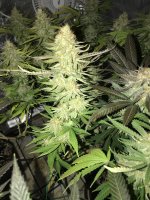
I use this method in my grow. I used MH to veg and first 2 weeks of bloom. After that it’s HPS with red T5 tubes to supplement. The reds really increases the bud size. The last 2 weeks of flower I switch the red t5 bulbs out for UV ones. This increases THC production.
 

Attachments

  • photo75231.jpg
    photo75231.jpg
    2.1 MB · Views: 0
  • photo76590.jpg
    photo76590.jpg
    2.2 MB · Views: 1
  • photo76968.jpg
    photo76968.jpg
    2.9 MB · Views: 0
I like your set up! That's exactly how I wanted to add my supplemental lighting. I'll have to ask about those bulbs to see if anyone carries them near by. I like the idea of the uv bulbs
 
One thing to note is the UV is intense. To avoid burning plant material, set it to run for 15 min every 2 hours. Otherwise you will cook your girls like I first did. 😭
 
The emerson effect found by emerson in 1957 was about the discovery of distinct photosystems and not with an enhancement to photosynthesis. Although photosynthesis increases, this is only with respect to the parameters with which he was comparing them too. And is not at all applicable to typical conditions. He was merely able to identify there were multiple photosystems which co-operate together as shown by the increased quantum yield when used together compared to on their own.

Photosystem I (P700) which exhibits this enhancement effect is very inefficient. The system absorbs wavelengths between 680-730. Which at 710nm, quantum efficiency is typically around 10% of that of light used by photosystem II (P680) at 680nm. And at 720nm around 1% efficiency. This decrease in efficiency is called the red drop effect, which was also discovered by emerson. So even if there were such an enhancement. This alone would prevent any realistic benefit.

You may be thinking, if photosystem I is so poorly utilized. Why is it even used by plants ?. Well it is... Just not directly through these wavelengths. PSI and PSII work together using light of 680nm or greater. Through the Z scheme, the energy from light is passed through electron transport systems between photosystems where they work together to produce the final product of photosynthesis.

For those that are interested. Plants use energy from light, to power the light dependant reactions. During the light dependant reactions, water molecules (h20) are split, producing electrons, hydrogen ions and oxygen (o2) as a byproduct. Electrons and hydrogen ions are used to manufacture intermediates, ATP and NADPH. The intermediates from the light dependant reactions are used to power the chemical stages of the light independant reactions. Or commonly called the calvin cycle. ATP and NADPH power the carbon fixation (Co2) to create the ultimate product of photosynthesis, carbohydrates.

Now the other end of the far red sword is with its use as supplimental lighting. But there are issues with why and how they are used. As i had previously mentioned, the use of far red light above 680nm, is highly inefficient. Due to the red drop effect. So its use for photosynthesis and yield increase is pointless. There is however a benefit of using far red light (730nm and higher) for phytochrome manipulation where PFR proteins are converted to PR more quickly. What this does is allow cultivators to be able to use less dark cycle and more light cycle compared to traditional cycles, without affecting the photoperiodic effect. Meaning instead of having to use 12/12, one can use 13.5/10.5 or even as much as 14/10. With the same flowering effect as 12/12. Allowing more light amd potential yield. But whats important to understand is that, in order to benefit from this accelerated phytochrome conversion. The far red lighting must be used imediately after the light cycle, while the lights are off. With a duration of about 5 minutes. So it makes no sense to include far red lighting as part of the main light source during the light cycle.

 
Wow. Thank you so much for taking the time to explain things so well. That is very interesting. So I guess I should probably save myself the cash and invest in something more efficient for supplemental lighting.
 
So it seems like using 660 nm in combination with 700 nm is better than just using 660 nm alone ( I am currently supplementing 660 nm only). And far red has the ability to aid the nightly conversation that would typically happen over a longer period of time (if far red was not available). Basically both together increases the rate, allowing the conversion to happen faster and more efficiently. Giving the ability to handle longer days with out creating reveg or Hermies when used properly.
But 660 nm does enhance photosynthesis when used alone, just not as efficiently as having it combine with 700 nm.
Is that correct?
 
So it seems like using 660 nm in combination with 700 nm is better than just using 660 nm alone ( I am currently supplementing 660 nm only). And far red has the ability to aid the nightly conversation that would typically happen over a longer period of time (if far red was not available). Basically both together increases the rate, allowing the conversion to happen faster and more efficiently. Giving the ability to handle longer days with out creating reveg or Hermies when used properly. But 660 nm does enhance photosynthesis when used alone, just not as efficiently as having it combine with 700 nm. Is that correct?
The process of photosynthesis is dependent on two photosystems. Where photosystem II (oxidation) requires photons of 680nm or less and photosystem I (NADPH+ reduction) with 700nm or less. Emerson first noticed when working on the quantum yield tests of photosynthetic organisms, that the efficiency declined at wavelengths above 680nm. Which was later called the red drop. At the time this was confusing with current understanding on photobiology as quantum yield should be linear up to 700nm. Later on with his experiemnts, he found that this red drop deficiency could be prevented (up to 700nm) by supplimenting with wavelengths below 680nm. This was the main driver for the discoveries in multiple photosystems and the current theory on photosynthesis (Z scheme).

The reasons for the red drop and enhancement effect were later discovered by others, which showed that when monochromatic testing of quantum yield above 680nm were used, this energy was insufficient to drive both photosystems. This is because of the energy barrier difference of P700 to P680. And so quantum efficiency declined as a result of the imbalance of photosystems.

Again this is not something that is enhanced if far red supplimentation is used. Because this phenomenon is conditional only to the parameters with which was used in these experiments. And so the main outcome of the expirments was not a photosynthetic enhancement property (because there is none), but merely the research that lead to the discovery of multiple photosystems. The enhancement of photosynthesis seen by emerson only occurs because of the monochromatic spectrum used. In that far red at 680nm-700nm would only activate one photosystem (PSI), but not both. And so photosystem II would act as a bottlekneck for photosystem I. Where as wavelengths below 680nm drive both PSI and PSII equally.

Under normal conditions with practically all typical grow light sources, both photosystems are driven equally and so no enhancement is to be had. Wavelengths that preferentially activate photosystem I and cause the red drop effect is between 680-700nm. Beyond 700nm, there is very little energy to be able to drive photosystem I and beyond 730 it is ineffective. Again because of this energy barrier difference. Its a bit of a laugh really for those manufacturers that advertise the emerson enhancement effect but yet their products fall outside the 680-700nm range to support their own hypothesis (looking at you rapidled).

With respect to your other question. Yes far red encourages the conversion of phytochrome protiens more quickly. But remember, the benefit of this can only be seen when the cultivator takes advantage by increasing the light cycle and uses this spectrum at the beginning of the dark cycle only (not during the light cycle). On its own without light cycle changes, it has no effect.
 
Ok. Got it. So for the Emerson effect...If I left a 730nm red light on 15 min after lights out, then I can increase my lights on time by 2 hrs. Meaning 14 on and 10 off. The extra light hours is what leads to increased yields.
 
The emerson effect is unrelated to phytochrome manipulation. But yes, using far red after lights out allows longer light cycles which leads to increased yields due to more total light energy (does nothing for autoflowers).
 
For sure. I only run photos anyway.
When the lights go out, do I continue to run my 660 nm light, or just the 730 nm alone for 15 min after?
 
660nm is not far red so will have no effect on Pfr phytochrome conversion. Pfr degrades in the abscence of < 700nm so it requires wavelengths higher than 730, preferentially at least 740nm to avoid proximity to the Pr proteins. Using 660nm is quite pointless during lights on and serves only to reduce the efficiency of the grow as the photon efficiency is very low. Hope it all makes sense ;)
 
Yes, I got it. But this is supplemental lighting I am talking about. Not the main source. Even with low photon efficiency I am able to reach places in my garden that my main source typically leaves in shadows. So I wouldn’t say it’s pointless, but I understand that the shorter wavelengths won’t travel as far as say blue light could.
I was under the impression that red light was best for stimulating plant growth. I was taught that red light was the easiest for the chlorophyll to absorb, and it was far more effective to photosynthesis. Would you say that is true?
Seems like I need to find a far red light (740nm) to run alone for 15 min after lights off in order to gain the yield benefits of additional day light hours.
Thanks for all this information on this subject. I’m going to give this a try if I can find one with the proper far red spectrum. Do you know of any low wattage far red grow light manufacturing companies that make a true 740nm model? Or is this more of a DIY LED light project?
 
Last edited:
For purposes of experimentation, wouldn't a good old fashioned incandescent bulb suffice? They throw a ton of IR.

From a personal perspective, I'm seeking quality over quantity, so my next lighting investment will probably be at the other end of the light spectrum. Resin / UVB correlation seems intriguing.
 
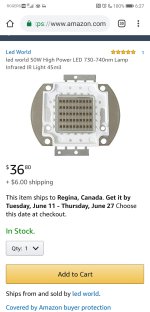
Yes, i saw that too. Only, that’s just for a diode. It’s a component to a DIY LED light. You still need a frame and power drive to make it work I believe.
 
Back
Top