No Title
alltatup `A
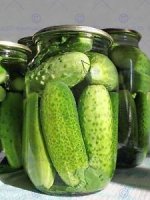
pickled cucumber (commonly known as a
pickle in the United States and Canada or generically as
gherkins in the United Kingdom, Ireland, Australia, and New Zealand) is a
cucumber that has been
pickled in a
brine,
vinegar, or other solution and left to ferment for a period of time, by either immersing the cucumbers in an acidic solution or through
souring by
lacto-fermentation.` and
`Gherkin
A gherkin is a variety of cucumber:[SUP]
[1][/SUP] the
West Indian or burr gherkin (
Cucumis anguria), which produces a somewhat smaller fruit than the garden cucumber (
Cucumis sativus).[SUP]
[2][/SUP] Gherkins are cooked, eaten raw, or used as pickles.[SUP]
[3][/SUP] Gherkins are usually picked when 4 to 8 cm (1 to 3 in) in length and
pickled in jars or cans with vinegar (often flavoured with
herbs, particularly
dill; hence, "dill pickle") or brine. Sugar is also a popular addition, in which case the label typically shows "Sweet Gherkins" whereas ` [h=3]Kosher dill (US)[/h]
A "kosher" dill pickle is not necessarily
kosher in the sense that it has been prepared in accordance with
Jewish dietary law. Rather, it is a pickle made in the traditional manner of Jewish New York City pickle makers, with generous addition of
garlic and
dill to a natural salt brine.[SUP]
[5][/SUP][SUP]
[6][/SUP][SUP]
[7][/SUP]
In New York terminology, a "full-sour" kosher dill is one that has fully fermented, while a "half-sour", given a shorter stay in the brine, is still crisp and bright green.[SUP]
[8][/SUP] Elsewhere, these pickles may sometimes be termed "old" and "new" dills.
Dill pickles (not necessarily described as "kosher") have been served in New York City since at least 1899.[SUP]
[9] Below I give you the mighty Gherkin, a true culinary experience....like eating the offspring of a small cucumber and warty toad
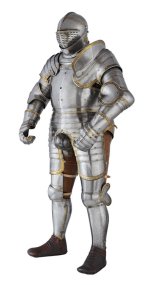
A gherkin has never given it`s name to anything armour wise though the nearest would have to be the humble Codpiece `[/SUP]A
codpiece (from
Middle English:
cod, meaning "
scrotum") is a covering flap or pouch that attaches to the front of the crotch of men's
trousers and usually accentuates the
genital area. It was held closed by string ties, buttons, or other methods. It was an important item of
European clothing in the 15th and 16th centuries, and is still worn in the modern era in performance costumes, for rock music and metal musicians, and in the
leather subculture, while an
athletic cupprotects in a similar fashion` (Pic below) Personally, I always thought you were at risk of a sword glancing down the front of your armour in battle and chopping it off but since it hasn`t gone down as one of history`s greatest blunders, guess not


 Pic`s 1-2....Pic 3 is another lass have a trim, feed and structure