What's new
GrowWeedEasy.com
You're browsing as a guest. Sign up to join the conversation, share your grows, and get help from thousands of fellow growers — it's free and takes less than a minute.

can anyone exsplain why/how defoling increases yeilds?

When a plant is outdoors- the sun travels across the sky and provides light to all parts of the plant-
Indoors the light is stationary and directly above- so defoliation is effective in getting more light to more buds.
 
This crossed my mind but im not convinced, all you would be doing is changing the area where light is being delivered. You would not gain any more surface area if the canopy is already filled. The amount of photons leaving the light source that reaches the plant, still ends up being utilized, regardless where it lands.
Theres also the issue of the shade leaf being exposed, leafs that are shaded are biologically structured for specific light levels. This is the prime reason why moving plants from indoors to outdoors can be stressfull as their ability to process light is different.
 
I have witnessed explosive growth after hard core defoliation on many,many pot plants. Different strains vary with defoliating, some like it alot, some not so much. Just don't take to much green. It will help with your yield, at least it always has helped with mine.
 
It has gone both ways for me- here is a side by side that simply didn't work. http://forum.growweedeasy.com/forum/...oe-og-kush-50g -It was an anomaly for my grows.

I attributed it to a strain (sativa) that doesn't respond well, as I have had great results when defoliating.

Mostly I use LST/defoliation as an aid to obtain the best canopy when I grow several different strains together!
 
I would love to see this as well side by sides arnt always good because different strains act differenly to stress so a more accurate peace of evidence would be nice if anyone has found any saying ya or nay
 
There's an internet full of studies... again nothing with cannabis directly, but the usefulness of defoliation on plants abounds.

The 2 things that limit study on cannabis is well, prohibition makes study difficult, and Summer Annuals like Cannabis are more difficult in a test environment than grasses and perennials. These are just 3 that a simple google search will bring up.
[h=2]Abstract[/h] 1 Competition is considered to be one of the main biotic factors shaping plant communities. Experiments on the role of mycorrhizal symbiosis in plant competition have reported conflicting results. 2 We studied the effect of arbuscular mycorrhizal symbiosis on below-ground interactions between seedlings and established adult plants in a system where plants compete for below-ground resources. In this glasshouse experiment, seedlings of Gnaphalium norvegicum were grown with and without an arbuscular mycorrhizal fungus, in the presence and absence of a large conspecific adult plant. The ability of adult plants to support the fungus was modified by defoliating 0%, 50% or 75% of its leaf area. 3 We found that mycorrhiza increased below-ground competitive intensity. The mycorrhizal benefit to the seedlings was low in the vicinity of non-defoliated adult plants, but increased with increasing defoliation intensity of the adult plant. This was mirrored by reductions in mycorrhizal benefit that adult plants gained at the highest level of defoliation. 4 These results emphasize the importance of below-ground competition during seedling establishment and show that competition for mycorrhiza-mediated resources may be an important factor underlying seedling establishment in nutrient-poor systems. Defoliation of neighbours can increase the beneficial effect of mycorrhizae to seedlings establishing in the vicinity of larger plants, suggesting that grazing or mowing may improve seedling establishment by decreasing below-ground competition.

...

Results for total carbohydrates mirrored those for concentration, but were not as significant. Our findings were consistent with the idea that faster growing species respond more rapidly than slower growers to defoliation, through changes in carbohydrate pool concentrations. Growth rate as an indicator of life-history and ecological strategy may therefore be key to understanding post-defoliation recovery and storage strategies.

...

ABSTRACT

Mustard (Brassica juncea L.) is characterized by a large number of leaves in the lower layers. These leaves are poorly illuminated, remain below the light compensation point and abscise at maturity. The effects of removing 50 % of all leaves taken from the lower half of the plant at 40 (pre-flowering) or 60 (post-flowering) days after sowing (DAS) were studied on photosynthesis and growth at 80 DAS and on yield at harvest. A comparison of stomatal and mesophyll effects on photosynthesis upon removal of such leaves was also made. Defoliation at 40 DAS resulted in a higher rate of photosynthesis (P[SUB]N[/SUB]), growth and yield compared to defoliation at 60 DAS or the no defoliation control. The non-significant variation in stomatal limitation (I[SUB]S[/SUB]), increased activity of carbonic anhydrase (CA) and constant C[SUB]i[/SUB]/C[SUB]a[/SUB] ratio in defoliated plants suggest that the main effect on P[SUB]N[/SUB] was through enhanced mesophyll rather than stomatal effects. Defoliation at 40 DAS caused the greatest emergence of new leaves with rapid growth, which contributed to maximum leaf area as well as leaf and plant dry masses. The favourable effects of defoliation at 40 DAS on photosynthesis and growth were reflected by seed yield and attributing parameters.
 
Well now that's where the controversy lay, lol.

It honestly appears to be a plant by plant (species) situation. Works for this but not for that. In general it seems usually good for grass type plants, terrible for tubers and hit or miss for others. And many are looking at it from a damage perspective from natural problems rather than a system of training.

And like so many things it depends on what one is trying to accomplish, It may not increase yields in and of itself, but on an individual level where one is fighting space being able to utilize say 8" of otherwise "dead" space could easily increase yield even if the defoliation results in no, or even a small decrease in "normal" plant yield.

I would think it also depends on the light, it seems you'd have to have a light with good penetration potential to take full advantage.
 
Actually i have read all the major studies on defoliation for many species of plants, as i have described previously, they all come to the same conclusion.
When it comes to the management of the plant for structural or environment reasons, this is really classified as plant training or pruning. Especially selective removal of leaves is not really defoliating.

I have actually spent the last couple of days on the subject, looking at practically all material relating to defoliation. I thought i might even find some reason that could convince myself of the possibility. However it went completely in the other direction. I will likely do a follow up post of my research.
 
I yield to the man who has read every major report on the subject. I personally haven't read them all. Looking forward to your summary.
 
First off, i looked at this objectively and went through all possibilities from a scientific stand point.

I will cover the main theories behind the technique and what we know about each.

Air And Light:
A traditional theory is the exposure of air and light to the bud sites, increasing said factors by removing obstructing plant material to facilitate more growth. It makes sense when you first look at it and people have tried it and agree it "appears" to improve things. However a deeper look shows that cannabis is a 'Angiospermae' or an anual flower. Which contributes little to no photosynthate.
Here someone called THC-Farmer describes his highly educated opinion and experience on the subject.
He details an experiment where he had a control and a variable. With the variable he removed all leaves during flower, including the new developing leaves from the flower. He wanted to see if any photosynthetic capacity was viable from the cannabis flower only. To no surprise to myself or him, the plant died within days after. Many other science articles have shown this also, that flowers, even though containing some amounts of chlorophyll, typically do not hold the ability to photosynthesize. Its just not possible. The smaller but underdeveloped leaves do contribute to photosynthesis, however they cannot compensate enough to compare with more mature leaves.

So exposing air or light does not appear to offer any advantage to the flower development. One could argue that reducing foilage will help with air movement and light penetration, however this is only going to end up with the same 'total' photosynthetic yield. All that is changed is where the photons will land. Infact exposing shade leaves could be harmful as i have previously said about shade vs sun leaves.

Stress & Phloem Translocation:
This was the more logical theory for myself, as it does seem possible but only lacks the evidence to support it.
Studies on defoliation have showed that a majority of species of plants, show an ability or buffer to compensate for some type of structural damage during its life. Its almost expected by plants that some event will happen and that it be prepared. What defoliation studies have in common, is that plants are not negatively impacted by the loss of leaves up to a certain point (around 25%). It seems that a plant will typically have more leaves than it requires, almost as if history has taught it to anticipate the loss of leaves through enviromental factors. This was some of the conclusions by people conducting these studies.

Now a plant holds the ability to store nutrients (carbohydrates) in its roots, this is its major sink during early growth and vegetation. However in the event of stress, injury or sickness, a plant may be able to redirect this stored nutrient through a process called phloem translocation. A lot is still unknown about this process but it does appear to function this way in some types of plants. These types of plants are ones where all top growth can be removed but still have enough stored energy to revegetate. Cannabis does not hold this ability but it may be possible that all plants have some degree of stored energy to respond to stressful events.
In the defoliation studies some report the event where the variables grew taller than the controls. Suggesting that the plants response to reduced number of leaves caused them to branch out to create new leaves to sustain its level of performance. This response could be aided by phloem translocation. This also brings up the interesting prospect of why supercropping (i like to call it scropping) may increase growth and vigor.
However, to all extent there has been no evidence to support this.

Leaf Age & Exposure To Light:
This is also a possibility however i would not consider this part of traditional defoliation and more selective that would really be classified as pruning.
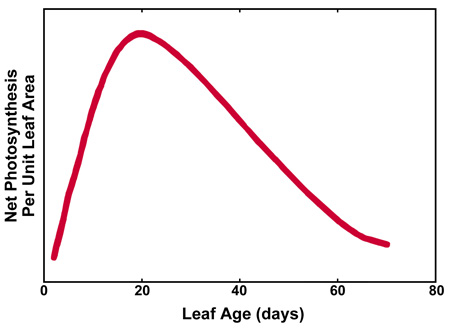
As a leaf ages, its ability to photosynthesize follows almost like a bell curve with a peak around 20 days.
B1252-10.jpg

​

Here it can be seen how leaf age is very impacting on its photosynthetic capacity. As the leaf gets older, certain fundamental building blocks responsible for key aspects in photosynthesis, start to be reduced and focused on younger leaves. The amount of chlorophyll does not change. Its just the priority by the plant has shifted. This is why older leaves start dropping off at the bottom when the plant decides it is no longer needed.

With more selective pruning of leaves, it is likely that energy wasted keeping leaves alive that provide very little in return may help develop a plant faster by directing energy where it is most efficient. To some extent plants do this themselves, like how leaves are abscent inside a bushy tree. We do this also by methods such as lollipopping or plant training. By developing a structure that is more efficient for a specific environment. As said however this is a proven method and is practiced throughout horticulture. The traditional method of defoliaiton is a non selective process that removes specific amounts of leaves at specific times. Whats usually practiced and is learned through experience is how much is too much, when & how often such a process should be used during a plants life.

Evidence:
This has been the most dissapointing aspect of my findings. Although then again maybe not.
I looked all over for any and all controlled comparisons, comparing defoliated plants to controls. Unfortunately i found very few. The ones i did find showed clear indications of no improvement but infact a decline in yeild. You would think of all the people who have grown, they would have done such a simple experiment. However it seems people keep insisting on doing the method without controls and make subjective opinions on the matter. The most surprising one is where people defoliate and somehow are surprised that a few days later there is more growth. Then conclude the success of their experiement. I cannot enough make it clear how important controlled side by side comparisons are. This is to remove any and all variables that you 'may' or 'may not' expect, regardless of what you have experienced in the past. Visial bias alone is enough to convince somone of something that is not true, i have much experience with this from my audio engineering side. Not everything is as it appears.
I have been through many forums and threads where people claim once and for all to answer this issue and would conduct a controlled grow. Only to almost always fall through and never return, countless threads encouraging people to post their results. Nothing, ever at all comes to light. Only the select few that seriously go through with it, end up showing the failure of defoliation.
Most who are educated in botny or horticulture almost always seem to disagree with the method. Field experts in commercial grows do not employ techniqies, even though there are ways of doing it efficiently. Studies find no connection, no evidence of any kind. It can only really indicate one thing. We like cheeseburgers.

If anyone has any other possible theorys or further information on the subject that may be interesting, please let me know. If there is anything that may show otherwise i am happy to know, however as it stands i am unconvinced. This is not the first time i have gone away on this subject and come back with the same conclusion.

 
Nice write up!

I find it interesting that your graph and the aggressive defol each agree on the ~ 2 week mark.

I've read THC Farmer and yes pulling all leaves wasn't a surprise in the results, but that isn't the case with the tutorials or the methods mostly used, that I've run across, so I'm not sure that it applies well. I'm still new so I got a bit to go before experiments are going to happen but it's in the plan. It's one of the main reasons I went with a 2 tray set-up rather than a single table.
 
Well when I get to it I will post :)

It would seem just as important to post a bad result.

But yes that would be a very possible conclusion, unfortunately.
 
No it may not apply much, however i felt it enough to include to rule out this aspect anyway.
Perhaps the idea of more airflow and light penetration needs more looking into, but i cannot think of anything else. I cannot see from a biological point of view how it could possibly make a difference.
 
Back
Top