What's new
GrowWeedEasy.com
You're browsing as a guest. Sign up to join the conversation, share your grows, and get help from thousands of fellow growers — it's free and takes less than a minute.

Building new light

RosettaStoned

New member
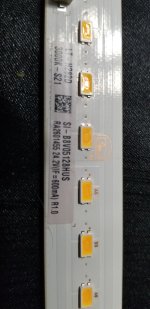
So here I go, got all my parts. This light will have 32 2' samsung lm561c light strips. They will be ran parallel and series to get the proper amps per strip. If all the specs are followed and achieved it should run just under 400 watts.
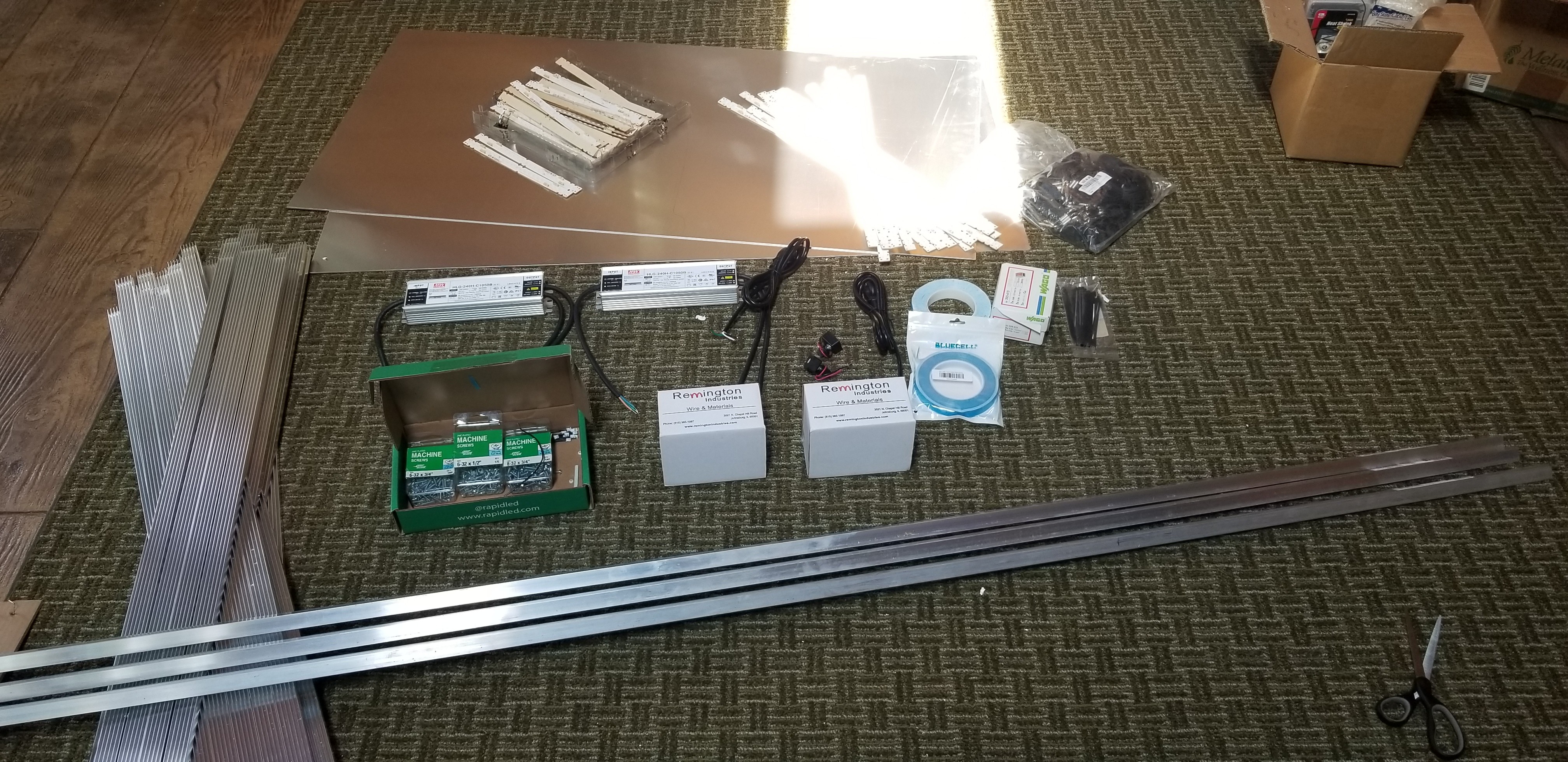
20180811_151021.jpg

all of this will become 2 2'x4' frames with 16 strips each.
.525 A a strip, luminous flux of 64,000 x .014= 896 PPF / 394 watts = 2.27 umols/s. I think that is correct DANGERDAN would know.
 
I would like to see the concept, i assume its going to be a oblong rectangle ? I also assume that its going to be 400 watts total so 200 watts per 2x4 fixture ?

Working out the accurate light output is a little more complex than what we have previously discussed. First theres the effeciency of the drivers, which are around 90% each. So you can take off 180umol, making it 714umols and 1.78umols per watt.

But then to make matters worse, the photon efficiency is highly dependant on several variables, such as diode temperature and drive amperage. These completely change the aspect of how efficient a fixture will be. Here is a diagram for your diode model.


Screenshot_20180812-092223_Drive.jpg


Not to mention the optical and radiative losses.
​​​​​​
The luminosity per watt values that are usually provided by diode manufactureres are theoreticle values which are only achievable under unrealistic ideal conditions. So one must use the datasheet provided by manufacturers in order to calculate a realistic value.

I know you were probably just after approximate figures, however its not even an approximation. The variables make too much of a difference that it makes simple calculations unrealistic.
 
Well really i was the one who misguided you with our previous conversations. I dont think i understood how large these variables are. The photon efficiency values i provide in my articles are including the losses of the ballast, lamp and luminaire. Which is much more valuable information than just the lamps efficiency and output on its own.

LED is no different, as they have losses for drivers, diodes and optical and luminaire losses. The only manufactureres i know that actually provide a accurate efficiency value that includes all those variables, are chill led and fluence. Which they have undergone full testing with full sized integrating spheres. Most other manufacturers use only simple calculations which provide only inflated values that do not accurately represent the true capacity of the light source. This is actually worse than i originally thought. The better ones may choose to include accurate temperature and optical losses into their calculation, providing a more true approximation.

The best way to calculate a fixtures efficiency, is to use the datasheet for the diode. Measure the temperature of the diodes under load (ideally using a laser sensor), longer than say 10 mins. Then corrospond the temperature with datasheets values, which should give you the lumens per watt value. Then corrospond that new efficiency data with the drive current you are using. Which should give you the total luminous flux. You then must also calculate the losses of the drivers and any optics or reflectors you may be using. The optical losses would again be provided by the data sheet from the optics manufacturer.
 
Not really ^.^

They use dual cooling systems for a reason, it improves the diode efficiency alot. So comparisons cannot be made.
 
Got this far today
Click image for larger version  Name:	20180812_133059.jpg Views:	1 Size:	1.76 MB ID:	235628
Click image for larger version  Name:	20180812_175740.jpg Views:	1 Size:	1.63 MB ID:	235629

one 2x4 with heatsinks and strips attached with thermal adhesive tape. Next drill out marks and tap for machine screws to hold them in place. Attach the aluminum angle to the edges for a place to hang it from and also make the sheet rigid. Build a small frame for the driver to sit. Wire it up.
Apparently I should have smoked before starting. I put one strip on backwards, or three....depends on how you look at it. Either way, now I HAVE to make the second the same. Its just the way I am. I justified not moving them because 3/4"is not going to make a difference in light output. It still drives me nuts but the mess of cleaning and scraping up the thermal tape makes me crazy too.
 
Last edited:
Required.....
1 2'x4' .09" 3003-H14 aluminum sheet - Amazon 
16 45"x1" aluminum heat sinks - heatsinkusa
12' 3/4" aluminum angle .8" thick - HD
18 gauge wire red/black - Amazon 
6-32 and 8-32 1/2" machine screws - HD
20mm and 25mm thermal tape - HD
wago connectors - HD
8 2' 4000k strips and 16 1' 3000k strips - digikey
1 HLG 240H-C1050B driver w/ potentiometer for dimming - rapidled (efficiency 93.5)

I ran the 1' strips parallel to increase the amperage they can handle (1.2 A max). Then ran the 2' parallel with the 1' s to make 8 strips, now they can handle 2.4 A max.  The sweet efficient spot is .96 A for the entire 4' per strip.  I'm at 1.05 A per 4' strip at max power.  So not far off, and can dim to make that sweet spot.  Would need a meter to find it though.....Full power it is.  

Forgot this, 22.8 V * 8= 182.4 * 1.05= 191.52 Watts
If all specs are met I should be getting around 180 lumens/watt minus the losses. Now I'm sure DANGERDAN will intellectually tear me a new ass for mentioning the PPF again, so I'll leave it there. Although....I believe he is just a giant brain connected to a super computer. 😁😉
 
Last edited:
That looks real clean, i see you used some kind of railing for the outer egdes to mount your hangers on. 👍
 
Thanks! I looked into optics but I didnt find any that could cover two strips with two focal points. I did leave room on the driver to add colored monos at some point. Would you blend colors or stick with 660 and far? DANGERDAN
Right now the heatsinks feel room temp. That's at max power, monos will change that.
 
Mixing colors is fine, in fact its actually more efficient to use multiple spectrum diodes such as 450nm blue and warm white together rather than just a full spectrum cool white diode. The reasoning for this is a little complex, i talk about it here in this thread. Ultraviolet has been shown to help with THC production in cannabis. However you want to be careful when using UV as it has also been shown to negatively effect photosynthesis in plants and reduce yield as a result. Common practice has it that it is best used in the last weeks of flowering, usually 2-3 weeks.

Far red has not been shown to have any positive effect in plants. If used during vegetation it will negatively impair growth by stimulating photoreceptors that create elongation, leaf expansion and more. What it can do is help reduce the dark cycle in flowering to allow more light to be used during the light cycle. This is done by using far red (700-750nm) at the beginning of the dark cycle which shifts the plant into sleep quicker, so to speak. This has been shown to reduce the required dark cycle by around 2 hours. Effectively allowing the light cycle to operate at 14 hours rather than 12 hours but still induce flowering.

Infrared has no effect on plants at all, its effectively just heat. Light manufacturers sometimes use infrared to mean far red lighting. Or they really are infrared and are just advertisement gimmicks. Infrared operates over 800nm, far red is around 700-800nm.+ More Options
 
Back
Top