What's new
GrowWeedEasy.com
You're browsing as a guest. Sign up to join the conversation, share your grows, and get help from thousands of fellow growers — it's free and takes less than a minute.

Brown thumb grow

Burro? Burrow? Bureau? The other bureau?
If you right-mouse-click on a red underlined, misspelled word, it will give suggestions.
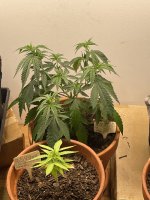
 
Click image for larger version  Name:	IMG_1503.jpg Views:	0 Size:	2.00 MB ID:	632975 This picture was taken at 2:30 pm before I watered this plant. It is a 10” diameter pot and I put 500ml of water in it. The ph of the soil measured 7.0, 7.1.
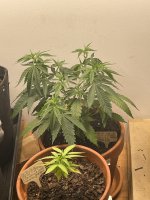
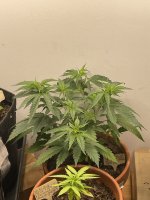
Click image for larger version  Name:	IMG_1503.jpg Views:	0 Size:	2.00 MB ID:	632975 This picture was taken just after 6pm. The bottom leaves have perked up quite a bit but not the top leaves. Is this what to expect or do the top leaves normally get perky also? To me the darker leaves look healthy and I like the way this plant looks. It is a Northern Lights variety. (I have others which are not as dark green.) is this a healthy looking plant and what I want my other plants to look like?
(I would not normally ask such a question but there is a category of problems on the leaf troubleshooting chart under dark green leaves.)
 

Attachments

  • IMG_1503.jpg
    IMG_1503.jpg
    2 MB · Views: 2
  • IMG_1505.jpg
    IMG_1505.jpg
    1.9 MB · Views: 2
Last edited:
@Rwise
About the pelleted dolomite and sulphur for raising and lowering the ph; is this because it is a “gentler” way than ph up and down?
 
Last edited:
I would not trust that to be a calibration, mine uses 2 fluids one 4.0 and one 7.0 to calibrate, as suggested before one could get these solutions to test with to see where it falls.
 
I got my answer. It’s 7:45am the next day (today) and the upper leaves have perked up. I took a picture and if I could find out how to post it in this comment I would show it. But I can’t find the button.
 
Someone might post a timelapse video for you so you can see how plants do that thing with the leaves. They look like they're trying to fly.
I haven't said it so I'm going to say it because I've wanted to say it and I won't bring it up again. Upsize those pots!
I feel better.
 
Someone might post a timelapse video for you so you can see how plants do that thing with the leaves. They look like they're trying to fly.
I haven't said it so I'm going to say it because I've wanted to say it and I won't bring it up again. Upsize those pots!
I feel better.

I’m really glad that you said that (upsize those pots!), because I need help with that. I do have 3 gallon fabric pots (just received my second batch of 5) to transplant into, and I have plants growing in 8” and 10” clay pots that need transplanted. What I lack is knowledge and experience. [because of size constraints I cannot go larger than 3 gallon fabric pots.]
The last time I tried this (and the one and only time) I had a hard time getting the root ball out of the pot. I read up on it since then and discovered that one of my mistakes was that I didn’t water the plant the day before. The soil was too dry. (I mistakenly thought you wanted it dry, but apparently not 3 days worth.) I do have a flexible piece of metal that I can run around the outside of the root ball and inside the pot, so I think I got that right.
Do you have any other advice for extracting a root ball from a flower pot?
 
Last edited:
A knife works well to separate the root ball.
My method is to put my hand over the soil with the trunk between middle and ring fingers and invert the pot. A few taps on the bottom should loosen it.
 
@Gingerbeard
That is sort of what I tried, I mean the inverted pot with stem between my fingers. Hopefully the soil was just too dry.
When you say a knife works well to separate the root ball, what are you referring to exactly?
 
Gingerbeard
I see. And it may interest you to know that I’m using a violin separation tool. A fiddle is about 8-1/2” wide. I do repair occasionally and so I have a tool on hand that is 9” long (plus the handle) and about 1” wide, that works real well for going down inside the wall of a flower pot.
Edit: PS. I doubt it is called a violin separation tool. In fact that tool would be short as it need not go all the way across. I don’t remember what this tool is called but if you are looking in luthier tools you can find it.
 
Last edited:
Perfect blade. It is the bigger plant in post 16 I was referring to.
Don't repot post 19, yet.
That root ball will be small and airy and has not had a chance to ball-up, if you will.
Repotting is usually done when the roots have had a chance to fill the pot and the drip line has reached the edge of the pot. They hold together much better and do not stress the roots as much.
You are losing no root space keeping that plant in that pot, right now. Give it a bit.
 
Last edited:
Perfect blade. It is the bigger plant in post 16 I was referring to.
Don't repot post 19, yet.
That root ball will be small and airy and has not had a chance to ball-up, if you will.
Repotting is usually done when the roots have had a chance to fill the pot and the drip line has reached the edge of the pot. They hold together much better and do not stress the roots as much.
You are losing no root space keeping that plant in that pot, right now. Give it a bit.

thanks. I’m glad you stopped me in time, but just barely. I was trying to free the root ball and soil of 19 and decided to water it again and try tomorrow. The soil was breaking apart too much when I ran the blade around.
I was afraid you were referring to my prize plant in the 10” pot. The last prize plant I had is not one anymore due to repotting.
 
Back
Top