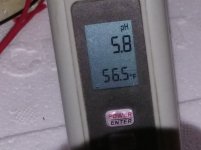
pH is calculated by the number of hydrogen ions in solution. At a pH of 7, the hydrogen and hydroxyl ions have equal concentrations, 1 x 10⁻⁷ M, keeping the solution neutral 27. However, these concentrations only hold true at 25°C. As the temperature increases or decreases, the ion concentrations will also shift, thus shifting the pH value 27. This response is explained by Le Chatelier’s Principle. Any change to a system at equilibrium, such as adding a reactant or altering the temperature, will shift the system until it reaches equilibrium again 28.
The equation:
H20 H+ + OH-
is an exothermic reaction 28. That means if the temperature of water increases, the equation will shift to the left to reach equilibrium again. A shift to the left decreases the ions in water, increasing the pH. Likewise, if the temperature were to decrease, the equation would shift to the right, increasing the ionic concentration and decreasing pH.
However, that does not mean that temperature changes will make a solution more acidic or basic. Because the ratio of hydrogen and hydroxyl ions remains the same, the acidity of water does not change with temperature 28. Instead, the entire pH range shifts, so that neutral water will have a value other than 7. Pure water will remain neutral at 0°C (pH is 7.47), 25°C. (pH is 7.00) or 100°C. (pH is 6.14).
http://www.fondriest.com/environmen...s/water-quality/water-temperature/#watertemp8