

GrowWeedEasy.com
You are using an out of date browser. It may not display this or other websites correctly.
You should upgrade or use an alternative browser.
You should upgrade or use an alternative browser.
My Raspberry Pi Grow Tent Controller

Mr.furley
New member
Nice box! Clean work. May I ask what you're controlling/ monitoring end game is?
I'm working on a auto doser with a Arduino but definitely not put together as far as you are, most the coding has been copy paste work so far as a refresh and other projects has table this project until winter for me.
definitely interested.
I'm working on a auto doser with a Arduino but definitely not put together as far as you are, most the coding has been copy paste work so far as a refresh and other projects has table this project until winter for me.
definitely interested.
Last edited:


OldManGrower
New member
Very nice! I too am a DIY-er and appreciate what you are doing here. But it exceeds my abilities to do one myself.

DW2
New member
Howdy tulabis, very interesting and exciting project! A long time ago, when I was working in manufacturing engineering, I did some basic programming for machines like plasma and laser cutters, milling machines, and some very basic ladder logic stuff. I have not kept up with all of the latest methods in the digital world, so this is somewhat 'new' to me. Please do keep us posted on your progress.

90Gizmo
New member
Might be interesting to RasPi techies. Talks about taking sensor readings and using AI to make decisions on what to do.
https://www.geeky-gadgets.com/best-g...ns-27-09-2022/
https://www.geeky-gadgets.com/best-g...ns-27-09-2022/
tulabis
New member
Nice box! Clean work. May I ask what you're controlling/ monitoring end game is?
I'm working on a auto doser with a Arduino but definitely not put together as far as you are, most the coding has been copy paste work so far as a refresh and other projects has table this project until winter for me.
definitely interested.
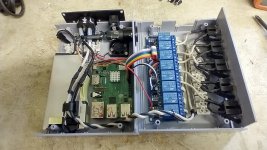
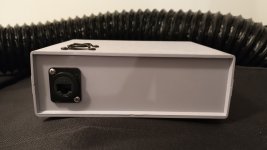
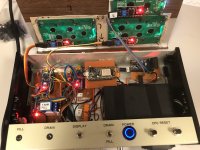
Currently it only monitors temperature and relative humidity (using a DHT22), and controls the lights, humidifier, and exhaust fan...however, it is set up to control up to 8 AC powered devices.
The software is ready for a heater if necessary, but I've yet to need that. If I was to need it, I'd be heating the closet in which the grow tent resides, rather running a heater inside the tent.
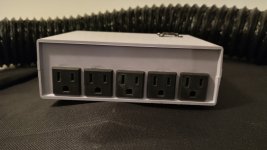
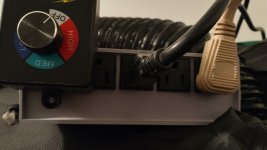
The only real oversight in this build was that, even though it has 8-relay controlled power outlets, I can only really use 3 outlets at once. Upon completing the case, only then did I try to plug the actual tent devices in, and only then did I realize my mistake in trying to make things as compact as possible...I made the damn outlets too close together, so transformer​ style plugs take up 3!! outlets. The outlets it's plugged into, as well as half of the two outlets on either side...DOH!
Also, in order to see what's going on in the tent, I need to pull up an SSH terminal to read the output from the python script that runs everything. Not really an oversight, but it is kind of annoying.
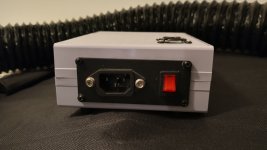
I used a power supply from a laptop charger to supply DC voltage needed to power everything, and I used a buck converter to bring down the 19VDC provided by the power supply, down to the 5VDC needed by the Pi, relay module, and sensor. The DHT22 is wired up with an ethernet cable for easy disconnect.
The software was written by me in Python. Nothing fancy, but it works. Might make the GitHub repo public if I ever get around to cleaning it up...
Version 2 Plans:
- Space out the outlets.................
- Convert DHT22 from the ethernet style plug to a USB style plug
- Completely rewrite the software in Javascript/NodeJS and create a web panel to store and display logs and analytics, as well as control and monitor sensors and output states
- Add an LCD screen on the case displaying sensor values and output states
- Add soil Moisture/PH readings
- Add an auto watering system (maybe)
- Project Enclosure ($11.49) [https://www.amazon.com/dp/B07ZRFMF82]
- DHT22 Temp/RH Sensor (2pk) ($12.69) [https://www.amazon.com/Temperature-H...dp/B07WP4VZTH]
- Buck Converters (10pk) ($15.99) [https://www.amazon.com/dp/B07VVXF7YX]
- Relay Module (2pk) ($12.99) [https://www.amazon.com/gp/product/B07C8LSXKC]
- Power Sockets (10pk) ($8.00) [https://www.amazon.com/dp/B078S17FZ5]
- Terminal Block (7pk) ($6.99) [https://www.amazon.com/dp/B08VND5XDN]
- Case Fan (10pk) ($14.98) [https://www.amazon.com/dp/B08KW6C84Z]
- RJ45 Socket $11.70) [https://www.amazon.com/dp/B081P826R6] (for easy disconnect of the DHT22 sensor)
- Power Supply Inlet ($9.99) [https://www.amazon.com/CGTime-Rocker...dp/B07FG7X9QF] (not the exact one I used, but very similar and what I plan to use in future projects)
- Raspberry Pi 3B+ ($149.00) [https://www.amazon.com/Raspberry-Pi-...dp/B01LPLPBS8] (3A would've fit better, but I didn't have one. And wow, that price is WAY up!)
- Header Jumper Wires ($7.99) [https://www.amazon.com/Solderless-Mu...dp/B09FPJ9TSP]
- Heat Shrink Tubing ($8.79) [https://www.amazon.com/gp/product/B07QM8249H]
Last edited:
tulabis
New member
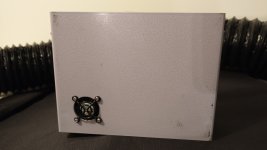
And some extra pictures...
And as mentioned above.. notice the fan controller plug takes up half its neighboring outlet, too...
And as mentioned above.. notice the fan controller plug takes up half its neighboring outlet, too...
Attachments

Insight
New member
I have been working on a Hydroponics Controller for the past years and have gone thru a few different phases. I have no training in programming. I've played around
with Raspberry Pi's and most recently...Arduinos
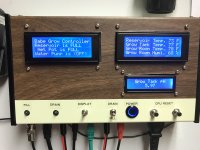
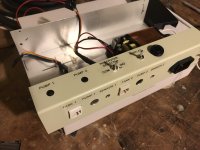
Originally I wanted it to control the level in the grow tank and reservoir. It will keep the grow tank full until it runs the reservoir dry or if there is a flood.
The grow tank and reservoir are 5 gallon buckets. I've been able to leave it and go away for 4 days, its really limited by the size of the reservoir tank.
Also wanted to monitor the tents temp and humidity.
After a while I eliminated the pH monitor...the probe would eventually fail if left in the grow tank 24/7. It also wasn't super accurate.
I eventually replaced it with a LUX sensor to measure the light.
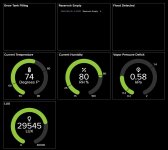
The latest version moved the Temperature and Humidity readout off the main unit and have it sent via WiFi to a "dashboard" where I can view the readings online, anywhere.
I'm glad I played around with the arduinos, it was extremely frustrating at times due to my lack of coding experience, but I cobbled it together and it works...good enough.
with Raspberry Pi's and most recently...Arduinos
Originally I wanted it to control the level in the grow tank and reservoir. It will keep the grow tank full until it runs the reservoir dry or if there is a flood.
The grow tank and reservoir are 5 gallon buckets. I've been able to leave it and go away for 4 days, its really limited by the size of the reservoir tank.
Also wanted to monitor the tents temp and humidity.
After a while I eliminated the pH monitor...the probe would eventually fail if left in the grow tank 24/7. It also wasn't super accurate.
I eventually replaced it with a LUX sensor to measure the light.
The latest version moved the Temperature and Humidity readout off the main unit and have it sent via WiFi to a "dashboard" where I can view the readings online, anywhere.
I'm glad I played around with the arduinos, it was extremely frustrating at times due to my lack of coding experience, but I cobbled it together and it works...good enough.
Attachments
tulabis
New member
I have been working on a Hydroponics Controller for the past years and have gone thru a few different phases. I have no training in programming. I've played around
with Raspberry Pi's and most recently...Arduinos
[...]
Very nice work, Insight!
What are you using for your dashboard front/back end? Coded by you?
This is my first time building an actual usable hardware project that wasn't confined to a test bench and breadboard, but, like you, I also have no formal programming training, but I do have some pretty extensive experience with "hobby" coding, in quite a few languages. I'm far less experience dealing with the hardware side of things, but I have also messed around a little with some very simple Arduino test projects.
As far as the PH probes go, I also got some of those as an afterthought, hoping to throw one into this project at the last minute, however, it wasn't until I received them and was working out how to implement them that I finally decided to read the reviews. I quickly realized the issue you mentioned concerning the probes eroding. I considered pressing on with the new plan to use one and only power it when it was actually taking a reading in order to (hopefully) extend the lifespan, however, I decided it wasn't worth including in this version as my original plan hadn't even included the PH probe and adding it with the auto-switching power feature would've meant moving everything to a new enclosure, after having it mostly completed and already being as cramped as it is inside.
Eventually I'll get around to testing out the auto-switching power theory!
My vision, as far as the enclosure goes, is quite similar to yours, with controls and readings accessible from the enclosure itself, as well as from the web. It's inspiring to see something so similar to what I'd like to achieve in the end...it motivates me to start work on version 2! Thanks for sharing!!

Going2fast
New member
Anyone else build one?
If so, did you write your own software?
​​​​​
I'll edit this later with details about my build, along with some more picture if anyone is interested.
Write your own software? I can only dream of being that intelligent. But I'm old so. Details please. I do build my own pc's so not a total newb.
Insight
New member
Thanks for the "flowers".
As far as the dash board, I'm using Adafruit IO..... https://io.adafruit.com/
The data from the humidity/temp goes to a Feather Huzzah ESP8266 and transmits wifi data to the dashboard.......... https://www.adafruit.com/product/2821
There are examples of code on the website, I also found some code that was for a burglar alarm to help me with getting the data from the ESP8266 to the IO dashboard.
The hardest part of the project turned out to be monitoring the fluid levels in the Grow Tank and Nute Reservoir. I first tried using small nails at different heights in the bucket. It worked well at first, but after about 3 weeks the electrodes (nails) disintegrated, so I switched to stainless steel and then brass screws, they did not disintegrate but got totally coated in some kind of salt which insulated them and stopped working. I never considered the effects of electrolysis. So then I tried ultrasonic detectors to detect fluid levels...it wasn't too stable due all the bubbles in the Grow tank, I tried making a "baffle" to shield the sensors..it worked better but after about a month, the ultrasound module would fail due to getting too wet from the bubbles and dampness. I finally found something called E-tapes and they worked the best and are still working after about 2 years. https://www.adafruit.com/product/464
As far as the pH probes, I'm not sure if cycling them on and off will make any difference. I think its time spent totally immersed in the nute solution...after a few months they start giving erroneous readings, I think reads too low..they all failed the same way.
The Lux sensors work well........ https://www.adafruit.com/product/4162
As far as controlling the Humidity with a controller... I think you'll need a variable speed fan motor.....So far I'm extremely pleased with the AC Infinity Cloudline with controller.
Good luck and glad you started this thread... maybe some others with better programming abilities will get involved.
Last edited:

Blowdout2269
New member
I feel like I'm on another planet right now...
This is all so interesting. I wish I knew more about how to do this myself! Definitely following along and re-reading, lol.
This is all so interesting. I wish I knew more about how to do this myself! Definitely following along and re-reading, lol.

UndergroundFarmer
New member
A homebrew Niwa! Cool! I'm running two Niwas in my tents. I only need a control for the lights, the exhaust fan (I tell the Niwa it's a dehumidifier) and a small no-frills heater in each tent. Have you considered trying to have your Mark 2 device run a contactor relay for an air conditioner?
90Gizmo
New member
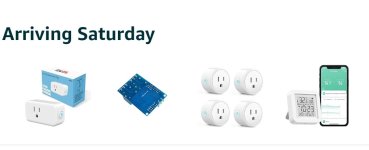
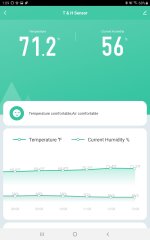
Well, I've done a 180 because I have so many electronics projects on hold (since I've gotten my Steam Deck) that I've decided on starting at a higher level. I've been looking at Tuya Smart components since my latest grow light is compatable and I've had good luck with it. So I've got four AC sockets for turning stuff on and off, one dimmer for controlling the fan (*might not work) and a temp/RH sensor for control input. That should be a good starting point for about $65 USD.
* Light dimmers and motor speed controllers can be different. The iPower duct fan uses a simple SCR for speed control so I've got my fingers crossed that the smart dimmer on order isn't any more fancy.
* Light dimmers and motor speed controllers can be different. The iPower duct fan uses a simple SCR for speed control so I've got my fingers crossed that the smart dimmer on order isn't any more fancy.
Attachments
Last edited:
90Gizmo
New member
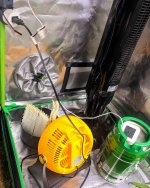
It's a start. I have my "humidifier" on a smart plug and the sensor wired. I'm not doing any control at this point, just monitoring. I expected I'd need at least 50% on the dimmer for the fan to start up. More like 60% but speed control on the duct fan is working.
Attachments

3Berries
New member
I took the rotary dimmer from my 4" inline and put it on a 4" axial and it worked, also starts up on the slow speed FWIW. Using it with a temp controller.
If the tent volume is large enough a constant slow minimum setting is nice. I use misters for humidifiers and add a bit of bleach to filtered rain water. In the tent that cycles on and off for humidity and temp gets a film build up. The tent with constant air flow, minimum of 1 out of 10, there is no build up.
But small tents are hard to control with constant air flow, usually getting too cold or dry. Too cold if it can't get the humidity down and too dry if it can't get the temp down.
If the tent volume is large enough a constant slow minimum setting is nice. I use misters for humidifiers and add a bit of bleach to filtered rain water. In the tent that cycles on and off for humidity and temp gets a film build up. The tent with constant air flow, minimum of 1 out of 10, there is no build up.
But small tents are hard to control with constant air flow, usually getting too cold or dry. Too cold if it can't get the humidity down and too dry if it can't get the temp down.
90Gizmo
New member
I hope come summer to use one tent to house the AC then run a blower to mix air into the growing tent as needed... I don't want to blow frigid air directly on the plants. The simple humidifier has a significant cooling effect... I need to study the complex interactions and test for some time before I'll feel good about leaving it running without supervision.