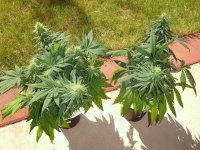
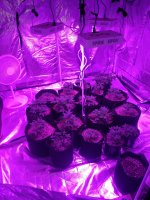
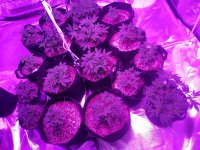
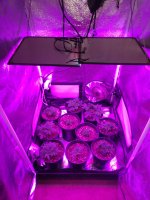
As mentioned, they like cooler light (in the 6000k 6500k range. But, the best veg lights I've used was a blurple LED. That created some very nice, tight, compact plants for a 4' tall tent. You'd see all that red and think it's not good for veg. But, the blues were enough to satisfy the plants.).
I'm growing two plants under ordinary household LED lightbulbs. I used 5000k "daylight" bulbs (the typical bulbs from the store) and they were still a little stretchy unless I put the light very close. Basically, I had to drive them hard with that color temperature. I was on the border of too much light. If I had used "cool" (6000-6500), I could have used less intensity.
I've never tried to veg under 3000k. I think it would just be more of what I experience with 5000k. You probably have to put the light very close. But, also risk driving them too hard.
If I were you, I'd go buy some inexpensive 5000k at the local Home Depot (or 6000-6500k online. But, you're needs are more urgent.). Get the kind with the base. There are newer LED lightbulbs that are like the old incandescent. They have a froted glass or plastic globe which goes all the way to the threads. You don't want that kind. It has "filaments" suspended in the bulb. You want the more common (over the past 5 years) LED lightbulb with the obvious base which runs halfway up the bulb. Like this Philips 15w (100w equiv) and 8.5w (60w equiv) shown side by side:
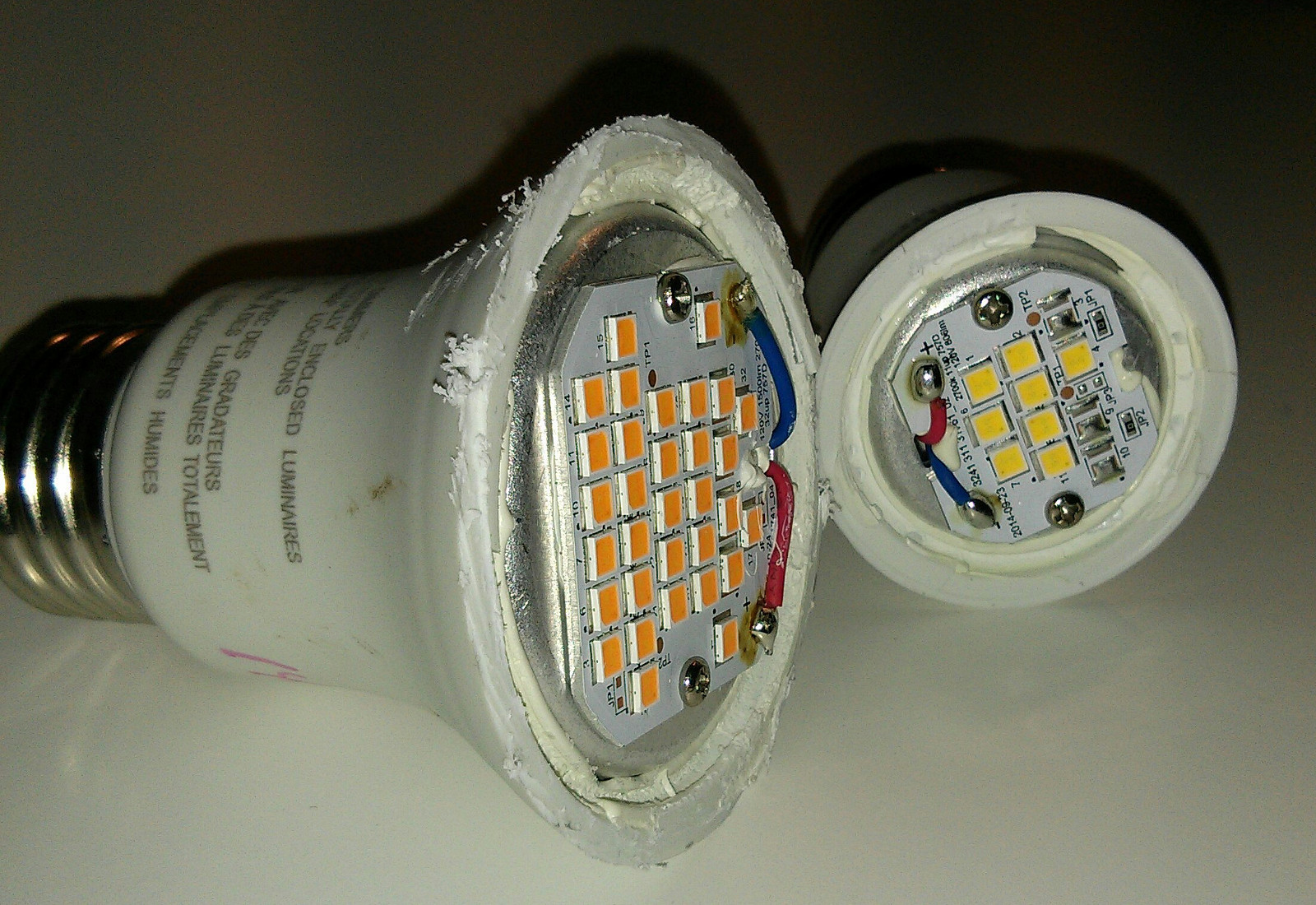
You want the LEDs to be surface mounted like that. Cut the diffusion globe off with a hacksaw, and you have instant directional light (no reflector needed. But, a reflector does help a little. But, not nearly as much as CFLs need to be reflected. The difference between unreflected LED lightbulb an CFL is 250% more light reaching the plant.). It's really a huge amount of light for the money. The only significant downside is that you expose electrical surfaces. You should use a GFCI outlet to power these. But, technically, that should be used to power everything in a grow tent.
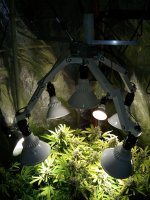
These can be challenging to mount, aim, position. I can talk to you more about that if you want to go this route. I think these lights make excellent supplemental lighting. For example, I grow with CMH in a 4x4 tent, and use household LED lightbulbs to supplement around the perimeter. I use T5HO in a 4' tall 2x4 tent, and will add some of these in late flower to boost performance. I think they're great tools to have in your tool chest.
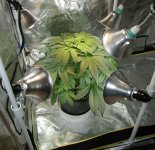
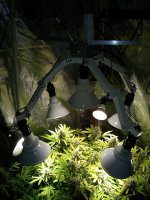
I made some different mounts for them. I can give you that info if that's the way you want to go. For example, I mount them on tent legs:
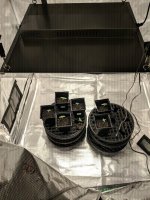
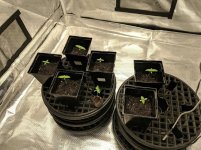
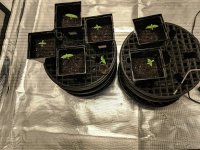
Those are actually the seedlings I mentioned above, and I'm driving them with more light intensity than I should have to, because the light isn't cool enough in color.
Finally, you can spend $20 USD on a Lux meter. (I have a Sunche HS1010.). That's a good way to sanity check your intensity. Since you're using white (full spectrum) light, a Lux meter is good enough. Lux isn't as useful comparing blurple, and HPS, etc. But, for comparing white light designated in color temperature, it's all fairly comparable.
I have a PAR meter too (Apogee 500). I'm finding that the conversion from Lux to PAR is about 50-55 lux per one PPFD. I.e., seedlings should have 200-300ppfd. That's about 13,200 lux. For $20, that's probably useful if you're concerned about intensity. (I'm not in love with the meter I have. I might prefer one with a detachable probe. But, I don't know how accurate the different lux meters are; how comparable they are. I can't guarantee that my 50-55 to 1 conversion applies to other Lux meters.