Hello guys,
I just read an article that says high pressure lights are a thing of the past and that LED lights are what's happening right now because of they are cooler than HPS and they are full spectrum lights as opposed to HPS which only provide a limited spectrum of light. Any thoughts?
The downside to LED is that it's hard to objectively compare. There's so much flim-flam out there. People will swear by some brand, and have photos to back it up. But, when you get into details you find out they're running 50-70w/sq ft. That's HPS territory. (I've seen fantastic LED grows that were pushing 90w/sq ft. Everyone got jazzed about "gotta have me one of those lights." But, it was never mentioned *how much* light you needed.).
Personally, I like CMH for tall grows (at 35w/sq ft. Maybe 40w/sq ft in flower using supplemental sidelighting). I like T5HO for shorter grows (at 40w/sq ft, maybe 45w/sq ft in late flower with supplemental side lighting.). What I like about this is that the fixtures are commoditized, componentized. You can replace the bulbs every couple grows. You can replace ballasts. If you're in a warm climate, you can get remote ballasts (Fulham makes a remote ballast for T5HO. It's in the Racehorse ballast product line. I can give you the part numbers.).
That's one thing I haven't liked about LED is that the entire fixture tends to be disposable. If you make your own, you might have more flexibility that way. But, most people don't want to get into it to that level.
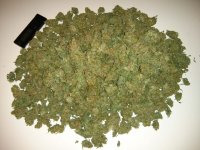
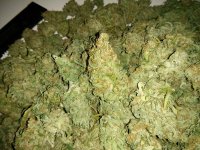
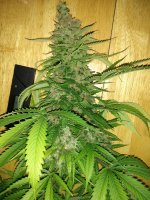
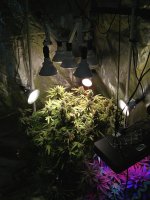
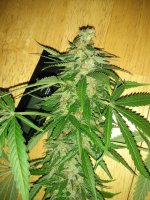
The only LED I run are household LED lightbulbs. They grow *surprisingly* well. Cut the plastic globe off the bulb, and all the LEDs are surface-mounted to the base: instant directional light without the need for a reflector (although a reflector helps a little). Removing the globe will expose line-current surfaces. It's best to power the lights through a GFCI outlet. (You can easily make an extension cord with an outlet box on the end, and two GFCI outlets in the box.). I grew the attache photo 5 years ago under 18-22w/sq ft of household LED lightbulbs. (The Caliber IV hygrometer is for scale).
The only real downside to growing with household LED lightbulbs is: it can be some *work* mounting them, and aiming, etc. But, that *distribution* of watts around the plant creates an effciency that you can't get anywhere else. The inverse-square law is very powerful. The closer you can move the light, the more efficient it will be (by orders of magnitude). To do that effectively, you need granular light sources (not a single top-down source), to create better coverage, surround the plant with all angles of light. For most people, it's just easier to throw 40-50w/sq ft on top. But, if you only grow 1-2 plants, the more you can break it up (smaller, lower-watt fixtures), you can get huge improvements compare to that amount of light from a single source.
I created a How-To" about this topic (including how to make that light fixture shown in the photo). I don't know if it's ok to post a link to that. PM me if anyone wants it.